Beyond oil tanks: Strategic pricing reserves, the new mantra for India’s energy security
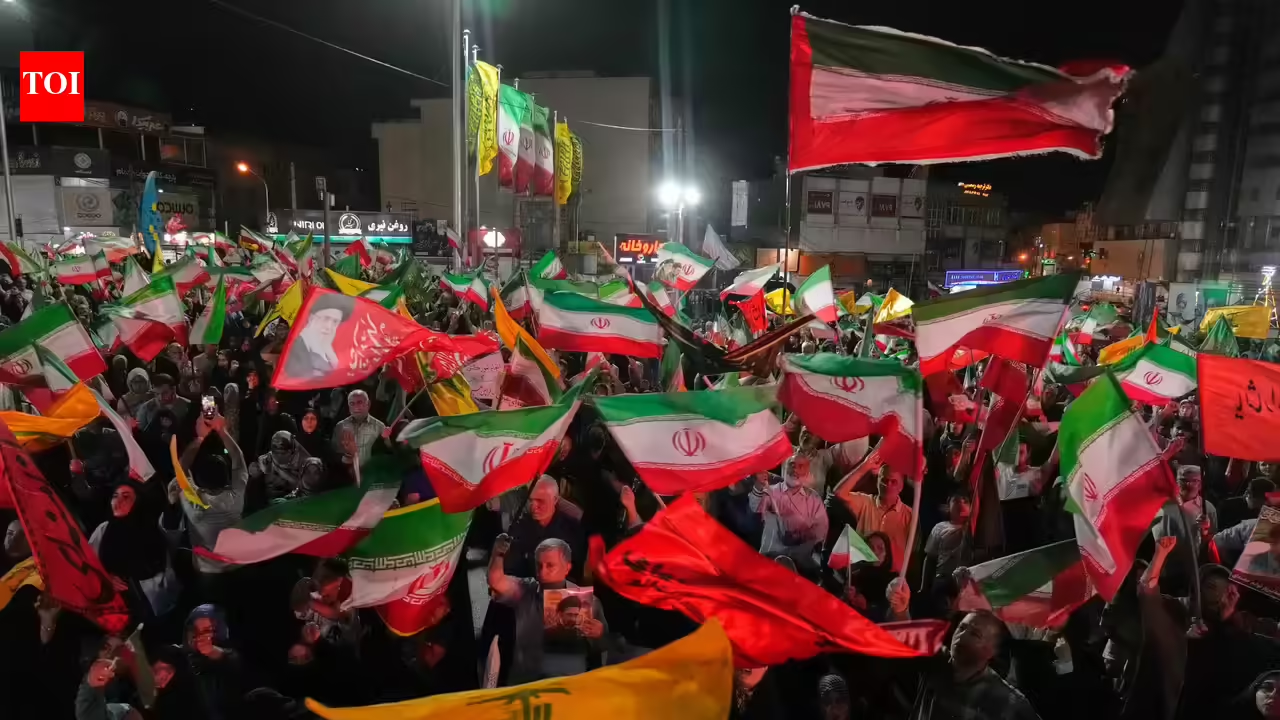
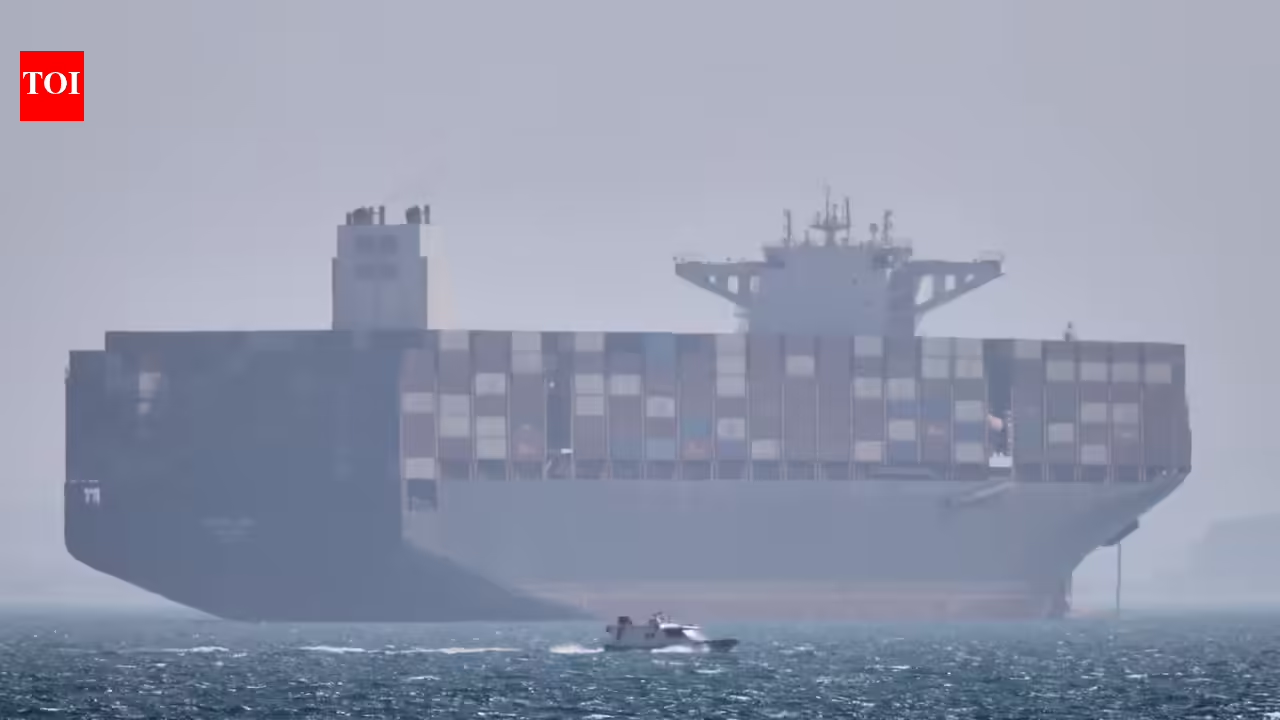
By Col Rajeev Agarwal (Retired), Senior Research Consultant, CRFWith the signing of the MoU by President Trump and President Pezeshkian on 16 June and the operationalisation of the Roadmap of 60 days, there is hope that the war in Iran is over, at least for the foreseeable future. The re-opening of the Strait of Hormuz means that a steady movement of ships has commenced and as per reports, almost 90 ships transited the Strait on 23 June.The removal of sanctions on sale of Iranian crude oil and gas, at least till 21st August, commencement of defreezing of Iranian money and assets, Iran’s commitment to permit IAEA inspectors back in Iran along with reports of the Israel-Lebanon ceasefire holding offer hope too. While the real tricky issues like Iran’s nuclear program and its ballistic missile program may take weeks and months to be negotiated, it is clear from both ends that neither the US nor Iran have any appetite for a fresh round of war.And with global oil prices falling sharply and supplies resuming, the global economy and nations like India which are majorly dependent on imports are breathing a sigh of relief. There are, however, crucial lessons for India to secure its energy requirements in case of a similar future conflict.India imports almost 88 per cent of its annual crude oil requirements, amounting to 1.8 billion barrels. Broken down, it translates to a daily import of around 5 million barrels of oil. Of this, as per figures of FY 2025-26, India imported almost 48 per cent from the Gulf region. On a daily basis, these imports from the Gulf region amounted to 2.4 million barrels.As a result, when the war broke out, India had to act fast to make up for the short supply of 2.4 million barrels per day. It had to be handled through a two pronged approach- diversify sources of oil imports and use part of the Strategic Petroleum Reserves (SPR) which have been created for exactly such situations. Plus, the oil supply from Saudi Arabia and the UAE through their pipelines bypassing the Strait of Hormuz helped too.
The Problem with India’s Strategic Oil Reserves
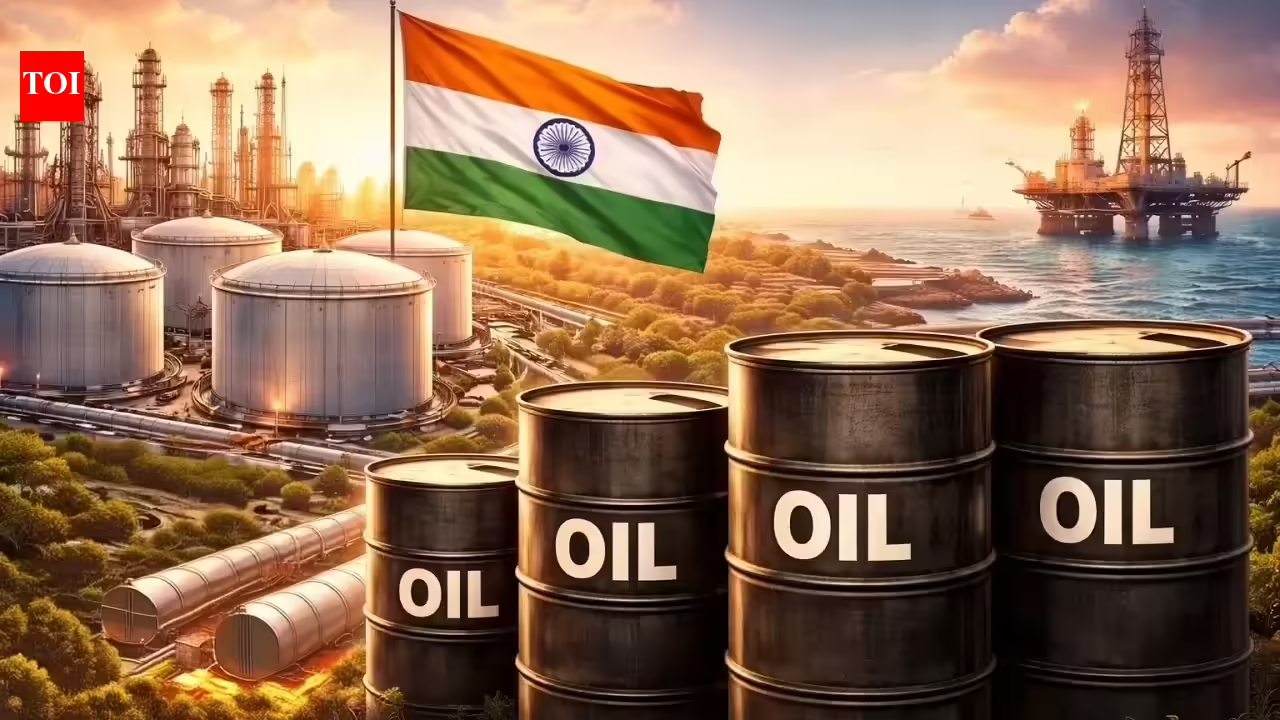
India has an installed capacity of around 5.33 million metric tonnes (MMT), or 39 million barrels, stored in underground caverns at Visakhapatnam (1.33 MMT), Mangaluru (1.5 MMT) and Padur (2.5 MMT). However, the actual storage at the start of the war was only 24.7 million barrels or 64 per cent. This implied that against a planned SPR of 7.8 days (39 million barrels), India had only 5 days (24.7 million barrels). After adding the floating stocks on tankers, refinery and pipeline stocks (64-68 days), India could muster up a reserve of 74 days on 28th February 2026.In addition to the above SPR, India had plans for Phase 2 of SPR with an additional storage capacity of 6.5 MMT or 47.6 million barrels of crude oil in Chandikol (4.0 MMT) and Padur Phase 2 (2.5 MMT), which was sanctioned in 2021. Sadly, the projects remained on paper, resulting in a loss of 9.5 days of SPR. Adding this up with the deficiency in existing storage, India lost almost 61.9 million barrels of storage or 12.5 days of reserves when the war started. Had the phase 1 and 2 of SPR been fully commissioned and filled, India would have had a storage of 17 days (87 million barrels).Another important factor in crude oil imports is the cost. At the start of the Iran war, the price of crude oil was $70 per barrel which rose to around $110 per barrel, an increase of $40 per barrel. Against an annual import of 1.8 billion barrels, it theoretically adds up to $72 billion or even touches $80 billion after adding the inflated insurance and shipping costs. To put this in perspective, the Indian Defence budget for FY 2026-27 has been pegged at $86 billion.Therefore, the increased crude oil import bill threatened to add another defence budget to India’s budget, an unsustainable fiscal burden. As per official reports, Indian oil companies were bleeding Rs 700 Crore per day in May 2026 despite a moderate price hike in petrol and LPG prices. Fortunately, the oil prices are now sliding down sharply, pegged at around $75 on 24 June.
What Should be Done
From a storage perspective, India should enhance its SPR capacities from 17 to 45 days on land with the possibility of having another 10-15 days of SPR on sea on tankers. Incidentally, the International Energy Agency recommends a SPR of 90 days. During the recent visit of PM Modi to the UAE on 15th May, a deal was signed wherein ADNOC (Abu Dhabi National Oil Company) will store up to 30 million barrels of oil in India’s SPR while also storing some additional reserves in UAE itself which will help in boosting storage.The other vital factor is the cost. Given the experience of this war, India should neither be bleeding its oil companies nor passing on the fiscal burden to the common public in the future. In the past few years, there are times when India has procured crude oil cheaply. At the start of the Russia-Ukraine war, Russia supplied oil at discounted rates of almost $40 per barrel, a huge saving.Even the global oil prices have dipped frequently to the levels of $60 (December 2025) and even $40 (April 2021). India has a ‘break-even’ cost pegged at $84 per barrel for crude oil beyond which India starts facing fiscal challenges. What can be done to firewall the Indian economy from war related price rise?Just like the SPR creates storage reserves, there is now a need to create another SPR- Strategic Pricing Reserves. How do we do it? The way to create this corpus is to save from the budgeted import bill whenever oil is imported cheaply. To further streamline how much to save and when, there could be a system of brackets and slabs. If crude oil is imported at $40 per barrel, it implies a budgeted saving of almost $44 per barrel whereas an import at $74 implies a saving of only $10 per barrel.The formula-greater the saving, greater the injection of money into the new SPR. A suggested rough model could be an injection of $15 per barrel if it is procured at rates of $40-50, an injection of $10 per barrel if the procurement rates are $50-60, an injection of $5 per barrel if the procurement rates are $60-70 etc. Even at this modest rate of saving, against a daily import of 5 million barrels, it could amount to an addition of $75 million per day and $2.2 Billion in a month! Over time, this corpus could build up to more than $80-100 billion, enough to sustain a prolonged war crisis, if required.To further ensure an effective utilisation, this SPR could be maintained and invested through a Special Purpose Vehicle (SPV) of the Government to further invest and multiply the saved corpus. To ensure that no future government is able to divert this corpus for some welfare scheme or some other infrastructure projects etc, strong safeguards could be built including a possible Parliamentary approval, for its utilisation.The war in Iran has offered many valuable lessons, primary among them is how to safeguard India’s energy security. With oil supplies resuming and import costs too coming down, India should prioritize filling up its petroleum reserves and early construction of Phase2 of the SPR.Iran’s oil adds to the pool of supply while UAE could offer special rates to India now that it is out of OPEC. Simultaneously, India should look immediately at Phase3 of the SPR which could take the storage capacity from 17 days (87 million barrels) to at-least 30 days (150 million barrels). Similarly on the pricing issue, it is time for India to think of another form of SPR, the Strategic Pricing Reserves, starting now when the prices are down and build it up steadily.