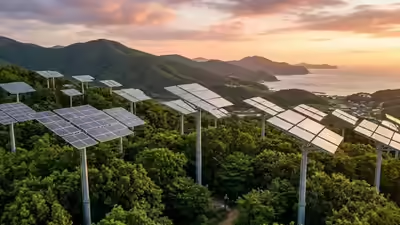
South Korea is leading an innovative effort with renewable energy that addresses how to resolve the major conflict between using land and protecting it. Historical solar farms generally require extensive deforestation; studies in Scientific Reports have indicated that conventional solar farms can eliminate 98 per cent of existing tree biomass. However, the new design for ‘solar trees,’ which consist of rows of tall poles with an array of photovoltaic panels, integrates vertical arrays within forest canopies and enables projects with 99 per cent canopy cover and equivalent total generation capacity as conventional solar farms. Therefore, this new dual-use solar design can protect essential climate ‘carbon sinks’ and support local biodiversity, indicating green energy generation and forest protection can be successful together.
How South Korea’s solar trees are solving the deforestation dilemma
The primary hurdle with large-scale solar energy generation in mountainous regions like South Korea is that many flat area sites will require the removal of trees that provide carbon sequestration. According to research published in Scientific Reports, the use of solar trees (tall photovoltaic systems mounted on poles) will preserve the vast majority of the forest floor and understory undisturbed, whereas conventional ground-mounted photovoltaic systems will almost completely deforest sites. Solar trees, by their tall pole-mounted designs, also contribute to protect by retaining as much as 99 per cent of tree canopy biomass.
3D simulations prove solar trees match conventional power
To make sure these ‘solar trees’ continue to produce at maximum efficiency despite receiving less than full sun because of surrounding trees, researchers used 3D geospatial information and simulations to determine how much height to give them and where to place them so that they would clear the surrounding natural tree canopy. The research showed that solar trees can provide as much power as conventional solar arrays without having the same environmental footprint as conventional areas.
Why land-scarce countries are turning to solar trees
Solar trees are an specialized application of agrivoltaics, which many organizations International Energy Agency (IEA) and the US Department of Energy (DOE) promote, as it relates to solar energy and agrivoltaics being done in the same area or using the same space. The government-sponsored research indicates that countries that have limited landmass and are committed to achieving net zero emissions by 2050 must use vertical space instead of horizontal land.
Solar trees are protecting forests as active carbon sinks
Preventing the destruction of existing forests is one of the key recommendations of the Intergovernmental Panel on Climate Change (IPCC) for climate-change mitigation. By using solar trees to prevent deforestation, the area continues to be a carbon sink and absorbs carbon dioxide while producing carbon-free electricity from the solar panels. This results in a ‘net-positive’ effect on the environment compared to the large-scale deforestation associated with conventional solar projects.