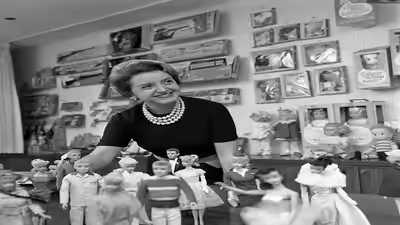
The innovation process can be found in places we least expect. This is true for Ruth Handler, one of the co-founders of Mattel Corporation. In the late 1950s, she witnessed a phenomenon while watching her daughter Barbara playing with paper dolls in their home living room. Instead of assigning to the dolls typical functions such as those of infants or assistants, Barbara treated them like real women – adults who have jobs and social lives.The toy market was dominated by “baby dolls,” whose purpose was to prepare young girls to be mothers and homemakers. Ruth recognised a vast discrepancy in how girls saw themselves. The image of the three-dimensional doll, of a woman who is independent, fashionable, and living her life, made Ruth realise the importance of changing what girls believed about themselves and where they were going with their lives. It took only one ordinary event in Ruth’s family life for a design idea to occur, which would challenge the very essence of the toy industry.From tending babies to dreaming about adulthoodThe transition from the two-dimensional paper doll to the first three-dimensional Barbie required a considerable amount of courage, as the toy industry was not quite sure that parents were ready to purchase an “adult” doll for their child. In an article on BBC, the real-life muse for the doll describes how Ruth’s idea came into being. While watching her daughter practice growing up using her toys, Ruth realised that while boys played with toys portraying a variety of professions, girls tended to play with nothing but baby dolls.When Barbie made her debut at the American International Toy Fair in New York on March 9, 1959, she was unlike anything else on the shelves. She had a ponytail, a black-and-white striped swimsuit, and, most controversially, a mature figure. An article in The New York Times notes that Ruth’s contribution was giving dolls an adult silhouette, which allowed for a much broader and more flexible kind of play. By moving away from the “maternal” doll model, Ruth gave children a tool to imagine careers and independence, a radical departure from the domestic world of 1950s toys.
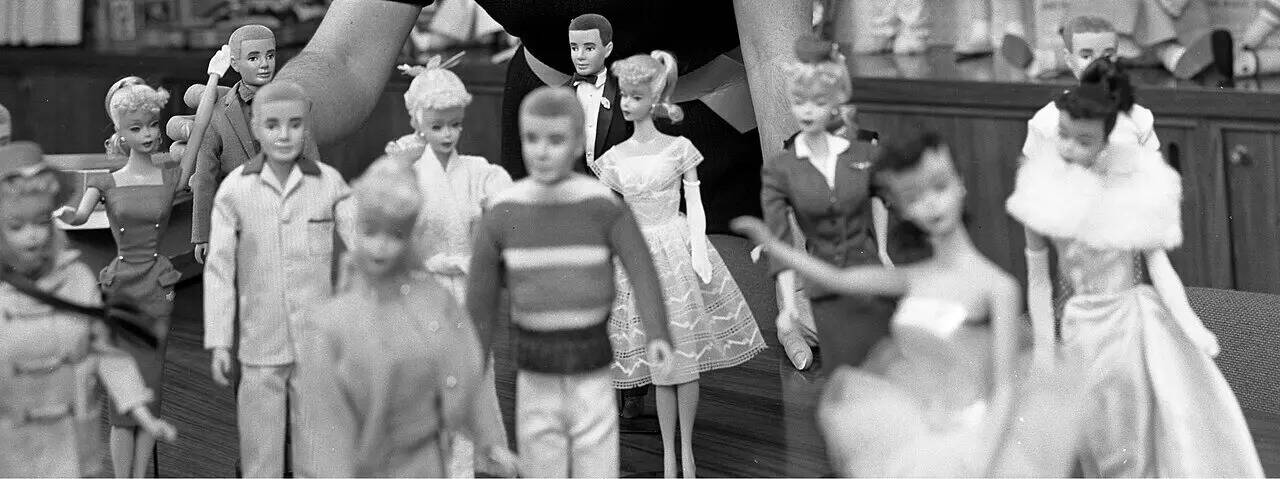
This led to the creation of Barbie, a doll that allowed girls to imagine careers and independence beyond traditional roles. Barbie’s adaptability and reflection of societal changes have maintained her enduring popularity. Image Credits: via Wikimedia Commons
The redesigning process not only affected Barbie’s appearance; it also changed the way she was meant to be played with. In fact, this doll became a blank slate that anyone would like to paint according to their imagination. She could go on a catwalk one minute and turn around the next to float in space orbiting the planet. This adaptability allowed her to gain numerous followers both among children and adults.A cult object reflecting cultureBecause Barbie was an object that incorporated adult themes, she inevitably came under intense scrutiny when the societal perception regarding the issues of gender and body image started changing. According to a peer-reviewed article published in PLOS ONE, even though the doll encouraged imaginative play among young girls, it attracted considerable criticism due to its promotion of unattainable beauty standards.The expansion of Barbie’s popularity occurred due to the fact that Ruth Handler relied on her observation regarding the way children play. Children need to practice life situations. As a consequence, Mattel has always made sure that its Barbie dolls were diverse when it comes to body shapes, skin colours, and careers available. In fact, it is all rooted in that first observation, which is why Barbie is still so popular – she represents the intersection of play and social anxieties in one person.Ruth Handler’s observation regarding the way children play with dolls is particularly remarkable in the context of today’s world for several reasons. First, it proves that a good product can be created based on an accurate observation of a mother. Second, Ruth Handler managed to notice something simple and turn it into a globally recognised phenomenon. Finally, it proves that sometimes the best observations are made within our homes. Barbie is an example of a product that started with an important observation and gained global recognition over time.