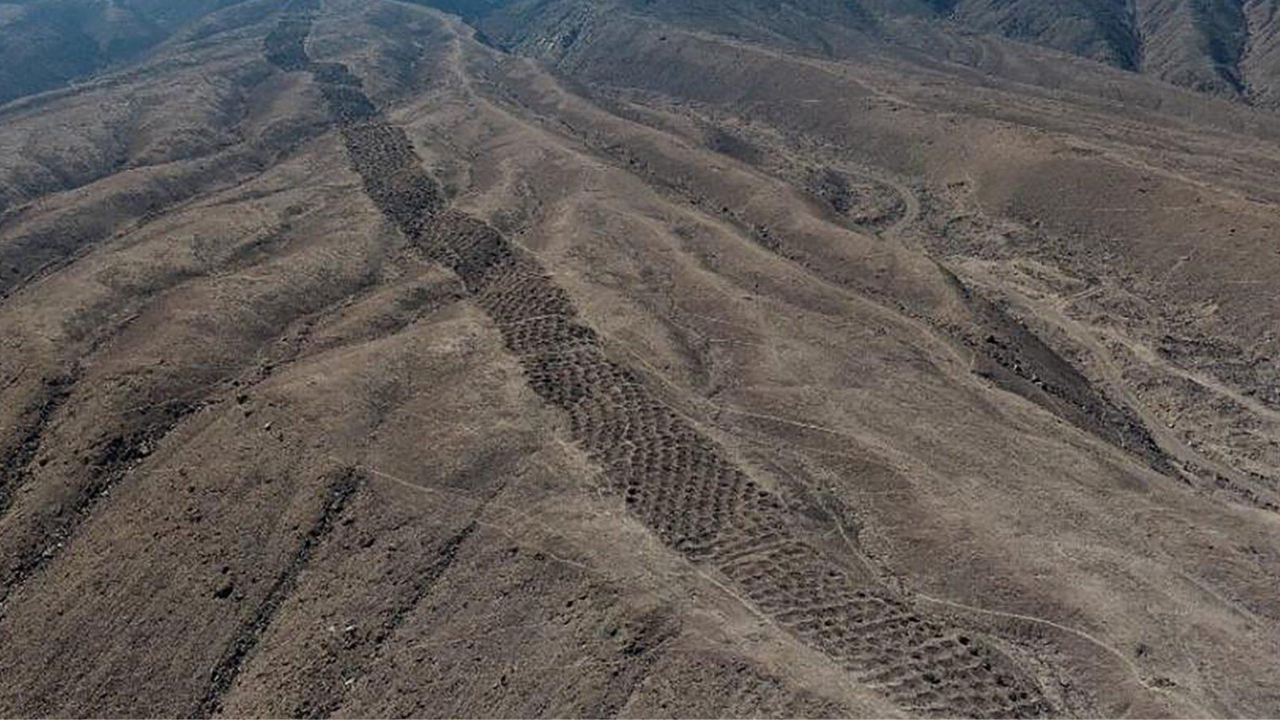
For nearly a century, thousands of strange holes carved into a barren Peruvian hillside puzzled archaeologists, historians, and even conspiracy theorists. Stretching across the dry slopes of the Pisco Valley in southern Peru, the massive formation contains more than 5,000 carefully arranged pits that can only truly be appreciated from the air. Some believed they were graves, while others thought they were military structures or ceremonial sites. Now, researchers led by archaeologists from the University of South Florida say the mysterious landscape may actually have functioned as a giant ancient accounting system, helping pre-Hispanic civilisations organise trade, taxation, and stored goods long before modern writing systems existed.
What is Peru’s ‘Band of Holes’
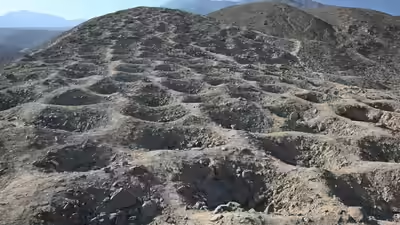
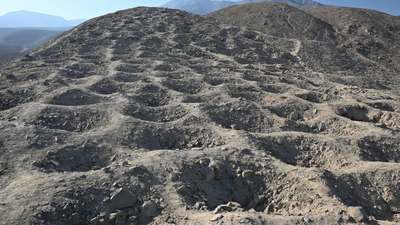
The site is known as the Band of Holes, or Monte Sierpe, which translates to ‘Serpent Mountain’. Located near the Pisco Valley in southern Peru, the formation stretches for roughly 1.5 kilometres along the hillside.The pits are organised into rows and blocks rather than being randomly scattered. Most are around 1–2 metres wide and up to a metre deep, with several lined using stones. From above, the arrangement resembles a giant patterned grid cut directly into the desert terrain.The site first drew international attention in the 1930s after aerial photographs revealed the scale of the formation. Since then, archaeologists have struggled to explain why ancient people created such an enormous and labour-intensive structure.
Theories ranged from graves to alien activity
Over the decades, researchers proposed many explanations for the mysterious holes. Some believed they were burial pits or military storage areas. Others suggested they may have been used for farming, water collection, or ceremonial rituals.Pseudo-archaeological theories even linked the site to extraterrestrials because of its unusual appearance from the air.However, none of these ideas fully explained the site’s highly organised layout or its connection to nearby ancient settlements and trade routes.
Scientists now believe it was an ancient accounting system
The latest research was led by archaeologist Jacob Bongers alongside archaeologist Charles Stanish and an international team of researchers studying ancient Andean civilisations.Using drones, mapping technology, sediment analysis, and archaeological surveys, the team concluded that the holes were likely connected to economic administration and resource management.Researchers noticed that the pits were arranged in repeating numerical patterns and grouped into sections, suggesting a deliberate organisational system rather than random digging.Some archaeologists compared the arrangement to khipus — the knotted-string recording devices used by the Inca Empire for accounting and record-keeping. Khipus allowed officials to track taxes, labour obligations, and stored goods without a written alphabet.The hillside itself may have acted like a physical version of that system.Scientists analysed sediments collected from several pits and discovered traces of maize pollen, plant fibres, reeds, and organic material associated with human storage and transport activities.The maize evidence was especially important because maize pollen does not naturally spread far through the wind in large quantities. Researchers say this strongly suggests crops or goods were intentionally placed inside the holes.The discovery supports the idea that the pits were connected to trade, storage, or taxation activities rather than ceremonial use.
A giant marketplace for ancient trade?
One leading theory is that the site may originally have served as a large barter and distribution centre before later being adapted into an Inca administrative network.The region was historically connected to important caravan routes linking coastal communities, farming settlements, and mountain populations. Traders transported goods using llamas across the Andes, exchanging products such as maize, cotton, dried fish, woven materials, and agricultural tribute.Researchers believe different sections of holes may have represented different categories of goods or quantities being counted and organised.In this sense, the Band of Holes may have operated like an enormous outdoor spreadsheet or inventory system.The findings challenge long-standing assumptions that advanced administration requires written language. Ancient Andean civilisations developed sophisticated methods for organising resources, labour, and trade without using traditional writing systems.The research also highlights how Indigenous societies engineered landscapes themselves to store and manage information on a massive scale.Rather than being a mysterious or supernatural structure, the Band of Holes may represent one of the most ambitious economic systems created in the ancient Andes.
The mystery is not fully solved yet
Although the accounting theory is currently considered the most convincing explanation, researchers say more excavation and analysis are still needed.Scientists are continuing to investigate whether different groups of holes were used for specific products, how the system evolved over time, and exactly which civilisations controlled the site before and during the rise of the Inca Empire.Even after decades of study, the strange hillside of 5,000 holes remains one of Peru’s most fascinating archaeological mysteries.