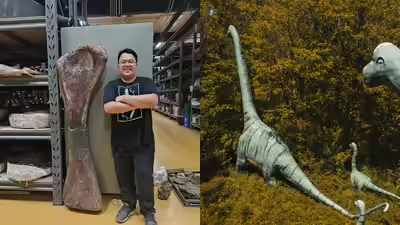
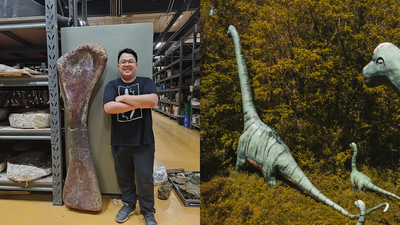
Scientists have found the remains of a huge 90-foot dinosaur in Thailand, thus confirming the discovery of the biggest dinosaur ever found in Southeast Asia. The recently discovered species called Nagatitan chaiyaphumensis is a very large sauropod dinosaur that lived in the region some 113 million years ago, during the Early Cretaceous period. Scientists from University College London, Mahasarakham University and Thailand’s Sirindhorn Museum state that the dinosaur weighs about 27 tonnes, which is the weight of nine adult Asian elephants. The amazing discovery in Chaiyaphum province is giving us an idea of how dinosaurs developed, as well as the environment they inhabited in prehistory.
Thailand’s giant dinosaur discovery changes prehistoric history
Nagatitan chaiyaphumensis, the recently discovered dinosaur, was found to be part of the sauropods – giant herbivorous dinosaurs that had a long neck, tail and tall body. The estimated length of the creature was about 27 meters, or 90 feet.The discovery of the fossils was made in 2016 by a local villager around a pond in the north-eastern region of Thailand. During excavations, vertebrae, ribs, fragments of pelvis and large bones of limbs were discovered, including a bone from the front leg measuring 1.78 meters in length.In the study ‘The first sauropod dinosaur from the Lower Cretaceous Khok Kruat Formation of Thailand enriches the diversity of somphospondylan titanosauriforms in southeast Asia,’ which appeared in Scientific Reports, it is said that the dinosaur lived in present-day Thailand during a period when the climate was warm and semi-arid, and was characterised by rivers, coniferous forests, and ferns covering the flood plains. The region was also home to crocodiles, fish and predatory dinosaurs.Lead author of the study, Thitiwoot Sethapanichsakul of UCL, said that the size of the dinosaur is among the most exciting aspects of the discovery.
Why Nagatitan chaiyaphumensis matters to science
Scientists are confident that the discovery fills a critical gap in the fossil records of Southeast Asia, since although giant sauropod fossils had been discovered in South America and China before, very few had been identified in the region.The name of the dinosaur itself is culturally significant as “Naga” represents the mythical snake of Southeast Asia, while “Titan” represents the huge size of the creature. The species name “chaiyaphumensis” is derived from Chaiyaphum province, where the fossil was found.The dinosaur has been dubbed the “last titan” since, according to the geological history of the region, dinosaurs of this huge size could not have existed in the region due to the rise in sea levels millions of years ago.According to palaeontologist Sita Manitkoon, the first impression of the bones’ measurements made the discovery stand out to her and her colleagues.“Initial measurements of the bones excavated suggested that this could be the largest dinosaur ever found in Southeast Asia,” Manitkoon explained.
The 90-foot dinosaur that once ruled ancient Thailand
In spite of its enormous body, however, the new species was a herbivore. According to experts, it probably ate plants, like conifers and ferns, growing at high altitudes, thanks to its incredibly long neck. At the same time, its large body would provide protection from potential predators.The dinosaur is considered to be a member of a sauropod subfamily with pneumatic skeletons, allowing for the growth of such enormous creatures.This discovery is already creating interest around the world as it helps expand knowledge about dinosaur migration and evolution on different ancient continents. Moreover, experts think it can lead to further excavations in Thailand and neighbouring regions.In addition to being a remarkable fossil, the giant dinosaur can also be viewed by scientists as a reminder that the Southeast Asian region still contains many mysteries of the prehistoric period hidden underground.