India’s economy passed the Iran war test. Could El Nino spoil the party?
The Indian economy has emerged as a picture of resilience amid the US-Iran conflict, with most economic indicators flashing green as the war shows signs of ending. In fact, economists note that the Indian economy saw a somewhat muted negative reaction to the Middle East conflict which began at the end of February. The spike in crude oil prices and its resulting impact on the rupee, foreign investor flows, import bills and forex is now being seen as transient.India imports around 88% of its crude oil needs and a big chunk of its LPG requirements. Dependency on the Middle East has been exposed, prompting a more diversified energy security strategy. But key sectors of the economy have emerged with fewer-than-expected scars.With a tentative ceasefire in place, opening of Strait of Hormuz, and hopes of a lasting solution to the US-Iran war, things are beginning to look up. Economists say that the world’s fastest growing economy may even end up clocking a 7% GDP growth number this year. But, domestically a poor monsoon caused by El Nino is painting a grim picture for inflation. Is the worst really over for the Indian economy?
India’s economic indicators back in green – almost
The first quarter of FY 2026-27 has closed on a positive note, with several high frequency indicators showing a strong momentum, even at a time when the Middle East conflict has negatively impacted most economies.Sample this: The gross Goods and Services Tax (GST) collections rose 13.9% to Rs 1.95 lakh crore – almost touching Rs 2 lakh crore. This means that the total collections for the April-June quarter were Rs 6.32 lakh crore, which is a rise of 8.4%.
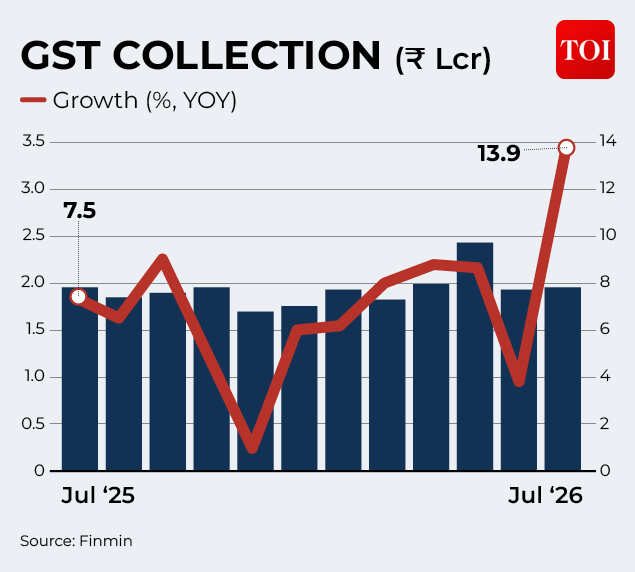
Strong GST Collections
Retail sales of vehicles went up 22% year-on-year to 2.56 million units. This is the highest ever figure for June and comes on the back of sustained demand for passenger vehicles, two-and-three wheelers, and commercial vehicles.
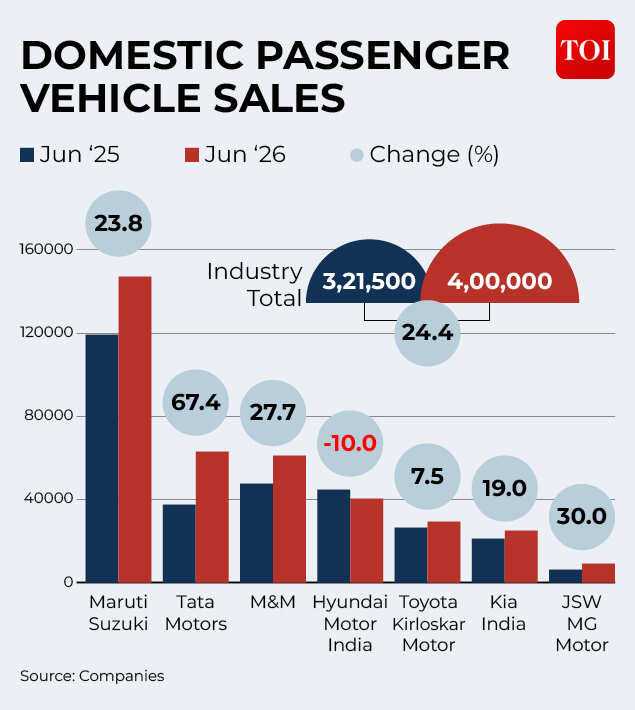
Domestic passenger vehicle sales
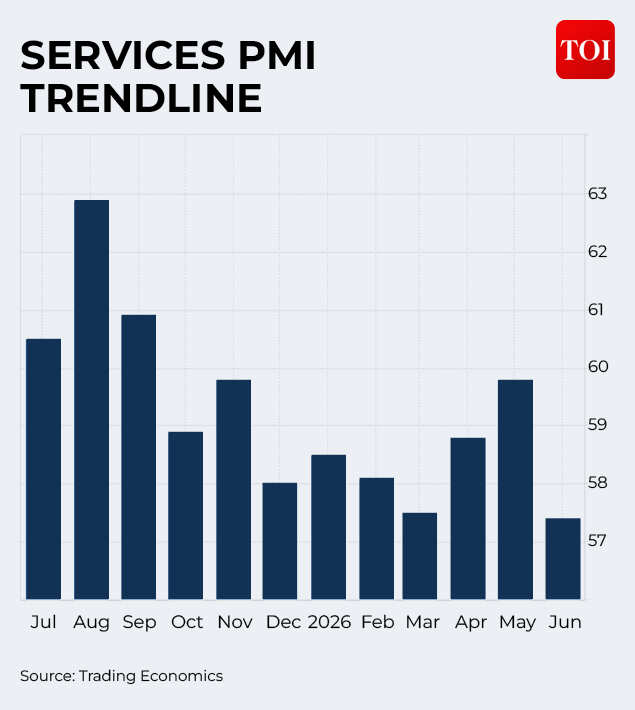
Not only that, passenger vehicle dispatches have jumped by 24% in June, UPI transaction volumes have risen 23%, and electricity consumption increased 11.6% to 166.5 billion units – all of which are signs of healthy economic activity. Results from the RBI Pulse survey showed close to half of the firms surveyed witnessing an increase in selling prices. Consumption of petroleum products (LPG, transport fuels etc.) declined and industrial fuels (naptha, bitumen, petcoke etc) moderated in May.However, some indicators do show signs of moderation, implying some slowdown due to the impact of the war. Manufacturing and services PMIs have dropped in June – while manufacturing is at a 3-month low, services has hit a 17-month low.
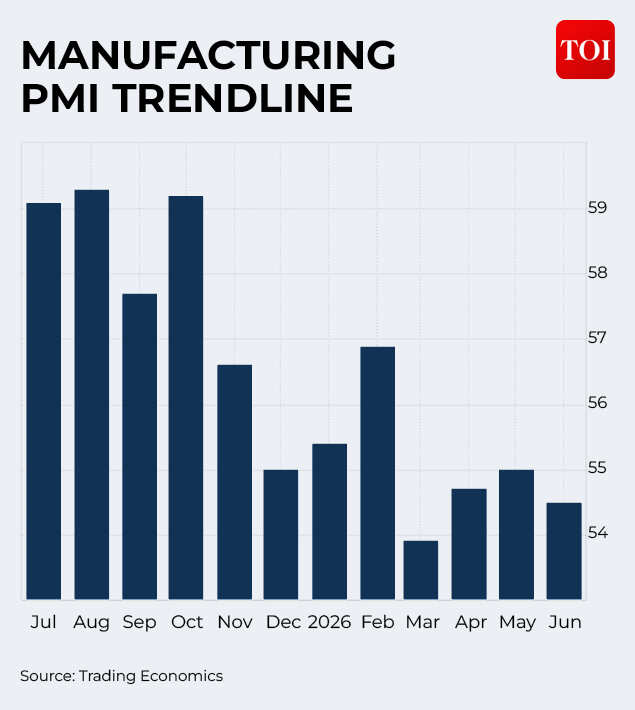
Manufacturing PMI trendline
But, the PMI readings remain in expansionary terrain.
Services PMI trendline
India’s industrial production expanded by 5.1% in May 2026, accelerating from 3.4% in the corresponding month last year, driven by robust growth in the electricity and manufacturing sectors. The stronger performance indicated that domestic demand remained resilient despite the disruptions caused by the West Asia conflict. Meanwhile, even as inflation has risen steadily, it is still within RBI’s comfort zone. If crude oil prices continue to be below $80, retail inflation is expected to moderate, though pressures on food inflation may persist due to a weaker monsoon.Reflecting confidence in the improving overall indicators, the stock market has also rebounded strongly and foreign investors are back on Dalal Street.
Monsoon woes weigh: Is the worst really over?
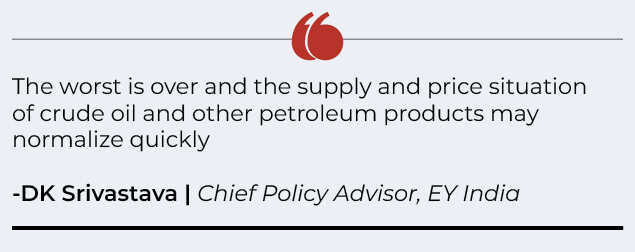
All of the above positive indicators raise an important question – is the worst over for the Indian economy? Economists are of the view that the worst is behind for the Indian economy, and indicators will progressively get better.The one remaining uncertainty relates to the performance of the monsoon owing to the onset of El Nino. The IMD has estimated that overall monsoon may be only 90% of the long-period average (LPA) implying a 10% shortfall. The spread of shortfall may also be uneven over time and across regions. According to the available information up to 6th July 2026, cumulative monsoon deficiency was 24% as compared to long period average.“This is an improved situation as compared to earlier estimates of deficiency of more than 40% for the month of June 2026. Considering all factors together our real GDP growth estimates for 2026-27 remain in the range of 6.6-6.8%,” DK Srivastava, Chief Policy Advisor, EY India tells TOI.“As per the RBI’s June monetary policy review, CPI inflation for 2026-27 was projected at 5.1%, up from 4.7% as per its April 2026 assessment. With progressive normalization of the West Asian situation, pressure on inflation might ease somewhat in the last three quarters of the fiscal year. However, it might still be in the range of 4.5-5.0%,” he adds.“The worst is over and the supply and price situation of crude oil and other petroleum products may normalize quickly and may remain stable for the rest of the year. Although the monsoon deficiency poses a challenge, the weight of the agricultural sector in the overall GVA is relatively low. In real terms, the share of agriculture in total GVA during 2022-23 to 2025-26, as per the 2022-23 base year series, averaged 18.9%. Although this will have an impact on rural demand, the overall impact is likely to remain limited,” Srivastava tells TOI.
GDP growth prospects
Arun Singh, Chief Economist, Dun & Bradstreet India cautions that sticky inflation may be a concern. “The immediate macroeconomic impact of the West Asia crisis is likely to be transmitted more through the inflation channel than through a material disruption to growth,” he tells TOI, adding that historically, every $10 per barrel increase lifts CPI by around 20-30 basis points and widens the current account deficit by around 0.3-0.4% of GDP.While Brent crude prices have moderated from their recent highs, the disinflationary benefit for households and firms will depend on the timing and extent of pass-through to domestic fuel prices. Until that adjustment becomes visible, energy-related costs could remain elevated, keeping pressure on household purchasing power, business margins and broader price expectations, he says.“India continues to draw support from resilient services exports, healthy investment activity and the government’s infrastructure-led capital expenditure. The key risk, therefore, is not a derailment of growth, but a period of stickier inflation that could soften private consumption if energy costs remain elevated for longer,” he adds.
Impact of monsoon deficit
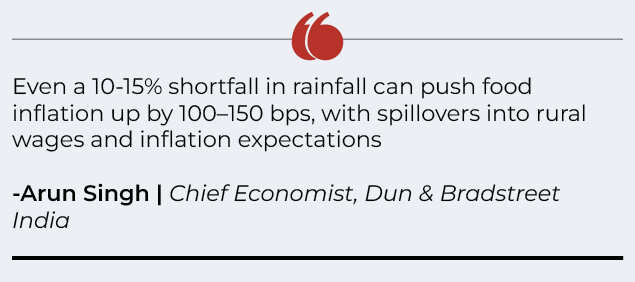
He also points to monsoon concerns: Given that food accounts for nearly 37% of the CPI basket, any significant rainfall shortfall could trigger renewed inflationary pressures.“Even a 10-15% shortfall in rainfall can push food inflation up by 100–150 bps, with spillovers into rural wages and inflation expectations. That said, structural buffers have improved. The monsoon risk is more likely to temper the growth outlook than trigger a sharp downturn,” he says.Radhika Rao, Executive Director & Senior Economist, DBS Bank strikes a more optimistic note.Given the interplay of spatial distribution of rainfall, buffer stocks, reservoir levels, and global food movements, a weak start might not necessarily imply a strong inflationary lift, based on differing trends in previous two strong El Nino years within this decade, she tells TOI.
Worst is over?
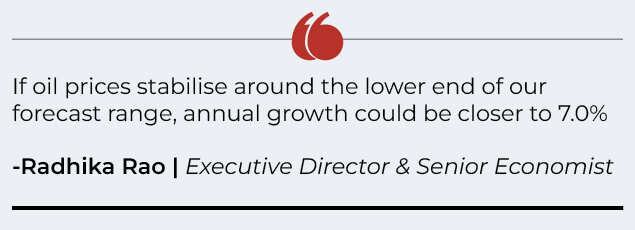
“With DBS baseline oil prices pointing to around 20% decrease from FYTD levels, our growth projection for FY27 stands at 6.8% yoy. If oil prices stabilise around the lower end of our forecast range, annual growth could be closer to 7.0%,” she adds.It seems to be a decade of stress tests for the Indian economy – Covid pandemic, Russia-Ukraine war, US trade policy uncertainty, and now the Middle East conflict. The last comes in a year when the monsoon is also weak. Navigating the challenges will continue to require policy interventions – both fiscal and monetary.