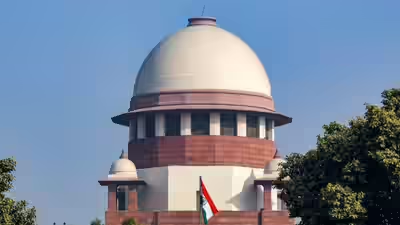
NEW DELHI: The Supreme Court on Tuesday held that a person who professes a religion other than Hinduism, Sikhism or Buddhism cannot be recognised as a member of a Scheduled Caste. The top court observed that conversion to any other religion results in the loss of such status.A bench of Justices PK Mishra and NV Anjaria upheld an Andhra Pradesh high court order, which had ruled that individuals who convert to Christianity and actively practise the faith cannot retain their Scheduled Caste (SC) status. The top court said the position is clearly laid down in the Constitution (Scheduled Castes) Order, 1950 and the bar on recognition is absolute.The court observed that any person who does not profess one of the religions specified under Clause 3 of the 1950 Order ceases to be a member of a Scheduled Caste, regardless of birth. It added that such individuals cannot claim any statutory benefit, protection, reservation or entitlement available to Scheduled Castes under the Constitution or any law enacted by Parliament or state legislatures, according to Live Law. Emphasising the scope of the law, the bench said a person cannot simultaneously practise a religion not listed in the 1950 Order and claim Scheduled Caste status. “No statutory benefit, protection or reservation or entitlement under the Constitution or enactment of Parliament or state legislature can be claimed by or extended to any person who, by operation of clause 3, is not deemed to be a member of the Scheduled Caste. This bar is absolute and admits no exception. A person can’t simultaneously profess and practice a religion other than the one specified in clause 3 and claim membership of the Scheduled caste,” the Court held.The ruling came in a case involving a man who had converted to Christianity and was working as a pastor, but had filed a complaint under the Scheduled Castes and Scheduled Tribes (Prevention of Atrocities) Act, alleging assault and caste-based abuse. The accused challenged the case, arguing that the complainant was no longer entitled to protection under the Act after conversion.The apex body observed that evidence showed the complainant had continued to practise Christianity for over a decade and was conducting regular prayer meetings at the time of the alleged incident.It said there was no claim or proof of reconversion to his original religion or re-acceptance into his caste community.Agreeing with the high court, the top court held that the caste system is alien to Christianity and, therefore, a person professing the religion cannot invoke provisions of the SC/ST Act. It also clarified that the mere possession or non-cancellation of a caste certificate does not entitle a person to claim Scheduled Caste benefits after conversion, adding that such issues must be dealt with by the competent authority under relevant law.