



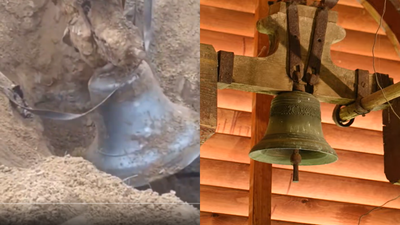
What began as a routine day of excavation in a Lithuanian field turned into an extraordinary rediscovery when farmer Laurynas Družas struck a large metal object buried beneath the soil near the town of Antašava in the Kupiškis district. As the earth was cleared away, a massive church bell slowly emerged, one that locals believed had been lost since the Second World War. The bell belonged to St. Hyacinth Church and was reportedly cast in 1908 before vanishing during the chaos of wartime occupation. Although the discovery itself took place in 2024, the story resurfaced and spread widely online in 2026 after videos and photographs of the excavation went viral on social media.The rediscovery immediately drew attention because the bell was not only historic, but also remarkably well preserved after spending more than eight decades underground. Local reports said the bell had once hung in the church tower before mysteriously disappearing during the early 1940s.Parish priest Rimantas Gudelis later explained that villagers had reportedly removed and buried the bell themselves when war reached the region. According to local memory, residents feared the bell would otherwise be confiscated and melted down for military use.Videos showing the bell emerging from the soil were widely shared online after the discovery, helping transform what began as a local archaeological curiosity into an internationally discussed wartime story.
Why villagers buried the bell during World War II
The decision to bury the bell reflected a much larger wartime reality unfolding across Europe. During World War II, occupying forces confiscated thousands of church bells because bronze and brass were desperately needed for bullets, artillery components, and other military equipment.Church bells across occupied territories were often removed from towers and transported to collection depots sometimes referred to as “bell cemeteries”, where many were eventually melted down. To prevent that fate, some communities secretly hid bells underground, sank them in lakes, or concealed them inside barns and forests.The Antašava bell appears to have been one such case.
The historical confusion surrounding ‘Russians’ and Germans
Some online retellings of the story claim villagers buried the bell to hide it from Soviet troops. However, historians note that Lithuania in 1942 was under Nazi German occupation, not Soviet control.That historical detail matters because Nazi authorities across occupied Europe conducted widespread metal confiscation campaigns during the war. Historians believe the villagers’ fear was most likely tied to German wartime requisition efforts, although Soviet forces also seized religious property during later periods of occupation.Local oral history appears to have blended different eras of occupation over time, which may explain why accounts about who threatened the bell have sometimes varied between generations.
A story that survived through local memory
According to the parish priest, different versions of the bell’s disappearance survived in local folklore for decades. Some linked it to the First World War, others to World War II, while a few associated it with the Stalin era after the war.Despite the conflicting details, one thing remained consistent: villagers believed the bell had been deliberately hidden to save it from destruction.Over the decades, however, the exact burial location appears to have been forgotten. The bell remained hidden beneath farmland while generations passed without knowing precisely where it had been concealed.
Similar wartime bell stories across Europe
The Antašava discovery is not entirely unique. Similar stories have emerged from other parts of Lithuania, Estonia, and Eastern Europe, where communities attempted to protect church bells during wartime occupations.One of the better-known examples comes from Estonia, where the bell of Emmaste Church reportedly disappeared during wartime in 1943 under similar circumstances. Across occupied Europe, church communities often treated bells not merely as metal objects, but as symbols of local identity, religion, and continuity.That emotional attachment explains why some villagers took extraordinary risks to hide them.
What happened to the bell after it was found
After the rediscovery in 2024, the bell was examined by church representatives and heritage specialists, who reportedly found it largely intact despite decades underground.At the time of the original reports, the bell had not yet been permanently returned to the church tower. Experts were still assessing its condition and determining what restoration or preservation work might be needed before any reinstallation.Parish officials expressed hope that the bell would eventually return to St. Hyacinth Church, where two smaller bells currently remain in use.
More than just a buried object
Today, the rediscovered bell stands as more than an unusual archaeological find. It represents a surviving fragment of wartime history and a reminder of how ordinary villagers attempted to protect parts of their cultural and religious heritage during one of Europe’s most destructive periods.For decades, the bell remained silent beneath a Lithuanian field. Now, after 82 years underground, its story has resurfaced along with it.