


Not far from Haryana’s Panipat lies an empty township that looks like it has given up all hope of people ever moving in. Two kilometres away is the nearly empty village of Khukhrana, inhabited now by a small group of residents who say they have lost all hope of ever moving out.The two settlements are two sides of the same coin, connected by the usual hinterland story of neglect and apathy. If the township appears stillborn, Khukhrana wears a deathly veneer — of fly ash and dust blowing in from a power plant and a cement factory standing on its margins.For around four decades, Khukhrana — about 90km from Delhi — has been living in the shadow of a thermal power plant, which has been spewing fly ash into the air, sparing nothing and no one. And, since 2008, a cement factory came up at the border, billowing dust, which has been finding its way into every crevice and cranny. For Khukhrana, stranded in the middle, it’s been a double whammy.
‘Dekho, Mere Gaon Ki Haalat’
The new township — run-down even before it could get inhabited — is to be the resettlement colony for Khukhrana residents. Much of it has been built. In 2018, govt constructed three anganwadis, four chaupals , parks, a large community centre, sewer lines, water pipelines, even a cemetery. But the people it’s meant to serve languish in illness and uncertainty, measuring out their days in medical bills and depleting finances.“ Dekho, mere gaon ki haalat (look at the state of my village),” says Toshi, a 70-year-old resident. Nearly 60% of the residents — whoever could afford to escape the deadly emissions — have left. Row after row of houses stand abandoned. Once a thriving, fully functioning community of 2,000 people, it is now almost a ghost village.Khukhrana’s curse began in the early 1970s, when Haryana govt acquired land in and around the villages of Assan Khurd, Assan Kalan, Jatal, Sutana, Untla and Khukhrana to set up the Panipat Thermal Power Station (PTPS).Spread over 2,436 acres, PTPS once had eight units with a total capacity of 1,367MW. Today, only four units are operational. The plant was billed as the ticket to development and prosperity. What unfolded over the decades is a story of death and destruction, especially in Khukhrana, situated just 500m from the power plant. Before progress could arrive, fly ash floated in, hanging in the air, mixing in the water and soil, coating walls and clothes. In 2013, a report found over half of Khukhrana was living with chronic illnesses.Most houses in Khukhrana were built decades ago and show clear signs of decay. But years of govt assurances about relocation have left residents unwilling to invest in repairs. “Fixing our houses will cost us money. Building new ones will cost even more,” says Suraj Ban, 35. “We can’t do both.”So, the village is living in slow collapse. In Sitaram’s two-room, two-storey house, 11 people live under a ceiling with cracked wooden panels that sag in the middle, threatening to collapse anytime. In another house, soot has all but replaced the paint on the walls. The village chaupal , painted a light green six months ago, has become completely blackened.Sunil Kumar, a member of the village panchayat, says the local govt school that was built with 10 classrooms — classes 1 to 8 — now has only four usable structures. Waterlogging, cracks in the foundation and unstable ground forced six classrooms to be demolished. The few who can afford to, send their children to private schools, he says.Abandoned houses lie unused or are briefly rented out to the cement factory workers. “They leave in a week,” says Suraj Ban. “No one can live here very long. But we have been doing it for 30 years.”
‘Everyone Here Is Sick’
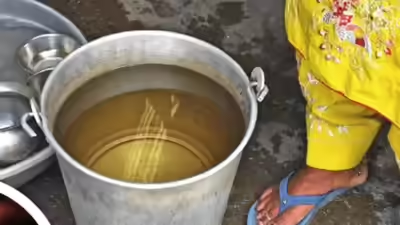
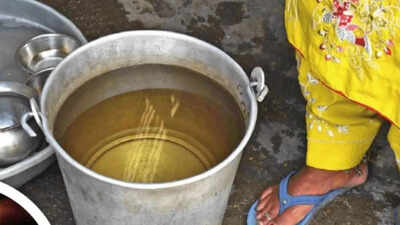
Ask anyone in Khukhrana about their health, and the answer is the same: “Everyone here is sick.” Allergies, eye infections, stomach disorders, respiratory disease, liver complications are routine. Cancer, too. Sukhbir Singh, 65, returned to Khukhrana after 35 years in the Army. Within three years of coming back, he had to undergo bypass surgery. Six months later, he suffered a stroke. “ Jab tak saans hai, tab tak dawai leni hogi (I will have to be on medication till my last breath),” he says.The water makes the crisis apparent. It runs yellow from taps — thick and foul-smelling. Those living closest to the factory speak of their neighbour, Krishna, 35, who “can’t walk more than a few metres without struggling for breath.”There’s a huddle of villagers outside Maha Singh’s house, speaking in hushed voices. His nephew, Satyavan, 44, died a month ago of a brain tumour. Maha Singh himself is undergoing treatment for throat cancer at a hospital in Panipat.Around Khukhrana, advertisements for cancer treatment and insurance line the streets. The village has just one govt clinic — an Ayushman Arogya Mandir — that opens for a few hours daily. People have to travel to Saudapur or Panipat for most treatment-related needs. “Earlier, govt used to organise medical camps every month. Even that they’ve stopped now,” says Tejbir Singh, a former sarpanch.
How It Got Here
Govt paid Rs 5,000 per acre for fertile fields and Rs 500 for arid plots while acquiring land for PTPS in 1972-73. Villagers were promised jobs and compensation. But by the time the plant became operational in 1983, their expectations got a reality check.There was constant noise, ash floating into homes, routine waterlogging and severe contamination of water sources. In the early 1990s, villagers got organised under the Gram Sudharak Samiti (GSS) and approached officials across Panipat district. But they got no relief.Things got way worse since the cement factory opened in 2008. “They open the vents and all the dust comes our way,” says Tanu, 30, who lives next to the cement factory. “We aren’t able to breathe. Our clothes, utensils — everything is coated with ash.”In 1995, GSS moved Punjab and Haryana high court. The case dragged on for over a decade. It was only in 2008, when the court ordered independent assessments, that Khukhrana’s plight became more widely known. Medical teams were deployed and studies conducted. The findings were stark: Khukhrana was unliveable. The court asked govt to relocate residents by 2014.Plans followed. Land was identified and funds allocated. Officials promised a fully developed settlement with infrastructure, but the relocation did not happen.In early March 2026, Haryana minister Krishan Lal Panwar distributed 445 allotment letters. Yet, there was again a delay, as the plots were neither registered nor demarcated.
Going Nowhere
The resettlement site is close enough to Khukhrana to make one doubt whether people would really be better off there. Yet, the air feels lighter, the roads are clean and free of coal residue, the trees appear greener. And it is easier to breathe.But the absence of residents has left the site in deep neglect. The community centre looks vandalised — windows shattered, glass shards strewn across the floor, along with empty liquor bottles, cigarette butts and syringes. Electrical wiring has been stripped away from the ceilings, and the main gate — once nearly 15ft tall — has been stolen, piece by piece.“Electricity poles have just been installed. They’ll also be gone in a few days,” says Kumar. Villagers say they have repeatedly asked officials to appoint a guard, but nothing has been done. “We don’t have funds to hire one ourselves,” he adds. And, even if relocation orders were issued tomorrow, shifting would not be possible. The chief hurdle is funds.Affected families are to build their own houses in the resettlement colony. But where is the money for that, they ask. “The govt conducted valuations of our houses in 2012. After that, there has been no revaluation to adjust for inflation,” says Naresh Kumar, the sarpanch.Kumar lives in a 150sqft house. In 2012, govt valued it at Rs 6-6.5 lakh. “I cannot build a house with Rs 6 lakh today,” he says. “Raw material costs have risen, so has the price of labour. We cannot work with compensation awards from 14 years back.” In any case, no payment has reached their bank accounts, villagers say.Panipat deputy commissioner Virender Kumar Dahiya says the relocation will be over in three months. He says infrastructure at the new site would also be repaired before residents are shifted. But on the ground in Khukhrana, the damage, for now, appears irreversible.