


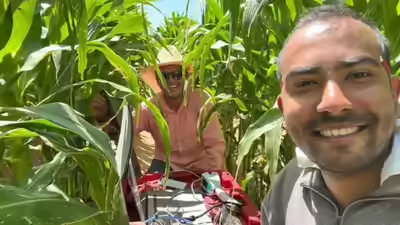
KOLKATA: A study by a team at an American university, of which a scientist from Bengal is a member, may help Indian farmers negotiate the unpredictable terrain of climate change by making staple crops more drought-tolerant.The increasing unpredictability of the monsoon, induced by climate change, has put a lot of stress on farmers cultivating staples like rice, wheat and maize. The research by Sabyasachi Sen’s team at New York’s Cornell University has unearthed a way plants regulate water loss. The findings, say scientists, will help devise ways to boost moisture retention by soil and boost cultivation in drought-prone zones.Sen, a doctoral student at Cornell who was born in Kolkata and went to La Martiniere for Boys before studying mechanical engineering at IIT Kharagpur, has been working on this project since 2020. The work, published in ‘Proceedings of the National Academy of Sciences’, can go a long way strengthening food security, ecosystem resilience and sustainability.“We can put to use findings of the study in western parts of Bengal such as Purulia, Bankura, Jhargram and parts of Birbhum and West Burdwan. These areas are considered drought-prone, where loss of soil moisture hits agricultural activity to a great extent,” said Pratap Mukhopadhyay, former principal scientist at Indian Council of Agricultural Research, who is not involved in the research by Sen’s team.“Moisture evaporation in those areas starts as early as March and hits the microbes and insects that provide nourishment to the soil. If plantation is done as per the study and water loss is regulated, soil health can be improved,” Mukhopadhyay said. Leaves exchange water and carbon dioxide (CO2) with the atmosphere, shaping both the water and carbon cycles. “For decades, scientists believed that this delicate exchange was controlled solely by stomata, the microscopic pores on the leaf surface that open and close to balance the plant’s need to take in CO2 for photosynthesis while minimising water loss. Our research challenged this. Using a new fluorescent nanoreporter called AquaDust, developed at Cornell, we peered inside living leaves to observe in real time how water moves through tissues,” Sen said.“What we found surprised us — living cells within the leaf can dramatically reduce their internal conductance to water, effectively tightening the plant’s internal plumbing, without reducing conductance to CO2,” he said.According to him, the discovery identifies a mechanism by which plants could reduce water loss without proportionally limiting carbon assimilation. The mechanism can be leveraged to ensure partial decoupling of productivity from transpiration, allowing crops to conserve soil moisture and delay onset of drought stress.“Our team is working with a global firm to apply this discovery to grow more water-use efficient maize,” Sen said.Former additional director of agriculture, directorate of agriculture, Bengal, Anupam Paul, said the study has novelty. He, however, added, “It’s still in an embryonic stage. India, too, has enough drought-tolerant rice and vegetables.”The study brought together plant physiologists at Harvard University (N Michele Holbrook and Fulton Rockwell), maize geneticists at the University of Illinois (Anthony Studer and R J Twohey), and a plant physiologist at the Flanders Research Institute in Belgium (Tom De Swaef). They teamed up with mechanical and chemical engineers at Cornell — Piyush Jain, Sabyasachi Sen, Annika Huber, Sahil Desai, Eric Wu, Mehmet Mert Ilman, and Abraham Stroock.