


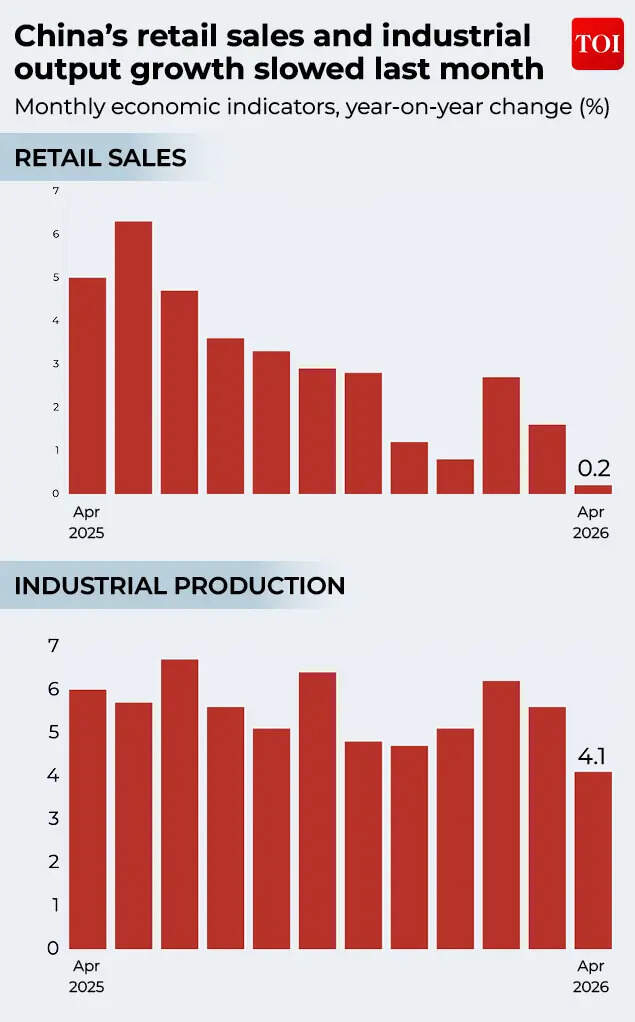
Driving the newsChina’s economy has unexpectedly staggered into the second quarter. Factories slowed, consumers pulled back and investment unexpectedly shrank, delivering one of the clearest signs yet that Beijing’s recovery is being squeezed from both sides: weak demand at home and a more hostile global environment abroad.Industrial output grew by 4.1% in April year on year, the Financial Times reported on Monday. The retail sales rose only 0.2% on year, below the 2% rise expected by analysts and well short of the 1.7% rise in March.

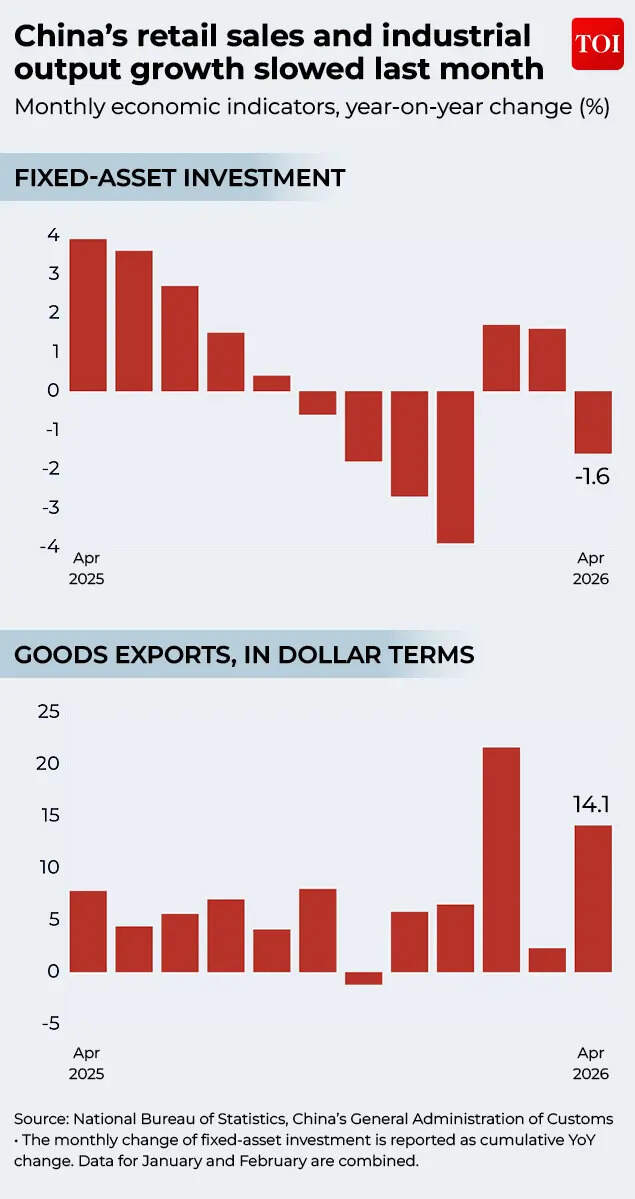
Fixed-asset investment fell 1.6% in January-April, reversing a 1.7% rise in the previous month.The data offered one of the clearest signs yet that China’s recovery remains fragile despite strong exports and the ongoing thaw in US-China trade relations despite President Donald Trump’s tariff war.Beijing sees a ‘severe’ worldThe official line from Beijing was unusually blunt.“The international environment was complex and severe, the spillover effects of geopolitical conflicts continued to emerge, global energy markets fluctuated at high levels and the difficulty of world economic recovery increased,” Fu Linghui, spokesperson and chief economist of the National Bureau of Statistics, said, according to the Financial Times.China has sought to cushion the blow from rising energy costs, Fu said. “China actively enhanced the guarantee of energy supply and temporary price control measures.”Why it matters
- Beijing is growing anxious that external shocks – notably the US- Iran war and higher energy costs – are colliding with persistent domestic weaknesses, as hinted at by China’s warning.
- The economy remains in the doldrums, thanks to a long stretch of bad news from the property sector that has sapped household confidence, hit demand for big-ticket purchases and weakened private-sector investment.
- The slowdown in April has revived the debate on whether Beijing will have to roll out stronger stimulus measures, Bloomberg reported. Authorities “may need to increase policy support to stabilize growth,” Nomura analysts said, warning: “Beijing has no room for complacency.
- China’s growth lost steam at the start of the second quarter as higher energy costs from the Iran war weighed on factories and consumers, the April figures showed.
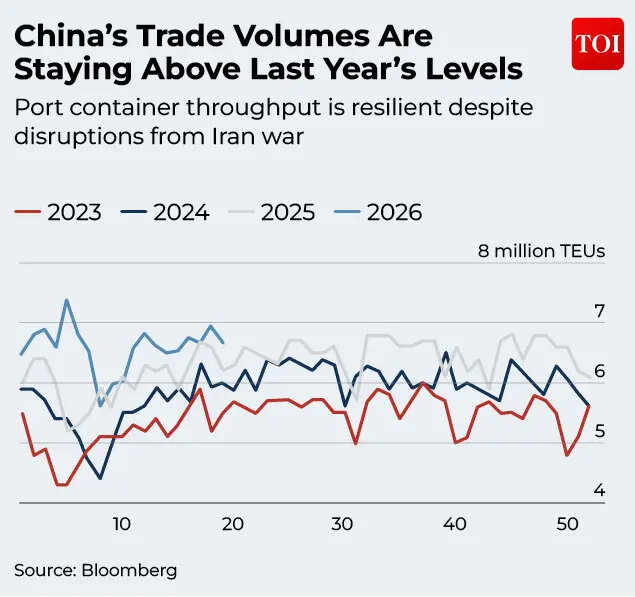
- Beijing’s danger is that its huge exports may no longer be enough to offset weakness at home. Demand for technology, green-energy products and AI-related goods has powered China’s export engine, but domestic consumption is still weak and investment has weakened.
- But the data still showed the resilience of China but the economy faces “a contradiction of strong supply and weak demand” Fu said.
- “Some enterprises are still encountering operational difficulties, and the basis for the continued stability and improvement of the economy has yet to be consolidated,” he said.
The big pictureThe Chinese economy is increasingly divided between manufacturing that is globally competitive and weak domestic demand.Export-driven sectors continued to do well, with electronics production supported by demand for AI chips and other tech products, Bloomberg said. Exporters also helped cushion domestic weakness, although not enough to fully offset it, according to Reuters.“Exporters did a good job in helping offset the weaknesses in domestic demand, but not enough to offset,” said Zhiwei Zhang, president and chief economist at Pinpoint Asset Management.That divide has helped create a two-speed economy, with factories tied to foreign demand still expanding but sectors tied to households, housing and private investment still struggling.

“China still looks like a two-speed economy: strong in strategic manufacturing and exports but weak where household confidence matters most,” Charu Chanana, chief investment strategist at Saxo Markets in Singapore, told Bloomberg.“The concern is not just about the missed activity, but that the weakness is broadening on the domestic side of the economy,” said Chanana.There are global implications to this imbalance too. But China’s exports have been strong, making its growth more lopsided, the WSJ reported, adding to trade tensions even as Trump and Chinese leader Xi Jinping celebrated “strategic stability” after their summit in Beijing.Zoom inPerhaps the most troubling sign was consumer data.Retail sales rose just 0.2% in April, one of the weakest since China reopened from Covid restrictions. The FT report said the figures point to a household sector that remains cautious to spend broadly.“Retail sales growth in the first four months of the year reflected weak household demand, as consumers concentrated on selective discretionary items such as phones rather than broad-based consumption,” said Yuhan Zhang, principal economist of the China Center at the Conference Board.Car purchases slid 10.6 per cent, home appliances were down 4 per cent, and construction materials, a key indicator tied to the property sector, fell 7.1 per cent, according to the FT.

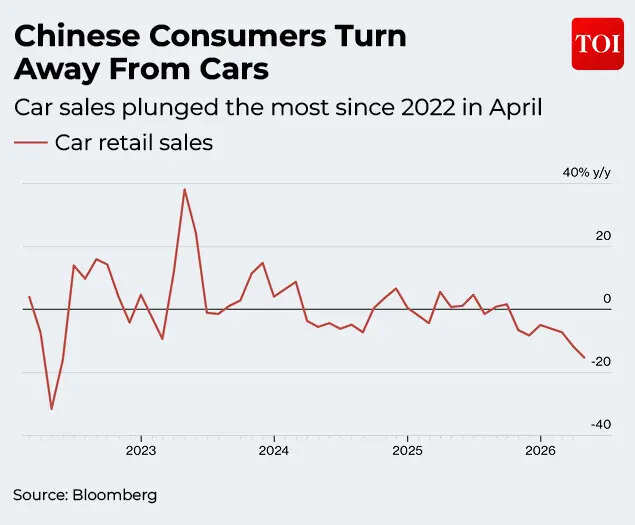
“The divergence indicates a bifurcated consumption recovery with consumers willing to spend on smaller lifestyle and tech upgrades but confidence in long-cycle, credit-intensive purchases tied to housing and income expectations remains subdued,” said Zhang.Car sales fell 15%, the biggest decline since mid-2022 when China was under Covid restrictions, Bloomberg said.The weakness in autos, appliances, furniture and housing related goods points to consumers shunning big ticket items tied to credit, income expectations and confidence in the property market.Between the lines The Iran crisis has added a new layer of uncertainty to China’s already bumpy recovery.China has tried to limit the domestic impact of higher oil prices through regulatory measures and short-term price controls, FT said. But the data pointed to stress in the energy and industrial system.China’s daily crude oil output was around 598,000 tonnes in April, with total production up 1.2% year-on-year but down 5.9% from March, according to FT. Refining activity slowed with the volume of crude oil processed falling 11.4% from the previous month and 5.8% from a year ago.The property sector is another big drag. Property investment fell 14% in January-April, construction starts fell 22% and home sales by value fell 15%, the WSJ reported.But there were a few signs of stabilization. Resale home prices declined at the slowest pace since March 2025, Bloomberg reported, with analysts at firms including Citigroup and Bank of America saying the battered sector may be closer to stabilizing.Lynn Song, chief Greater China economist at ING Bank NV, said: “The April numbers are telling us we’re closer to a bottom in the property market, although we’ve had a couple of false bottoms in the past as well.”With inventories still elevated, “a stabilization in prices is a much-needed first step for a recovery,” said Song.The warning beneath the numbersThere is a deeper message from the latest data. China’s economy remains strong but its underpinnings are patchy. It is more confident in making than in consuming. It sells better than it restores the domestic trust.In a world of volatile energy markets and global economic spillover from geopolitical conflict, Beijing’s warning of a “complex and severe” international environment now sounds less like standard official boilerplate and more like an acknowledgment of the moment.

China’s recovery has relied on a world ready to buy what it produces. The danger now is that the world is becoming less stable just as China’s own domestic consumers are still not willing to take the load.What’s nextOne month of soft data probably won’t force Beijing into a major stimulus, but the pressure to act is increasing.Bloomberg: The next key window for policy adjustment may be the July meeting of the Communist Party’s Politburo, when leaders review growth and decide if more support is required.“The view still appears to be to play it safe,” Jing Liu, chief economist for Greater China at HSBC Holdings, said in an interview with Bloomberg TV. “Our base case is no further stimulus to the economy for the time being.Reuters also cited analysts saying Beijing might wait for second-quarter GDP data to be released before rethinking its policy stance.But if the weak demand persists, calls for easing will grow louder. The April figures give a bleak picture for China’s economy, with both demand and supply deteriorating sharply, Bloomberg Economics said. “The broad-based misses underscore a serious lack of aggregate demand and make the case for immediate policy support all the more.”“Policy space remains ample,” Hao Zhou, chief economist at Guotai Junan International Holdings, told Bloomberg.The April data are less a sign of deterioration but a trigger for more pro-active easing, which should help anchor growth and support a gradual recovery into the second half of the year,” Zhou said.For the moment, Beijing’s message is that China is stable. But the warning of a “complex and severe” global environment shows policymakers see rising risks from geopolitical conflict, volatile energy markets and weak global recovery – all arriving while Chinese households remain cautious and the property sector is still struggling to regain its footing.(With input from agencies)