
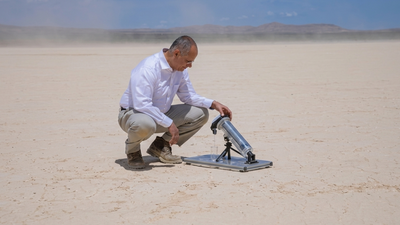
A Nobel Prize-winning chemist has unveiled a solar-powered machine capable of extracting up to 1,000 litres of clean drinking water per day from dry desert air, a breakthrough that could reshape how the world tackles water scarcity. Professor Omar Yaghi, a materials scientist at University of California, Berkeley, developed the system using metal-organic frameworks, or MOFs, highly porous materials that can trap water vapour even in low-humidity environments. Operating entirely off-grid and powered by sunlight, the technology is designed for drought-prone regions, disaster-hit communities and remote settlements where traditional water infrastructure is unreliable or absent.
How the solar machine harvests water from desert air
At the heart of the invention are MOFs, crystalline materials made of metal nodes linked by organic molecules. Their internal surface area is so vast that a single gram can contain pores comparable in area to a football field.At night, when temperatures drop, the MOF material adsorbs water vapour from the air, even at humidity levels as low as 20%. During the day, sunlight gently heats the material, releasing the trapped moisture. The vapour then condenses into liquid water, which is collected and filtered for drinking.“The science is here,” Yaghi said while describing the system. “What we need now is courage, courage scaled to the enormity of the task.”Earlier prototypes tested in California’s Death Valley produced modest outputs, but scaling the system to a 20-foot shipping container has increased production dramatically, making it viable for community-level supply.

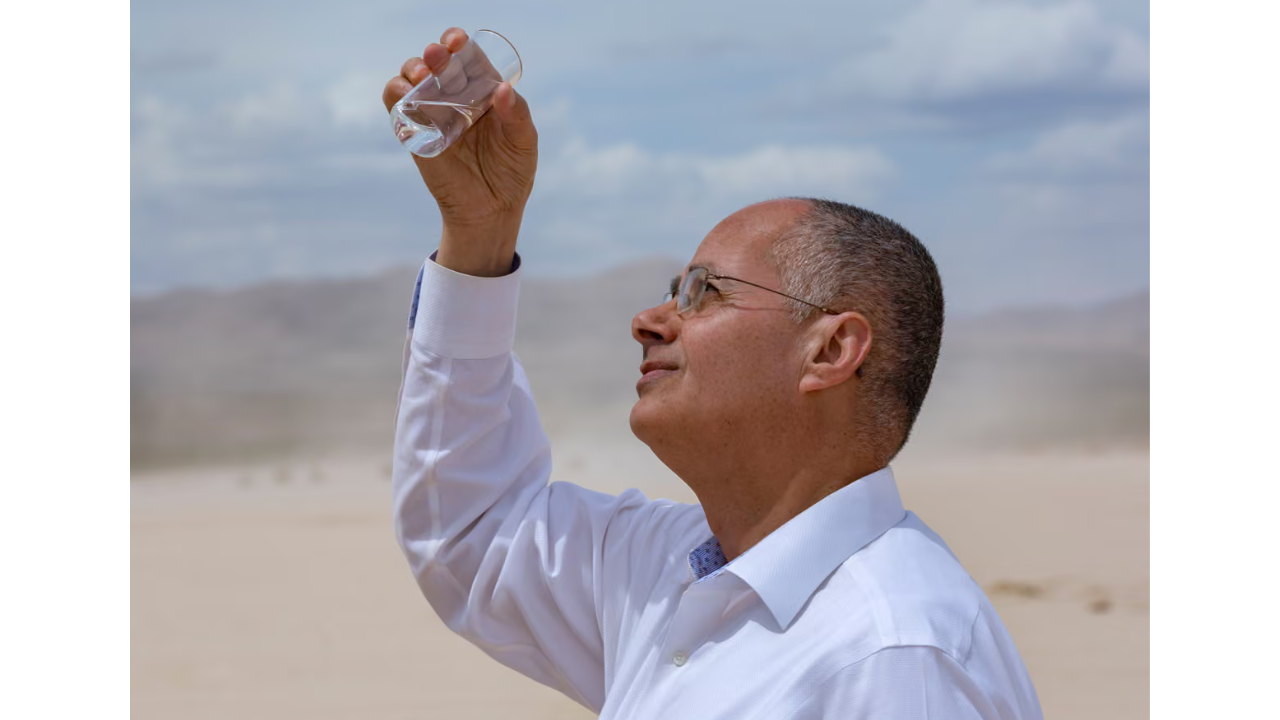
Professor Omar Yaghi
A response to global water stress
The innovation comes at a critical time. According to the United Nations, roughly 2.2 billion people worldwide lack safely managed drinking water, and billions more face severe water scarcity for at least one month each year. Recent UN assessments have described the planet as entering a “global water bankruptcy” era.Yaghi’s device offers a decentralised alternative to traditional water sources such as desalination, which can be energy-intensive and produce environmentally harmful brine waste. Because the MOF-based system runs on ambient solar energy, it does not require grid electricity or fossil fuels.“It could function when traditional infrastructure fails,” said Davon Baker, an environmental official in the Caribbean who has expressed interest in the technology for hurricane-prone islands. “The ability to operate off-grid using only ambient energy is particularly compelling for vulnerable communities.”
From refugee roots to global impact
Yaghi’s motivation is deeply personal. Born in Jordan to a Palestinian refugee family, he grew up in a desert community without running water. In his Nobel banquet speech, he recalled hearing whispers in his neighbourhood, “The water is coming,” as residents rushed to fill containers before supplies stopped.That memory, he said, shaped his determination to engineer materials capable of solving real-world survival challenges. He described his field, reticular chemistry, as “a science capable of reimagining matter” to address climate and sustainability crises.
Promise and remaining hurdles
Peer-reviewed studies in journals such as Science Advances have confirmed the efficiency of MOFs in atmospheric water harvesting. However, challenges remain before mass deployment becomes feasible. Producing MOFs at scale while keeping costs low is a major hurdle, as is ensuring durability in harsh environments over long periods.Yaghi founded the company Atoco to commercialise the technology and explore partnerships for wider distribution. Experts say that if manufacturing and cost barriers can be reduced, the system could provide a resilient supplement to existing water infrastructure, particularly in arid regions across Africa, the Middle East and parts of Asia.
A climate-era innovation
As droughts intensify and extreme weather events disrupt water systems, decentralised and climate-friendly solutions are increasingly urgent. Yaghi’s invention does not promise to replace rivers or aquifers, but it offers something radical, the ability to generate drinking water from air using nothing more than sunlight and advanced materials.For billions facing unreliable supply, that could indeed prove to be more than just a scientific breakthrough. It could be a lifeline.