




Across the world, millions of women spend years searching for answers to pain that quietly disrupts their daily lives. Severe cramps, fatigue, stomach issues, or trouble getting pregnant often appear long before doctors identify the real cause. For many, that cause is endometriosis.According to WHO, endometriosis affects around 10 percent (around 190 million) of women of reproductive age globally, yet diagnosis often takes seven to ten years after symptoms begin. This delay is not just a medical issue. It reflects how menstrual pain is discussed, how symptoms are interpreted, and how the condition itself behaves inside the body.When a disease hides behind common symptoms and social silence, the path to diagnosis becomes long and confusing.
What exactly is endometriosis?
Endometriosis occurs when tissue similar to the lining of the uterus grows outside the uterus. These growths can appear on the ovaries, fallopian tubes, bowel, bladder, or other pelvic organs.Each month, this tissue reacts to hormonal changes in the same way the uterine lining does. It thickens, breaks down, and bleeds. But because the tissue sits outside the uterus, the blood cannot leave the body easily. Over time this can lead to inflammation, scarring, and severe pain.The condition is also strongly linked to fertility challenges. Some estimates suggest that 30 to 50 percent of women with infertility may have endometriosis.Dr Kavitha Kovi, Head of Department – Obstetrics & Gynaecology, Aster Whitefield Hospital, explains, “Endometriosis develops when uterine lining tissue grows beyond the uterus which results in inflammation and pain and creates potential fertility issues. The process of obtaining a diagnosis requires patients to endure through a lengthy and challenging path.”
Why cases appear to be rising
Doctors are noticing more diagnoses today than in the past. That does not always mean the disease itself is suddenly increasing. In many cases, it simply means that doctors are recognising it more often.But lifestyle and reproductive patterns may also play a role. Women today often start menstruation earlier, delay pregnancy, and experience more menstrual cycles during their lifetime. Each cycle exposes endometrial tissue to hormonal changes that may influence disease progression.A large study supported by the Indian Council of Medical Research (ICMR) has highlighted the need for better awareness and earlier identification of gynecological disorders including endometriosis in Indian women.Researchers also note that increased urban stress, environmental exposures, and changes in diet are being studied as possible contributors. These factors are still under investigation, but they highlight how complex the disease may be.


Symptoms vary widely and can resemble other conditions, making detection difficult. Social attitudes toward menstrual pain and limitations in standard imaging also contribute to delays.
Why the symptoms are often misunderstood
Endometriosis does not look the same in every woman. That is one reason it escapes attention for years.Some women experience sharp pelvic pain during periods. Others struggle with bloating, fatigue, digestive problems, or pain during intercourse. A few only discover the condition when they try to conceive.Dr Ruchi Jain, Fertility Specialist at Nova IVF Fertility in Kolkata, explains the confusion clearly, “People frequently confuse the symptoms which include severe menstrual pain and pelvic discomfort and fatigue and painful periods with ordinary menstrual issues. Women develop the misconception that intense menstrual pain must be endured because they have spent their lives experiencing this discomfort.”Because the symptoms overlap with conditions like irritable bowel syndrome, pelvic infections, or routine menstrual discomfort, doctors may treat other possibilities first.This creates a cycle of temporary treatments but no clear diagnosis.
The medical challenge of detecting it
Another difficulty lies in how the disease appears inside the body. Endometriosis lesions can be tiny and scattered across pelvic organs. Early-stage disease often remains invisible on routine scans.Dr Ruchi Jain points out the diagnostic difficulty, “The clinical process of diagnosing endometriosis becomes difficult because standard imaging methods fail to provide clear results for early-stage detection. Medical confirmation of certain conditions requires advanced imaging techniques or surgical approaches which only become viable after a person shows ongoing health issues.”In some cases, the only way to confirm endometriosis is through laparoscopy, a minimally invasive surgery that allows doctors to see the tissue directly.Because surgery is not the first step doctors take for pelvic pain, diagnosis can be delayed for years.
Social silence also slows diagnosis
Medical science is only one part of the story. Cultural attitudes toward menstruation play an equally strong role.In many societies, menstrual pain is considered normal. Girls grow up hearing that cramps are simply part of being a woman. When pain becomes severe, it may still be dismissed as “just a bad period.”Dr Kavitha Kovi highlights this concern, “The main reason for this delay occurs because many societies have established menstrual pain as an acceptable condition. Patients and healthcare providers sometimes treat severe cramps and heavy bleeding and pelvic pain as standard components of the menstrual cycle.”When symptoms are normalised, women may delay seeking medical care. Even when they do visit doctors, the conversation about menstrual health may remain limited.Public figures have also spoken about the long struggle for diagnosis. Actor Lena Dunham, who lives with endometriosis, once described the condition as “an illness that hides in plain sight,” reflecting how often it is overlooked despite severe symptoms.

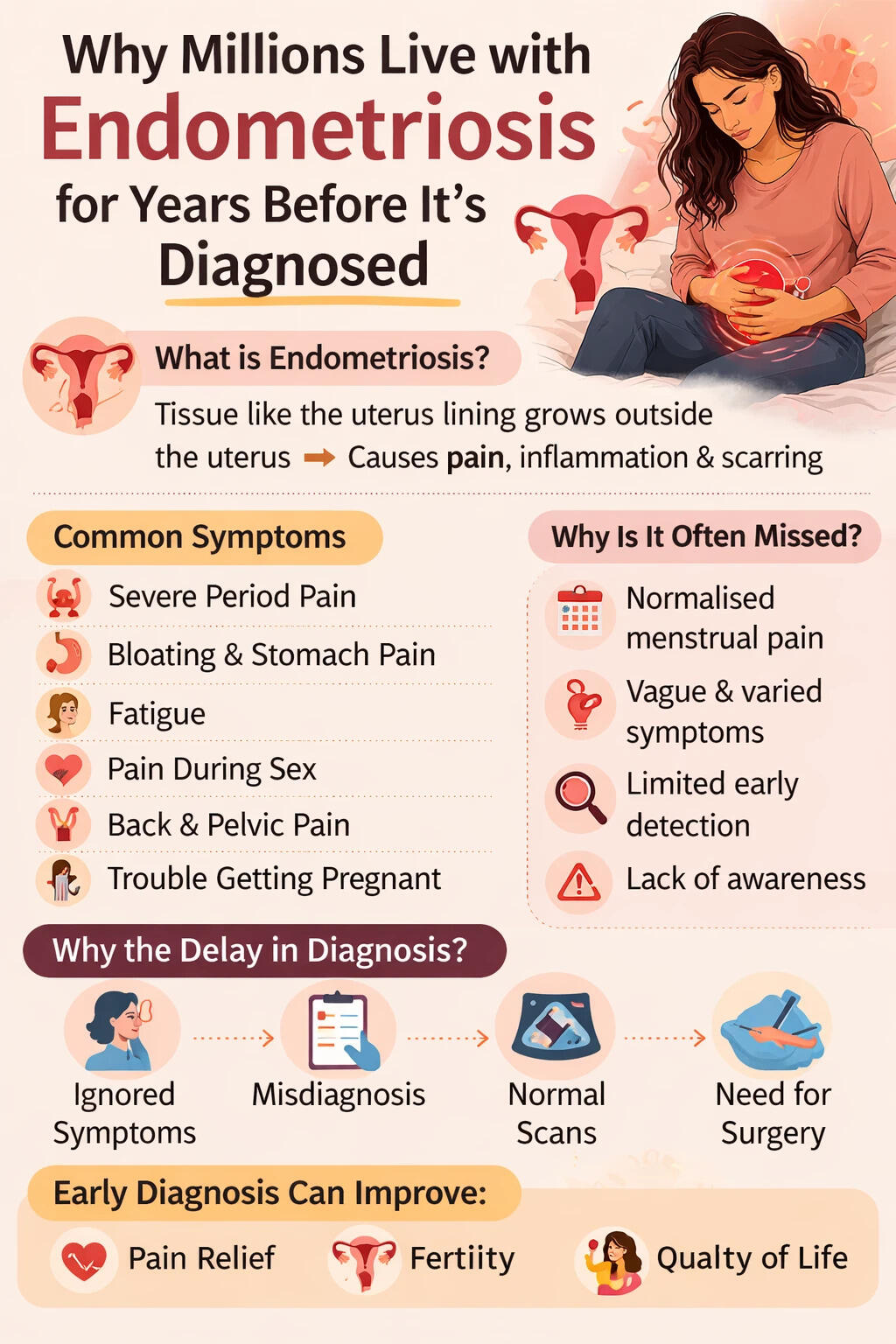
Experts say improved awareness among doctors and better menstrual health education can help women receive earlier diagnosis and treatment.
What doctors and healthcare systems need to watch for
Experts say early recognition can significantly improve quality of life. Treatment options today include medication, hormone therapy, pain management, and in some cases surgery.But the first step is listening carefully to symptoms.Dr Kavitha Kovi notes, “The disease presents multiple obstacles because its complex nature creates challenges. Endometriosis does not present the same way in every individual. Women experience different symptoms because some develop severe pelvic pain while others report ongoing fatigue and digestive problems and lower back pain and pain during intercourse.”Doctors are increasingly encouraged to look beyond routine explanations when symptoms persist. Severe menstrual pain that disrupts daily life should not be dismissed.Greater menstrual health education also helps women recognise when something is not normal.Dr Ruchi Jain emphasises this point, “Women who receive prompt assessment of their symptoms experience improved life quality because medical professionals take their symptoms seriously.”
A condition that needs earlier attention
Endometriosis is not rare. It is simply under-recognised.When severe period pain is dismissed, when digestive symptoms are treated separately, and when scans appear normal, the condition can remain hidden for years.But awareness is slowly improving. Doctors, researchers, and patients are speaking more openly about menstrual health. That conversation may shorten the long wait many women currently face before hearing the correct diagnosis.For millions living with unexplained pain, that change could mean answers arriving years earlier.Medical experts consultedThis article includes expert inputs shared with TOI Health by:Dr Kavitha Kovi, Head of Department – Obstetrics & Gynaecology, Aster Whitefield Hospital.Dr Ruchi Jain, Fertility Specialist at Nova IVF Fertility in Kolkata.Inputs were used to explain why endometriosis diagnosis is often delayed and how greater awareness of symptoms can help women seek timely medical care.