


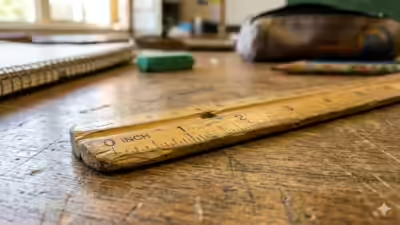

It seems that one of the most obvious instruments of everyday life is a ruler. However, many people have already noticed the presence of an intriguing feature in rulers. This gap before the zero mark is not just a mistake of manufacturers. Actually, this particular feature significantly increases precision and durability.Why does a ruler have a gap before zero?First of all, it helps us to avoid errors caused by wear and tear. In other words, the edge of a ruler is its vulnerable area, as it may be dropped, scraped, etc. The slightest damage to this part will affect every measurement from this moment. For instance, the loss of 0.5 mm in width due to wear and tear will change the reference point by the same distance along the entire length of the ruler.It is known that all measuring instruments should ensure their integrity and stability because of the following principle: any instrument can provide precise measurements only when its reference point is reliable and durable.By positioning the zero value slightly inward, manufacturers can provide an additional buffer zone. It allows absorbing impacts and protecting the measurement scale itself from damage.A principle often seen in precision devicesOf course, this principle is not applied exclusively to rulers for educational purposes. There are other precision devices using it as well. For instance, vernier callipers have measuring jaws protected from the edges. They are not influenced by any mechanical damage as they have reference points inside the tool.On tape measures, this technique is replaced with another one – the metal tip that can move and compensate for its own thickness when measuring inside or outside dimensions. The research in engineering pays much attention to reducing the impact of mechanical and positioning inaccuracies on the final results. According to a study published in Measurement Science and Technology, even minor differences may become significant during multiple measurements.It all leads us to a similar principle of designing a measuring device. The starting point of measurement should be independent of the fragile edge.

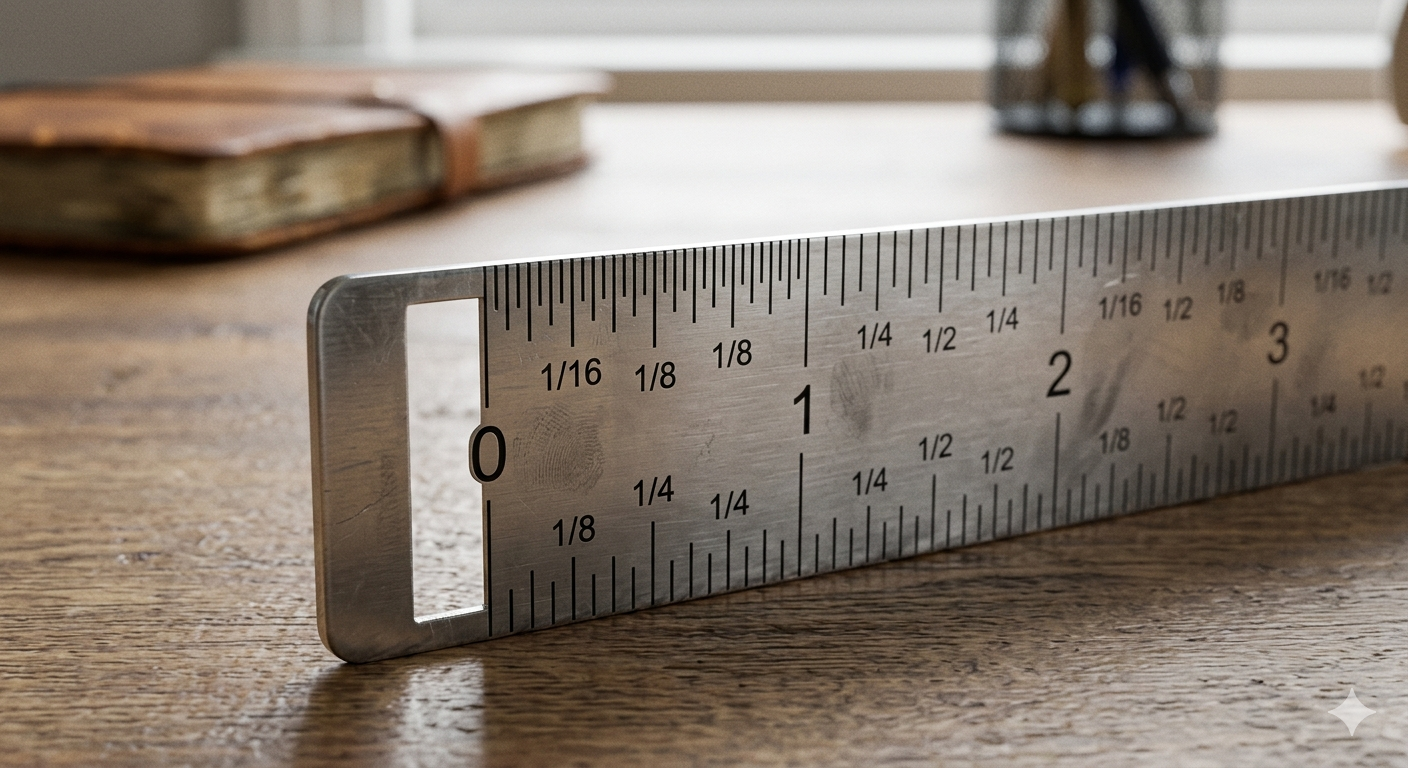
Why rulers have a gap before zero, and what it actually does. Image credit – Gemini
Manufacturing and design considerationsThe distance prior to the zero line also facilitates manufacturing. Rulers are often mass-produced via a cutting and printing process. Ensuring that the printed measurement starts precisely from the edge of the ruler can be challenging, especially when done at a fast pace.Using a gap allows manufacturers some leeway when producing rulers to avoid issues. This allows manufacturers greater flexibility while ensuring the measurement starts correctly. Product design studies have found that providing a little wiggle room when designing a product can reduce errors and ensure quality. This means that the gap not only benefits usage but also manufacturing.An inherent method of teachingAnother way a gap between zero and the edge of the ruler benefits is through education. Students starting out often tend to measure from the edge. Having an obvious zero line provides an easy visual cue for students to understand when measuring. It helps to understand that one must begin measuring at a designated point, not from the edge of the ruler.Educational studies have confirmed the benefits of having visual aids in early mathematical skills acquisition. A study by the National Council of Teachers of Mathematics highlights the importance of using reference points while teaching concepts related to measurement. An intelligent way of design silently assists the correct method of application without having to write any instructions.Measurement accuracyExperts have stated that instruments will never be more accurate than their reference points. Inaccuracies in measurement will happen even with perfectly designed instruments.Additionally, precision measuring devices depend upon the consistency of the reference points. Experts advise using object alignment with reference marks, rather than instrument edges, as the cumulative errors tend to be quick even in construction work or tailoring tasks.Key takeawayAn inch of blank space in front of the zero point of a ruler serves multiple purposes. Its purpose is to ensure the accuracy of measurement and its durability. It also serves as a protection mechanism, an accurate measure guarantee, and a tool for technique learning.