


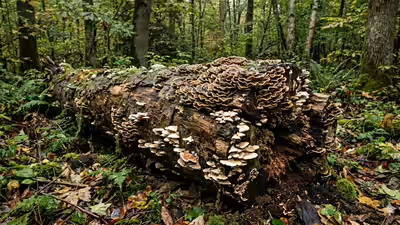
Forests seem sturdy and solid from the outside, but there might be something happening silently underneath. Some fungi can cause trees to decay internally and leave them weakened without showing any sign of it. Researchers are cautioning us that these seemingly insignificant beings could be pointing towards a more serious environmental problem, which is global warming. Due to the rise in temperature and changes in climate conditions, these fungi may start affecting forests at a faster rate than ever before.
Why changing weather patterns are boosting fungal infections in trees
Fungi depend on certain environmental factors for their growth and reproduction, but now, thanks to climate change, their preferred environmental factors are being modified in their favour. Rising temperatures, changing precipitation levels, and increasing humidity levels may promote the growth and distribution of fungi. According to an article published about this topic titled ‘Climate change putting millions more people at risk from infection-causing fungi,’ it was noted that “changes in environmental factors … will change habitats and drive fungal adaptation and spread.”This is especially dangerous considering the adaptability of fungi. With climate change leading to changes in the environment, fungi can now grow and multiply in different environments and affect trees that cannot develop immunity against fungi. The study published about ‘The impact of climate, local habitat, surrounding landscape and management on coffee wilt disease and Armillaria root rot on Arabica coffee in its native range‘ also highlights the effect of climate factors on different infections like root rot.In other words, with the climate becoming unpredictable, fungi are finding new chances for development and spreading.
How fungi rot trees from the inside
However, while certain species of insects and animals may cause visible injury to the leaves or the bark, there are other organisms that affect the internal organs without leaving any visible indication of their existence on the external surface. Some examples of the kinds of fungi causing damage to the internal structure include root rot, trunk rot, and wood decay.Armillaria root rot, also known as shoestring fungus, is an example of a type of internal decay caused by a fungus. It interferes with the transport of water and nutrients within the plant, resulting in the death of the tree even though it looks healthy from the outside.In conclusion, fungal infections can go unnoticed for years, even decades. While the effects of fungal infections may be apparent only after some time, the extent of internal damage becomes irreversible when it manifests itself externally.
Why this matters for forests and the climate
While climate change drives fungal development, there is also a reverse connection between these phenomena. There are some fungi capable of sequestering carbon in soil, whereas other species emit carbon dioxide during decomposition.As mentioned in the study titled ‘Mushrooms in climate change mitigation: a comprehensive review,’ mushrooms are referred to as “the key players in carbon cycling.” As trees are affected by the infection caused by mushrooms, the carbon present within them is slowly released into the environment, resulting in higher levels of greenhouse gases.Moreover, mushroom growth can negatively affect forests, making them less resilient against climate change effects such as droughts, insect attacks, and extreme climatic conditions. In other words, climate change drives the growth of fungi, and these fungi contribute to global warming.Currently, scientists emphasise the need for additional studies on fungi. Although their importance is well-recognised, fungi lack proper consideration when formulating conservation plans and climate policy.Fungi eating away at the insides of trees are not just bad news for forest scientists; it may also be a warning about what’s to come in the ecosystems of the future. With changes in the environment continuing, there’s a good chance that these invisible creatures will play an increasingly important part in determining how things develop.