


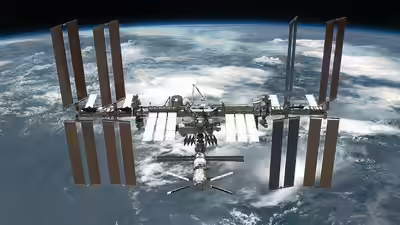
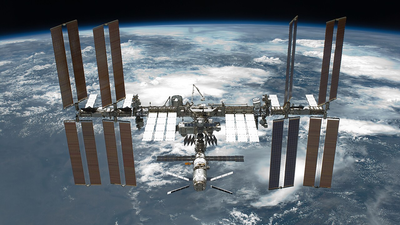
For 25 years, the ISS was the only address humans kept beyond Earth. It is closing. What replaces it is not one station; it is an orbital economy, built by private companies and designed to manufacture things that cannot be made on the ground.In November 2000, two Russian cosmonauts and one American astronaut moved into the International Space Station and did not come back for months. Someone has been living up there continuously ever since. Twenty-five years, nearly 300 people from 26 countries, and more scientific experiments than most institutions on Earth will ever run, all of it in a laboratory the size of a football field, orbiting at 28,000 kilometres per hour.The ISS cost more than $150 billion to build and costs the US roughly $3 billion per year to operate. It is widely considered the single most expensive object ever constructed. And the plan, now confirmed, is to bring it down deliberately, controlled, into the ocean around 2030 or 2031.What happens next has consumed the space industry for three years.
Not just one station
Rather than build a single government replacement, NASA has made a strategic decision to become a customer rather than an owner, funding multiple private companies to build commercial space stations, then buying research time and crew berths from them. Contracts worth between $1 billion and $1.5 billion are expected between 2026 and 2031.Vast Space’s Haven-1, the first standalone commercial space station in history, is targeting early 2027 for launch aboard a SpaceX Falcon 9, initially supporting crews of four for up to ten days. It is a proof of concept for Haven-2, a larger station targeting twelve crew members by the early 2030s.Axiom Space is taking a different path, attaching its first module directly to the ISS before the station retires, creating a seamless thread of continuous habitation, with a free-flying station expected as early as 2028. “The future of human spaceflight lies in the hands of commercial operators who can drive innovation and reduce costs,” said Axiom CEO Michael Suffredini.Orbital Reef, led by Blue Origin and Sierra Space with Boeing and Amazon as partners, describes itself as a “mixed-use business park 250 miles above Earth”, and its plans include a spherical inflatable entertainment module earmarked as a film location for a future movie starring Tom Cruise.Starlab, the Voyager Space and Airbus joint venture, is targeting 2029 and is designed to launch in a single go aboard SpaceX’s Starship.
Why is the orbit worth this much money?
The business case rests on what microgravity makes possible that Earth cannot. Proteins crystallise more perfectly in zero gravity, yielding pharmaceutical data unavailable from ground-based research. Fibre optic cables manufactured in orbit outperform those made on Earth. Certain alloys and semiconductor crystals simply cannot be produced in gravity conditions. Commercial operators are designing platforms to support microgravity research, pharmaceutical development, advanced materials manufacturing, and space tourism tailored to specific markets and expandable as demand grows.The station, in this vision, is not merely a place where humans live. It is a factory floor with a view.
The risk nobody wants to say out loud
A gap between the ISS’s retirement and the availability of commercial alternatives would leave the United States without a crewed presence in low Earth orbit for the first time in decades, a situation experts and Congressional leaders have flagged as both a scientific and national security risk. Commercial timelines are optimistic, and the space industry has a long history of delays. The economics of multiple competing private stations all chasing the same pool of government contracts may not sustain all of them.What is happening is not just a change of address. It is a change of model. The ISS carried the flags of fifteen nations and represented multilateral cooperation that was extraordinary for its time. What replaces it looks more like a business district, research labs for rent, manufacturing bays for hire, habitat modules for private astronauts who can afford the ticket.Ticket prices in the tens of millions of dollars are expected initially, though if successful and profitable, these stations could eventually broaden access to researchers, national agencies, and firms wishing to manufacture in space.The ISS will hit the ocean in a few years, burning up on the way down, the most expensive controlled demolition in history. What replaces it is already taking shape in hangars in California, design rooms in Houston, and engineering offices in Toulouse. It will not look like the ISS. It will not function like the ISS.It just does not have a flag on it yet.