


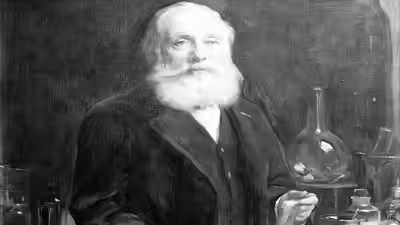
William Henry Perkin, a London-based chemistry student, was conducting experiments in his home laboratory. He was attempting to prepare a drug, quinine, that is used to treat malaria. One particular experiment did not work out as intended. The failure resulted in the formation of a strange, dark-coloured stain. After cleaning the container with alcohol, he observed that the deposit turned into a purple solution.This led to Perkin’s discovery of mauveine in 1856 when he was only 18 years old. After further testing, the chemist found that the new compound can be used to stain fabrics effectively. In his research, published in the Molecules journal, he noted that it successfully stained textiles in rich shades.Key features of mauveinePrior to this invention, most textile dyes were extracted from natural sources. These were plants, insects, or even minerals. Colours produced using natural ingredients were expensive, and their quality might vary.Mauveine was a breakthrough because of its origin. This new compound was synthesised from coal-tar products, which were available in large quantities due to industrialisation.According to the Royal Society of Chemistry, mauveine became the first industrially profitable dye created by man using organic substances. Soon, the substance turned out not just an object of scientific studies but also a commercially viable product that could be mass-produced and sold.Mauveine’s journey from the lab to the marketRight after his invention, Perkin filed for a patent for mauveine. Not long afterwards, he founded a factory where the dye was produced. According to the University of Chicago Library, the chemist then quickly ventured into the field of dye-making right after his breakthrough.This fact is significant since it indicates that chemistry could be directly involved in industrial processes. Mauveine was widely used in clothing production in Europe and the United States.In particular, mauve – the colour produced using this dye – became a trend, and was actively incorporated into the world of fashion.

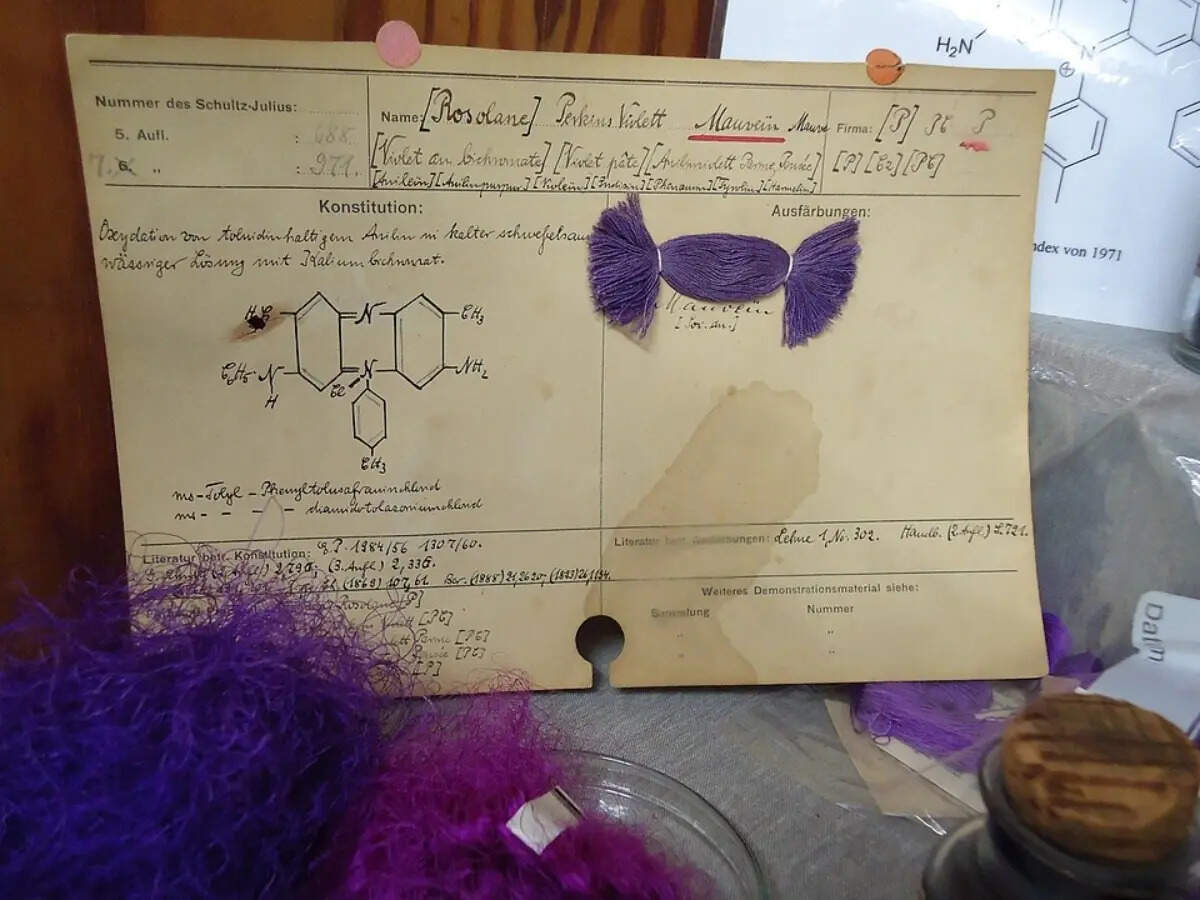
A purple residue that led to the first synthetic dye. Image credit – Wikimedia
The chemistry of mauveineAlthough the discovery of mauveine is usually recounted as a happy accident, its chemistry is more intricate. Research reveals that it is not a pure substance but rather a mixture of phenazinium derivatives.According to the Royal Society of Chemistry, mauveine is composed of several phenazinium compounds. This explains the stability of its vibrant hues. It also demonstrates that early chemical innovations were more empirical than the contemporary formulations.Other scientific research points out that the colouring agent was made via oxidation reactions using aniline, a coal tar byproduct. These facts illustrate that the discovery involved luck and practical chemical techniques.The dawn of the synthetic dye industryHowever, the discovery of mauveine had far-reaching consequences. It marked a watershed moment for the chemical industry, which shifted toward synthetic chemistry. Various articles state that Perkin’s discovery was the birth of the synthetic dye industry.Such progress led to advances in many disciplines, including synthetic chemistry, which entered industries such as medicines, plastic products, and cosmetics.Additionally, synthetic colourants were eventually applied in the manufacture of paints, inks, and other substances. The invention provided the foundation for linking lab-based studies and mass manufacturing.Why Mauveine’s discovery is still relevantAlthough the history of Perkin’s discovery usually includes references to luck, historians stress the role of observation. Every experiment can result in failure, but sometimes it leads to a discovery. In this case, what distinguished the project was the chemist’s decision to examine the unusual result.Scientists’ historical studies reveal that innovation often requires recognising the potential of unintended outcomes, which is exactly what happened in Perkin’s case. His findings were proof that young people could bring something significant to science. Indeed, mauveine turned out to be the first artificial dye. It played a key role in the development of an entire new industry and proved that laboratory research could result in useful items for everyone.