


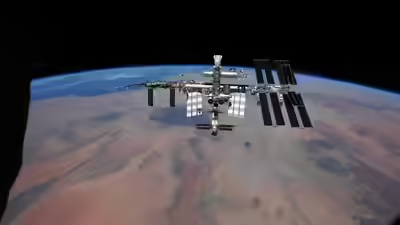

The United States is reaching a critical point in its space policy. While long-term plans are being made to create a permanent human presence on the Moon, a pressing concern in the near term is arising in the realm of low Earth Orbit (LEO). According to a report from the ESA, this area, which reaches up to 2,000 kilometers from Earth, has been continuously occupied by astronauts for over two decades. At the centre of this activity has been the International Space Station, which has facilitated scientific research, international collaboration, and technology advancement since 1998. Its planned retirement is set for 2030, with questions being raised about whether a new one will be ready in time.
International Space Station retirement raises risks for LEO research continuity
The ISS has had over 280 astronauts and has carried out thousands of experiments in microgravity. It has been a vital tool for human exploration and understanding of long-duration spaceflight. Structural and material degradation, which is a result of ageing, is now starting to occur, and this has increased costs.There is a plan by NASA to move from a government-run space station to a commercial space station. This is aimed at reducing costs and enhancing commercialisation. It takes several years to build, test, and send a new space station to space, and this has reduced the transition period.
China’s Tiangong space station strengthens its lead in low-Earth orbit operations
During this transition period, China has already established a stable presence in orbit through the Tiangong space station. Completed in 2022, Tiangong supports continuous crewed missions and scientific research.The existence of an operational alternative station creates a strategic consideration. According to Aerospace Security, if the ISS retires without a successor, Tiangong could become the only active space station in LEO. This would influence international collaborations, technology standards, and access to orbital research platforms. Space infrastructure often shapes the development of compatible technologies, and long-term dominance in orbit can affect global partnerships.
NASA’s slow rollout of LEO strategy raises concerns for private space firms
NASA has been gearing up to transfer responsibility for LEO missions to private entities. The process, however, has been slower than anticipated. The request for a proposal, meant to provide a framework for commercialization, has been delayed on multiple occasions.Administrative changes and politics have contributed to a shift in the schedule. The confirmation of Jared Isaacman and a government shutdown in 2025 have created a number of challenges. The delay has an effect on the planning cycles of various private entities, as many of them rely on NASA for funding.
Commercial space stations under development
Several private companies are engaged in developing next-generation space stations. Some of the companies include Axiom Space and Vast. The former has announced funding rounds and a plan for launching its space station within a few years. The same is true for the latter, which is developing a smaller space station.The new space stations are intended for independent operation. The initiatives include a project with Blue Origin and Boeing for a much larger space station. The new space stations are intended for independent operation. Most of these initiatives are dependent on government support. The current commercial space station market is still small. The primary consumers will be national space agencies.
ISS retirement could disrupt the US presence in low-Earth orbit and space research
If the International Space Station retires before a replacement is operational, the United States could lose its ability to sustain continuous human activity in low-Earth orbit, as highlighted by NASA and analyses from the Center for Strategic and International Studies. This would affect scientific research, astronaut training, and mission preparation.Research conducted in microgravity is essential for long-duration missions under the Artemis program, including studies on human health, life support systems, and advanced technologies required for deep-space exploration.