


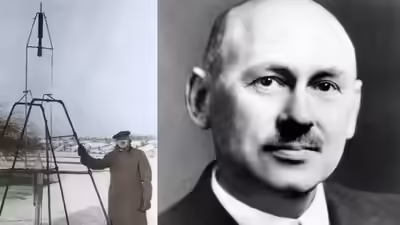
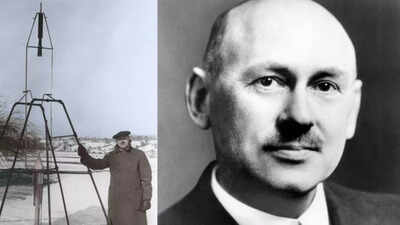
A century ago, in a quiet cabbage patch in Auburn, Massachusetts, something happened. Dr Robert H. Goddard, a Clark University Physics professor, fired up a rocket powered by liquid fuel. It flew for a mere 2.5 seconds and landed in a cabbage patch 184 feet (56 meters) as reported by NASA. This little test, on March 16, 1926, reportedly changed the way humans would explore the skies. Liquid-fuelled rockets were born. And from that modest flight came a century of exploration that would carry satellites, probes, and eventually astronauts far beyond our world.
Robert Goddard’s early rocket experiments that revolutionised liquid fuel technology and spaceflight
The fuel mixture was liquid oxygen and gasoline, that is a strange combination back then. Most rockets relied on solid propellants. Once lit, they burned out with no control. Goddard’s approach was different. Liquid fuel meant he could throttle, control, maybe even steer. His first flight was tiny in scale, sure. But it demonstrated that controlled, powered flight was possible. Within a few seconds, just forty feet. Over the years, Goddard didn’t stop. He worked on pumps, engines, and guidance systems. Small tweaks that would become essential. They feed fuel into engines at incredible pressures.From his cabbage patch tests to later launches in New Mexico, Goddard laid the groundwork for every major launch vehicle in history. The usage of liquid-fueled rockets has been a key in the exploration of space, from voyages of spacecraft to the Moon and beyond. On March 16, 2026, it marks 100 years since the first successful test of this technology.
How Goddard’s idea still powers NASA today
Fast forward a hundred years. NASA’s Artemis 2 mission is set to orbit the Moon. The rocket is 322 feet tall. Fueled by a mixture of liquid hydrogen and oxygen, topped with solid boosters. Liquid fuel still powers the main engine. Solid boosters still help lift off. And just like that first tiny rocket, the spark ignites a journey into the unknown.It looks odd to think a 2.5-second flight could lead here. Yet each Artemis mission builds on history. Artemis 2 is a shakedown, testing Orion’s life support. Artemis 3 and 4 aim for lunar orbit and landing.