


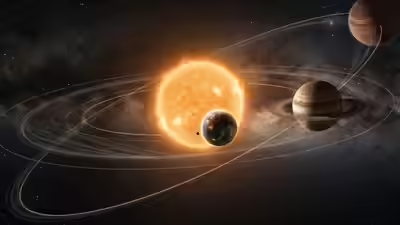
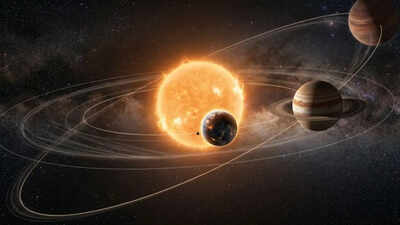
Astronomers announced they discovered the TOI-201 planetary system, which greatly expands our understanding of how solar systems form and develop. It is located 370 light-years from Earth, has three distinct objects (a super-Earth, a warm Jupiter, and a very massive brown dwarf) and contains a dynamic gravitational interaction. Unlike the solar system we inhabit, as seen with its more stable ‘pea in pod’ architecture, the planets from TOI-201 are all in misaligned orbits that are rapidly shifting orbital architecture in real-time. Researchers have determined that the extreme gravitational interactions among these three planets are continuously changing the overall structure of the TOI-201 system on human-observable timescales, and therefore, its transient observational windows for future transitory observations over the next several centuries.
Orbits will shift out of alignment in 200 years
The TOI 201 system has an extreme amount of dynamic instability, an uncommon phenomenon that present telescopes have very rarely observed. Science Advances published research revealing that there is a gravitational tug of war occurring between the outer brown dwarf and the two inner planets. This gravitational interaction is causing a large variation in the orbital angles over time. Because of this non-coplanarity of the orbits, the planets will eventually get out of our line of sight from Earth. Researchers estimate that in as little as 200 years, the inner super-Earth will no longer transit the face of its parent star, and the other planets should follow in close succession.
How the brown dwarf reshapes transit timing
According to the research published in Science Advances, three distinct types of astronomical objects make up this system: a rocky super-Earth (TOI-201 d), a gaseous ‘warm Jupiter’ giant (TOI-201 b) and a brown dwarf (TOI-201 c). The brown dwarf is the second most massive object in this system, after the central star, and has a very elliptical and highly elliptical orbit about the star that takes approximately 7.9 years to complete its full cycle. The brown dwarf is causing the ‘transit timing variations’ that are observed by TESS because the highly massive brown dwarf’s gravitational force is affecting the timing of the inner planet transit cycles. These variations are affecting the amount of time that the planets make their transits compared to each other, allowing astronomers to derive information about the overall system architecture.
How astronomers are unlocking the complex migration of distant planets
The majority of planetary systems seem to be static, i.e., they are static, with only subtle changes that don’t take place until they have been through millions/billions of years. TOI-201 is scientifically important because researchers have an opportunity to use it as a real-time laboratory to help understand how planets migrate and evolve (secular evolution) via astronomical observations and theoretical models. By combining data from NASA’s TESS with data from ground-based observatories (like the ASTEP telescope in Antarctica), scientists have been able to create a 3D map of this planetary system. This 3D map will allow scientists to investigate the mechanisms of giant planets migrating inward and the processes by which planets interact with one another, such that the resulting planetary systems do not have the same relatively orderly, coplanar architecture of our own solar system – i.e., that they evolve in a way that is quite complex.