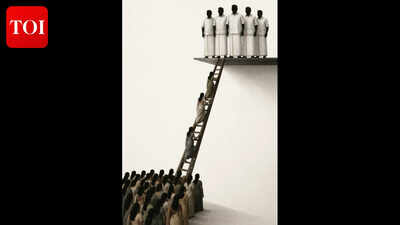
In a state where women voters outnumber men, political parties are actively wooing them with promises of monthly cash transfers, free LPG refills, support for self-help groups, and most recently, refrigerators. Yet, this electoral attention has not translated into meaningful political representation, despite the state having had a woman chief minister – J Jayalalithaa – for four terms. And the 33% reservation for women in the legislature remains a pipedream.Since 1967, when DMK first came to power, 1,609 women have contested assembly elections, and only 171 won – just 6% of the collective strength of the assemblies. DMK fielded only 105 women across 13 assembly elections, and 37 of them were elected. AIADMK has nominated 154 women since 1977, of whom 93 won. During Jayalalithaa’s first term as chief minister in 1991, 25 of the 26 women candidates it fielded were elected. She maintained two-digit tickets to women members, barring the 1996 election. In 2016, during her fourth term, she nominated 29 women candidates and 16 won.The outgoing assembly has just 12 women legislators. “Politics, like any other field, is full of men,” says DMK MP Kanimozhi Karunanidhi. “As power is involved, men do not want to share the space. They don’t mind letting women work, but don’t give them the space, positions or opportunities they deserve. That is why we need 33% reservation, as most political parties are not going to provide it on their own.”The few women who rise in politics are often from influential political families, while others struggle as cadres or lower-level functionaries. The state cabinets have also been dominated by men, women occupying one or two – at the most three – berth. S Sathiyavanimuthu, a dalit leader remained in the cabinets of C N Annadurai and M Karunanidhi till 1974; she handled portfolios like harijan welfare, information, health and agriculture over the years. Later on, women ministers were mostly assigned ‘light’ portfolios such as social welfare, Adi Dravida welfare, backward classes and handlooms.In 2006, DMK gave just 12 seats to women while campaigning on welfare promises such as free colour television sets, LPG stoves and financial aid for pregnant women. It won the polls.Five years later, both DMK and AIADMK expanded their welfare promises to include free mixers, grinders, fans, gold and financial aid for weddings, free rice through the public distribution system, increased maternity leave with cash assistance and enhanced loan support for women’s self-help groups. Yet they offered only 11 and 12 assembly seats respectively to women. Over the past six decades, not one of the 636 women who contested as independent candidates has won.While most parties do lip service, Naam Tamil Katchi has been walking the talk the past two elections, nominating women in half of the 234 seats. “Our core belief is that without women’s freedom, there can be no freedom for the land,” says NTK chief coordinator Seeman. “Giving women equal opportunity is not a matter of pride; it is their birthright.” Seeman has pledged half the seats in his “future cabinets” for women.Seeman says it was not easy finding women candidates for the 50% seats. “Most women hesitate to enter politics because of societal pressure. More women should come forward boldly,” he says. Most of NTK’s women candidates are graduates, undergraduates, or professionals.Even as demand grows for more women in leadership, Congress recently appointed just four women as district unit heads in Chennai, Salem, Ariyalur and Cuddalore, while naming 73 men to lead the remaining districts. Incidentally, veteran Congress leader A S Ponnammal representing Nilakkottai was appointed as the pro-tem Speaker twice in 1991 and 1996 to administer the oath to the newly elected members.“There is a lot of awareness about women’s rights after Amma (Jayalalithaa) assumed charge. To sustain winnability, political parties should give due place and recognition to women,” says former AIADMK minister C Ve Shanmugam.BJP says it has implemented 33% reservation for women in party posts, helping normalise women’s leadership within the organisation. But in elections, only two of BJP’s 46 women candidates since 1991 have won. Electoral politics is shaped by community equations and resources, says BJP national women’s wing president Vanathi Srinivasan, and this pushes parties to choose women seen as winnable or those from illustrious families. “Women who are new to politics often struggle to build an identity, gain acceptance from cadres and colleagues, and secure recognition from party leadership,” says Vanathi.Women also hesitate to enter politics fearing character assassination, she says, adding that the demands of modern electioneering are another reason. “It is difficult for a woman to mobilize ₹10 crore on her own unless she comes from a powerful family with a strong support system.”BJP’s women brigade in the ensuing assembly election includes Vanathi (Coimbatore North), former party state president Tamilisai Soundararajan (Mylapore) and S Vijayadharani (Vilavancode).Taking centre stage——————————————-1967-71, 1971-76 S Sathiyavanimuthu (Harijan welfare, Information, Health and Agriculture)1977-80 Subbulakshmi Jagadeesan (Handloom)P T Saraswathy (Social welfare)1980-84, 1985-88 Gomathi Srinivasan (Social welfare)1985-88 Vijayalakshmi Palanisamy (Khadi and handloom)1989-91 Subbulakshmi Jagadeesan (Social welfare and rural industries)1991-96 R Indira Kumari (Social welfare)1996-2001 S P Sargunapandian (Social welfare)S Jenifer Chandran (Fisheries) 2001-2006 R Saroja (Backward classes, milk and dairy development and tourism)B Valarmathi (Social welfare)Valarmathi Jebaraj (Backward classes)V Vijayalakshmi Palanisamy (Social welfare)2006-2011 Poongotha Aladi Aruna (Social welfare and information technology)P Geetha Jeevan (Animal husbandry)A Tamilarasi (Adi Dravida welfare)2011-2016 S Gokula Indira (Commercial taxes, tourism and handloom and textiles)Selvi Ramajayam (Social welfare)B Valarmathi (Social welfare and animal husbandry)2016-2021 V Saroja (Social welfare)Nilofer Kafeel (Labour)V M Rajalakshmi (Adi Dravida welfare)S Valarmathi (Backward classes)2021-2026 P Geetha Jeevan (Social welfare and women empowerment)N Kayalvizhi Selvaraj (Adi Dravida welfare and Human resources management)Assemblies Contested/Elected DMK AIADMK1967-1971 16 4 3 (3) –1971-1976 15 5 4 (3) –1977-1980 24 2 3 4 (2)1980-1984 16 5 3 2 (2)1985-1988 61 8 8 6 (5)1989-1991 78 10 7 (5) 8 (2)*1991-1996 102 30 7 26 (25)1996-2001 156 11 9 (8) 72001-2006 109 24 16 20 (19)2006-2011 156 22 12 (7) 23 (7)2011-2016 143 17 11 (1) 12 (12)2016-2021 320 21 18 (4) 29 (16)2021-2026 413 12 11 (6) 17 (3)(winners in brackets)*(Janaki and Jayalalithaa factions)Jothi Venkatachellum was sworn in as minister for prohibition and women’s welfare in C Rajagopalachari’s cabinet in 1953, becoming the first woman minister in the Madras Legislative Assembly. She was later elected from the Egmore and Srirangam constituencies in 1962 and 1971. Between 1962 and 1967, she served in the cabinets of K Kamaraj and M Bhaktavatsalam, handling the public health portfolio. She later became the governor of Kerala and, in August 1980, unveiled portraits of national leaders Periyar E V Ramasamy, B R Ambedkar, Quaid-e-Millat Muhammad Ismail, and Pasumpon Muthuramalingam in the Tamil Nadu Legislative Assembly.