



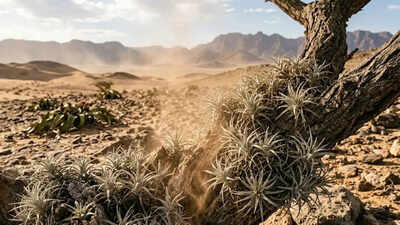
In terms of plant nutrition, the root system is traditionally viewed as the main access point to nutrients. Ground-breaking research, however, has demonstrated an additional survival strategy with elegant sophistication. Plants in some of the world’s highly nutrient-poor environments have developed a strategy for ‘eating’ minerals found in aerial dust and, subsequently, avoiding exhausted soil completely. They use unique chemical exudates to solubilise mineral particles in the air via their foliage in order to extract essential elements, such as iron and phosphorus, from the atmosphere.This finding fundamentally alters our understanding of nutrient cycling on a global scale and illustrates an exceptional form of evolutionary adaptation. Understanding this canopy-mediated method of obtaining nutrition will be essential for predicting future resilience to environmental changes affecting global dust patterns in the most vulnerable and biodiversity-rich ecosystems on the planet.
How plants use leaves to ‘digest’ nutrients from dust, study reveals
Studies show that plants growing in dry and low-phosphorus soils (e.g., the Mediterranean area and the Amazon) utilise their leaves as living digestive surfaces. While most foliar surfaces are primarily dedicated to gas exchange and respiration, this specialised foliage secretes organic acids. However, this type of foliage secretes organic acids that acidify their leaf surfaces, effectively chelating and dissolving mineral cations from dust particles deposited on the phyllosphere. A recent study published in New Phytologist offers compelling evidence: shrubs from the Judean Hills exhibited significantly elevated levels of iron and other trace metals in their shoots compared to their roots. This finding emerged after the plants were subjected to dust exposure.
The role of aerial nutrients in ancient ecosystems
The magnitude of this effect demonstrates the significance of atmospheric dust as a source of primary nutrients for some of the planet’s most critical forest systems. For example, in the Amazon Basin, where soils are typically quite old and depleted of phosphorus, the introduction of Saharan dust into this area is an important lifeline that supports productive rainforests. Studies conducted under NASA’s guidance and reported in several geophysical research journals show that millions of tons of Saharan dust are deposited on the Atlantic Ocean each year. Phosphorus uptake through leaves constitutes a large part of the phosphorus supply for these areas, where ground phosphates are occluded phosphorus.
How atmospheric minerals alter ecosystem forecasting
Most botanical and climate models generally do not include the canopy as a source of mineralisation, assuming that all minerals will first pass through the soil. Nonetheless, as desertification progresses and as the incidence of global dust storms increases, the capacity of vegetation to obtain atmospheric minerals could alter our expectations with regard to the annual carbon uptake rate of forests and their associated growth patterns. Organisations such as the Advancing Earth and Space Sciences (AGU) have demonstrated that atmospheric nutrient deposits are an important factor in maintaining ecosystem health for both inland and tropical areas of the Western United States. Incorporating the uptake of minerals through leaf surfaces into climate modelling will result in lower-cost and more accurate environmental modelling results.