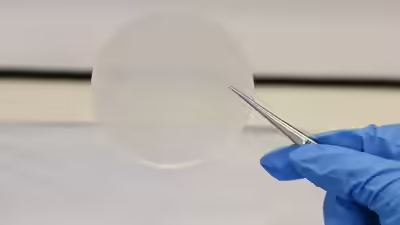
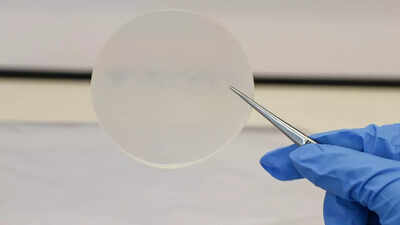
Today, the world is fighting against pollution. Many kinds of NGOs in the whole world are working tirelessly to minimise the problem of pollution. Data from the Global Environmental Organisation Index (2024), highlighted by the Varanasi Diocese Community Network, tells that over 120,000+ officially registered environmental NGOs are worldwide. Plastic pollution is one of the major issues currently that is rapidly growing, and to tackle this, researchers from Flinders University in South Australia have taken a step ahead to solve the problem. They have worked on creating a material (plastic) that can be decomposed under normal soil conditions.
What is the science behind plastic made from milk
This research has refined this process to create a biodegradable film that could replace traditional single-use plastic. The invention of this plastic relies on a field of science which is called polymeric nanocomposites. Researchers at Flinders University collaborated with experts from Colombia and developed the material by extracting calcium caseinate (CAS) powder containing 92.1% protein, a primary protein found in milk.To transform the dairy protein into a packaging material, the team combined modified starch and bentonite nanoclay that acts as a skeleton of plastic. This helps the film to making strong enough to handle weight and extra pressure. They used glycerol and polyvinyl alcohol, which maintain the material in remaining flexible and help to not break when it dries.
The 13-week decomposition process
The time frame of the decomposition process of milk-based film to return to nature can be surprising for anyone. But there is a breakdown process behind this biodegradable film, unlike the traditional plastic that persists for centuries, this invented film is different, as it vanishes in 13-weeks. The science behind this is simple. The primary ingredients of this film are calcium caseinate (milk protein) and starch, which act as the carbon and energy source for the soil microorganisms. These organisms consume this material and break the molecular bonds that hold the film together.
The breakdown timeline
- Week 1-4: The film begins to lose its smoothness during this period as it absorbs the moisture from the soil, which allows the organisms to penetrate the area.
- Week 5-8: During this period, the structural integrity weakens. The bentonite nanoclay begins to get separated as the protein matrix disappears.
- Week 9-13: The plastic goes completely in fragmentation process. And by the end of 13 weeks, laboratory tests showed that the plastic had completely vanished. Leaving behind no toxic or harmful microplastics.
The future of bioplastic collaboration
Researchers from Flinders University in Australia teamed up with experts from the Universidad de Bogotá Jorge Tadeo Lozano in Colombia to tackle one of the biggest challenges in bioplastics. The team has developed a material that is not only cheap but also strong enough to be processed by machinery. The fact is, as the world looks for easy-to-use products like these, the ecological price of traditional petroleum-based plastic is no longer sustainable. This is not only good for the Earth, but it is also good for business, according to the research team. They claim that by using cheap, natural materials, industries can quickly adopt these kinds of materials, making a plastic-free future a reality.