Deep beneath our feet, the planet plays a game of pull and smash with tectonic plates that influence everything from coastlines to climates, all on timescales that make human life feel like a blink.It is these tectonic shifts that give shape and height to the mountains across the globe.This time, researchers’ eyes are on Africa slowly tearing itself apart along a massive scar, only for those pieces to drift, collide, and pile up into peaks that could dwarf today’s giants. Scientists have shown that a growing crack in Africa’s outer layer marks the start of a massive land collision that could create mountains even taller than the Himalayas. This slow process is already happening and will redefine coastlines and change weather patterns worldwide.
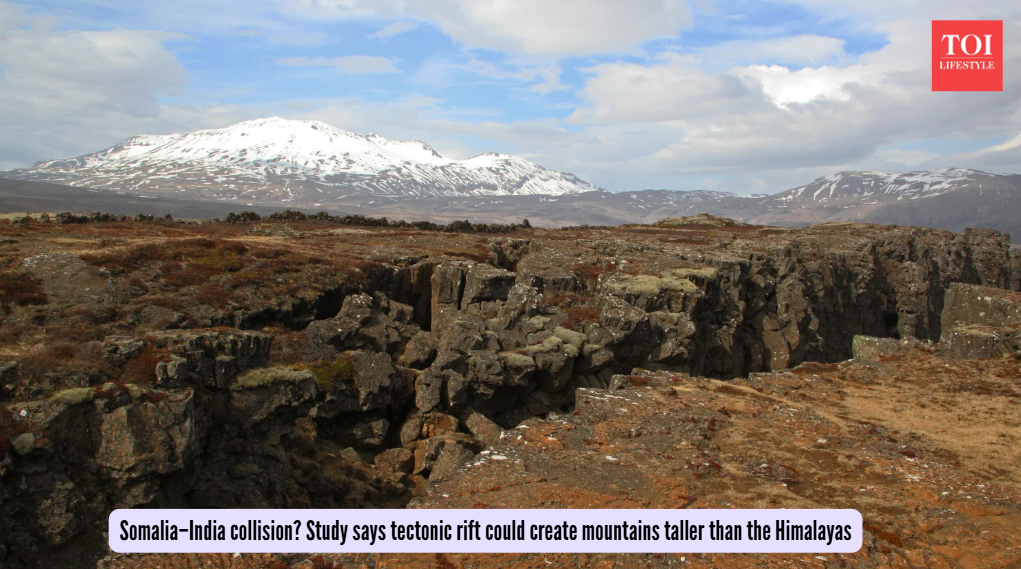
Somalia–India collision? Study says tectonic rift could create mountains taller than the Himalayas (representative Image)
African tectonic rift to create mountains taller than the Himalayas?
East Africa’s Great Rift Valley shows where the continent is slowly pulling apart, driven by heat rising from deep mantle convection that pushes the tectonic plates in opposite directions. Researchers like Douwe J. J. van Hinsbergen from Utrecht University track this 25-million-year-old rift as it develops into a true ocean basin, eventually guiding landmasses toward a major collision. “The spreading zone marks the first irreversible step in a sequence that shifts ocean basins and steers drifting landmasses toward impact,” states the Earth.com report.
New oceans and new landmasses?
Research says as crust thins and sinks, seawater will rush into the rift, forming new seafloor from cooling magma and sparking underwater quakes. Somalia could edge a fresh ocean, shifting trade and fisheries. Eventually, subduction zones—where plates dive under each other—pull everything back, melting rock into volcanoes and yanking slabs that fuel global earthquakes.
Earth’s supercontinent cycle is in motion
This process aligns with Earth’s supercontinent cycle, where continents merge into large landmasses before breaking apart again over hundreds of millions of years. Somalia and Madagascar may drift as tectonic plates shift, while trenches in the Indian Ocean gradually close the distance to India. Subduction pulls the seafloor downward, compressing islands and folding coastlines into mountain ranges, says the research.
Where will the taller mountains be built?
Like India’s crash into Eurasia 40-50 million years ago that birthed the Himalayas, a future Somalia-India pile-up would buckle thick crust skyward. Rocks thrust over each other, folding into belts, though erosion cycles counter the uplift.As there will be the development of newer landscapes, new peaks could reroute winds, trap rains, and slice habitats into pockets, changing monsoon patterns and biodiversity much like the Himalayas did for Asia.
Limitations of the models
Predicting tectonic shifts over such vast timescales, requires scientists to choose an initial setup and a specific set of assumptions.In their research, van Hinsbergen and Schouten called the work a thought experiment, a structured setting based on today’s geography. However, even with reliable physics, models cannot precisely forecast peak heights, as factors like rainfall and rock durability influence erosion rates.The East African rift represents the initial stage of this process, with future developments depending upon the locations of emerging trenches.