


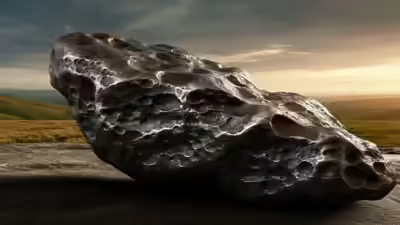
The world’s largest meteorite never made it to a museum. Image credit – Wikimedia
Meteorites are usually shown as small rocks housed behind glass panes in a museum display. Yet, some of the biggest meteorites ever unearthed resemble trucks more than they do stones. Such colossal chunks of iron and rock fell to the surface of the Earth many thousands or millions of years ago.This list of meteorites highlights the most massive individually recovered specimens, as opposed to meteorite showers or fields. The majority of the largest surviving samples of extraterrestrial objects are iron meteorites since they have greater chances of survival while entering Earth’s atmosphere and after being left on its surface for many years.The biggest one, called Hoba, was simply too large to ever move from its place of discovery.Hoba is the largest meteorite ever discoveredNamibian Hoba is considered to be the largest ever discovered meteorite. It weighs around 60 tons and consists mainly of iron and nickel. The meteorite was found in 1920 in the farm land near Grootfontein.According to Guinness World Records, the meteorite still remains in the same place where it was initially found. Today, the Hoba meteorite is a protected tourist attraction. Scientists say that Hoba did very little damage upon entering Earth since it most likely entered our atmosphere at an acute angle and considerably slowed down prior to impact.El Chaco is the biggest meteorite in Argentina’s Campo del Cielo FieldWith its estimated weight of 37 tons, El Chaco is the biggest fragment located in the renowned Campo del Cielo meteorite field, Argentina. Scientists believe that the massive object disintegrated in space thousands of years ago before crashing on Earth. While the area is full of meteorite fragments, El Chaco stands as the largest among them. According to Britannica, the Campo del Cielo translates to “Field of the Sky,” which is connected to myths of the indigenous population and modern science.

These giant meteorites actually hit Earth. Image credit – Wikimedia
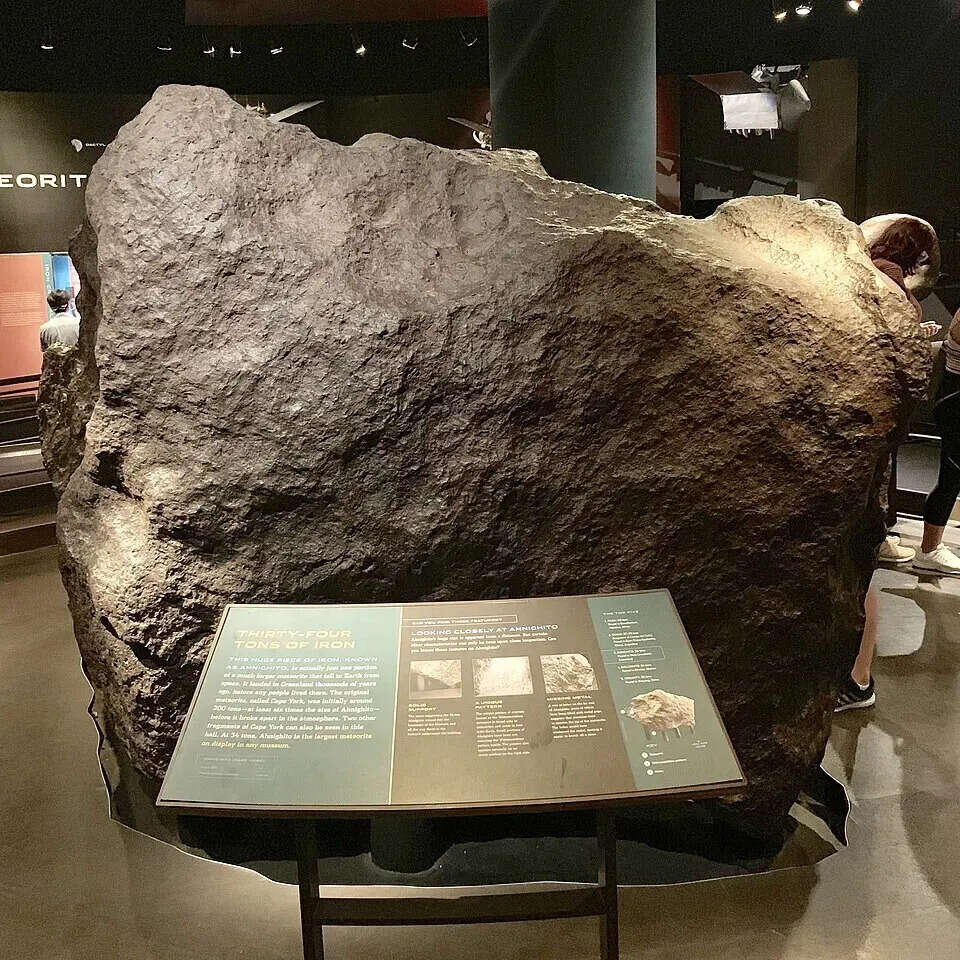
Ahnighito made its way to a museumAhnighito, nicknamed “The Tent” by locals, weighs 31 tons. It originates from Greenland but is now exhibited at the American Museum of Natural History in New York City. Its transportation alone was an engineering marvel during the last years of the 19th century.Explorer Robert Peary facilitated its shipping via sea and train from the Arctic Circle to New York City, where it has since been one of the museum’s most famous attractions. According to the American Museum of Natural History, one can still stand under the giant iron mass.Armanty is another proof that large iron meteorites endureThe Armanty Meteorite was discovered in China’s Xinjiang region and weighs around 28 tons. It has been classified as one of the largest meteorites in the world during the twentieth century.This particular meteorite is similar to a few other entries on the list since it is made of iron. Experts state that iron-bearing meteorites are more resilient to the process of travelling through the Earth’s atmosphere. According to various studies, iron meteorites consist of iron-nickel alloys formed in the asteroid’s core.The Bacubirito is the final entry on our listThe Bacubirito meteorite, located in Sinaloa, Mexico, weighs nearly 22 tons. Despite not being as well-known globally compared to Hoba and Ahnighito, it is still one of the biggest meteorites discovered.Due to its exceptional dimensions and unusual structure, scientists are continuing their research about the object to uncover more information about early times of the solar system.Reasons behind predominance of iron meteorites among big specimensIn most cases, meteorites do not make it to the surface due to burning up during their passage through the Earth’s atmosphere. However, iron meteorites are more likely to withstand such effects due to their durability.Scientists claim that iron meteorites are able to withstand atmospheric re-entry more successfully than stone meteorites. Thus, many of the biggest specimens consist predominantly of iron.Unique detail of Hoba’s historyWhile the vast majority of meteorites are usually either kept in museums or sliced for further examination, Hoba does not have any connection with those facilities. Despite its great significance, it has not been moved from its location since transportation turned out to be extremely difficult.Visitors are not looking at a museum replica or a polished fragment. They are witnessing the exact object that fell from space long ago.