


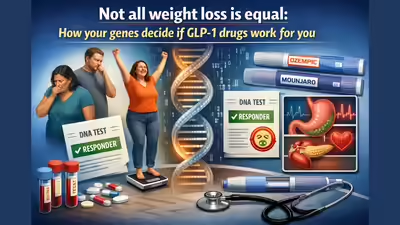
You’ve probably seen them around. Someone you know lost a remarkable amount of weight on Ozempic or Mounjaro. Another person tried the same drug and barely saw results. And another got so nauseous they quit altogether. These wildly different experiences aren’t random and according to a massive new study from Nature, your genes are partly why.The new research, analyzed nearly 28,000 people who’d taken GLP-1 drugs and matched their outcomes against their DNA. What they found is straightforward: your genetic makeup can predict how much weight you’ll lose on these medications and how likely you are to get knocked sideways by nausea. That’s not some academic footnote. For millions of Americans turning to these drugs, it could eventually change how doctors prescribe them.
Why GLP-1 suddenly became a thing
Let’s back up. GLP-1 receptor agonists like semaglutide (Ozempic, Wegovy) and tirzepatide (Mounjaro, Zepbound) have become some of the most prescribed drugs in America. One in eight Americans has used them. Why? Because they actually work. The drugs mimic a hormone your gut produces after you eat, telling your brain you’re full, slowing digestion, and making you eat less. Before these came along, treating obesity felt like pushing a boulder uphill. Now there’s finally a tool that produces real weight loss for most people.But here’s where the genes come in.
The problem with one-size-fits-all medicine
In clinical trials, the average person loses about 10% of their body weight on semaglutide. Sounds good, right? Except that average hides a messy reality. Some people shed a quarter of their body weight. Others lose less than 5%, or even gain weight. Side effects vary just as wildly. Nausea and vomiting hit some people hard; others barely notice them.That’s where the new research gets useful. The team identified a specific genetic variant — a single letter change in your DNA on the GLP1R gene — that predicts how much weight you’ll lose. People carrying certain versions of this variant can expect about 0.76 kilograms more weight loss per copy they inherit. That might sound small until you’re the person left wondering why the drug isn’t working when everyone else lost 30 pounds.The researchers explained this with their model: genes account for about a quarter of the variation in how well these drugs work. The rest depends on factors like your sex, how long you’ve been on the drug, your dose. Women lose more weight than men. Europeans tend to see better results than other ancestries, and yes, that’s exactly the kind of disparity that keeps researchers up at night.
The nausea gene (sort of)
The side effects story is more complicated. The team found that different genetic variants predict nausea and vomiting and the picture changes depending on which drug you’re taking.For tirzepatide specifically, a variant in the GIPR gene (which is what makes tirzepatide a dual-action drug) predicts nausea risk. The researchers found that people homozygous for the risk alleles at both the GLP1R and GIPR sites have a “14.8-fold increased odds” of experiencing moderate to severe vomiting on tirzepatide.
What’s next?
The real promise here is precision medicine. Imagine this: before you start a GLP-1 drug, your doctor could run a genetic test and give you realistic expectations. Maybe they will know you’re likely to have intense side effects and adjust your dose trajectory. Or they will recognize you’re less likely to respond to semaglutide and start you on tirzepatide instead. That’s not science fiction. It’s the direction this research is pointing.For now, we’re still in the early stages. But genes that predict response are out there, identified and waiting. The question is whether medicine will use them.