


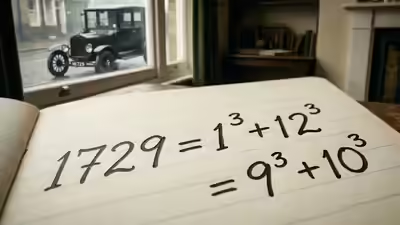
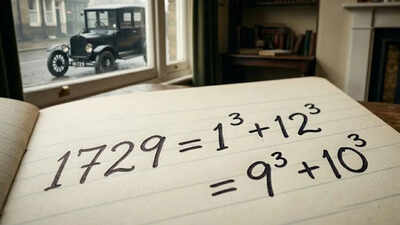
The story of 1729 chronicles the remarkable relationship between British mathematician GH Hardy and Indian mathematical savant Srinivasa Ramanujan, who taught himself mathematics. One day in 1918, Hardy visited Ramanujan, who was at a nursing home. He mentioned that the number on his taxi, 1729, seemed singularly devoid of interest. As noted in a report in Vedic Math School, Ramanujan instantly corrected him by saying it was actually extraordinary. It is the smallest number that can be written as the sum of two positive cubes in two distinct ways. Known as a taxicab number, this fact highlights Ramanujan’s incredible understanding of number theory and modular forms. In a contemporary context, 1729 isn’t just a historical curiosity; it’s a doorway into complex mathematical ideas like elliptic curves and K3 surfaces. The number continues to inspire cutting-edge research in both theoretical physics and mathematics today.
From a taxi cab to string theory: Why 1729 became mathematically legendary
The number 1729 is distinguished due to its unique mathematical property as the smallest ‘Taxicab Number,’ represented as Ta(2), as noted in a report of Bannari Amman Institute of Technology. This feature highlights Ramanujan’s exceptional understanding of integers. Historical records show that he was investigating ‘Euler’s equation’ a^3 + b^3 = c^3 + d^3 well before his famous meeting with Hardy at the hospital. His notebooks reveal multiple solutions for this Diophantine equation, illustrating that their encounter wasn’t a serendipitous accident. Instead, it was a testament to years of dedicated and sometimes unconventional research into the additive properties of numbers.
Ramanujan’s role in modern string theory
People often share the story of 1729 as a charming mathematical anecdote. However, scientific journals point out that Ramanujan’s work on numbers like 1729 had a deep connection to elliptic curve theory. Research featured in the Notices of the American Mathematical Society explains that Ramanujan’s observations on these numbers gave early insights into what are now called ‘K3 surfaces.’ These surfaces play a crucial role in modern string theory and complex geometry. Moreover, his ‘Lost Notebook’ includes identities that still puzzle mathematicians more than a hundred years later.
Ramanujan’s genius defined India’s mathematical identity
Ramanujan’s remarkable genius, highlighted by the famous 1729 story, had such a profound impact that the Government of India decided to honour his birthday, December 22nd, as National Mathematics Day. An initiative designed to foster curiosity and encourage the study of mathematics. In academic settings, places like the Indian Institute of Science (IISc) and the Tata Institute of Fundamental Research (TIFR) often share the tale of 1729. It serves as a bridge from basic arithmetic to more advanced concepts in their teaching materials.