


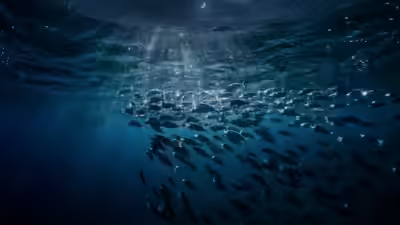
Every night, the ocean does one of the biggest magic tricks on Earth, and most of us have never heard of it.Imagine it’s 2 AM somewhere above the Pacific Ocean. On the surface, it looks dead calm, maybe a little spooky, but 600 feet below you, something quite wild is going on. Billions of sea creatures are coming towards you in the dark. Fish, krill, jellyfish, you name it. By dawn, they will all sink silently back to the deep. Tomorrow night? They’re going to do it again.This is not science fiction. It’s called diel vertical migration, and it’s one of the biggest animal migrations on the planet. Every single day.The sonar glitch that changed the gameDuring World War II, Navy sonar operators kept picking up signs of what seemed like a seafloor, a strange band that would rise at night and sink during the day. All were confused. Did the gear break? Some odd underwater geography? No. It was life. Massive, organised, earth-wide.Later, NOAA confirmed that sonar crews were seeing a thick layer of marine animals, which is now known as the deep scattering layer, or DSL, reflecting sound waves back up like a living mirror. The false seafloor was not stone. It was trillions of creatures in sync with the sun. One of the greatest discoveries in ocean science started with a glitch on a wartime radar screen.What makes them do that? Imagine the sea surface as something akin to a brightly lit diner, lots of food, but lots of predators that can see you. The deep ocean is like living in your apartment with the lights off. Safe, no food. What do you do then? You eat out after dark, when you’re less likely to be seen, and you’re home before sun-up. That’s what these animals figured out, only they’ve been doing it for millions of years.The daily commute starts in the ocean’s twilight zone, at depths of about 650 to 3,280 feet. It was dark enough to hide in during the day, but close enough to the surface to make a nightly trip worthwhile. Light is the schedule, literally. When it dies, the migration begins. When it comes back, everybody goes back down.

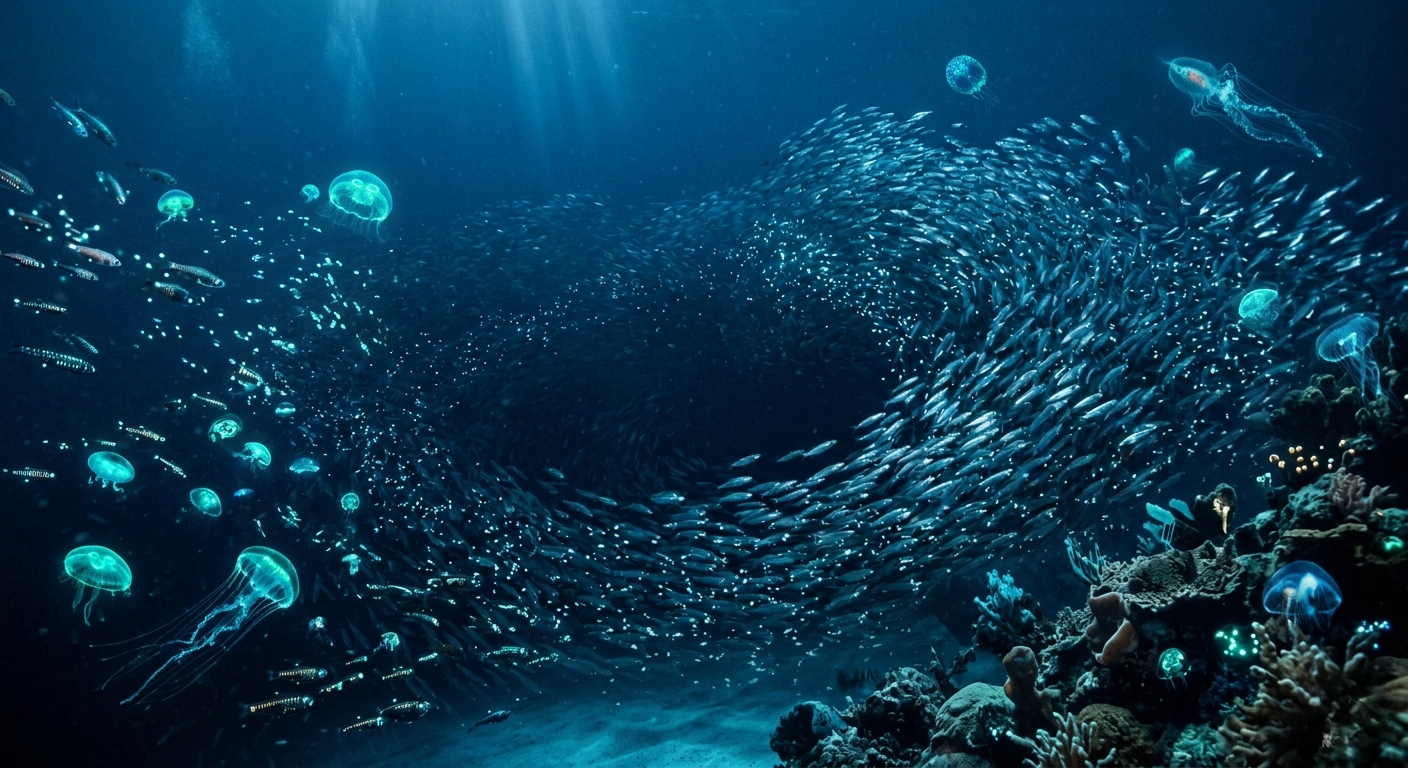
What looks like empty dark water is actually one of the most crowded places on Earth after sunset.Image Credits: Google Gemini
This isn’t just one ocean, it’s all of themThe scale of this movement is even more staggering. A study published in Scientific Reports has found daytime scattering layers in every ocean basin on Earth. This is not some regional oddity offshore California or the North Atlantic. There is a synchronised global phenomenon occurring every night in waters that make up more than 70 per cent of our planet.We are not talking about a species. The deep scattering layer is an entire community of fish, krill, shrimp and squid, all making different tradeoffs between food and safety, but all moving roughly in the same direction, at roughly the same time. It was more like a rush hour than a migration, but ocean-wide and totally invisible to anyone standing on a boat.Beyond the spectacleThis migration is doing a critically important service for the planet. It’s moving carbon around.When these animals feed on the surface, they are feeding on organic matter. As they sink back down, they carry that material, and the carbon in it, down into the deep ocean. According to a 2023 review published in iScience, this is part of the ocean’s biological carbon pump, a natural system that effectively extracts carbon from the surface and deposits it in the deep sea.In other words, these creatures aren’t just feeding themselves; they are quietly helping regulate Earth’s carbon cycle every single night.Why do we continue to research thisDespite all the knowledge to date, the deep scattering layer is still not fully understood. Much of it is underwater, too dark and too deep to be seen easily. For scientists, acoustic tools, essentially high-tech sonar, are crucial for mapping where the layer is, how dense it is and how it moves over time. NOAA’s ongoing twilight zone expeditions continue to reveal new details about the animals that live there and their role in ocean systems.It’s a reminder that the ocean, covering most of our planet, is still a mystery in many ways. Next time you’re at the beach, or looking out at the ocean, think about how under that calm surface the world’s biggest commute is either just beginning or just ending, and it’s been happening every night, way before any of us were around to see it.