


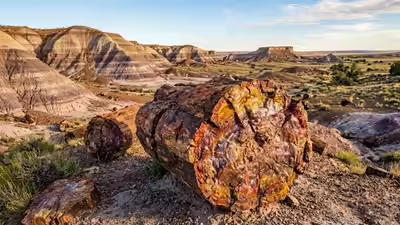
In Arizona’s dry, rugged badlands, you can find something far more valuable than any glittering gold: the Petrified Forest. These aren’t just old trees; they’re stone ones, dating back around 225 million years to the Late Triassic period. It happened because of a special chemical change, where volcanic ash and groundwater, full of silica, gradually turned the living wood into quartz and jasper. Unlike gold, which is a chemically inert mineral, this petrified wood acts like a real biological time capsule. It holds onto the tiny cell structures of plants that are long gone, giving us a peek into what Earth’s climate was like way back then. For scientists, these logs aren’t just interesting; they’re incredibly important pieces of information, showing how ecosystems managed to adapt to huge environmental changes long before dinosaurs really took over the planet.
How Arizona’s petrified wood helps scientists map Earth’s ancient timeline
When researchers look at the Petrified Forest, they see its true worth in how it helps them map out geological time. Gold might just sit there, unchanging, but these logs are different. They’re full of tiny volcanic crystals, which means scientists can use them for incredibly accurate radio-isotopic dating. It’s like these crystals act as tiny Zircon crystals for U-Pb dating, letting us piece together a detailed timeline of the Triassic period and better understand how early life started to evolve, as noted in a study by the National Park Service. Every single log is, in a way, like an old computer’s hard drive, packed with data from prehistory, giving clues about the air and how wet the world was over two hundred million years ago.
How ancient rivers turned forests into gems
According to a study published by the US Geological Survey, the way wood turns into stone is a pretty involved process, often called permineralization. Imagine those old trees, millions of years ago, tumbling into ancient river systems. They’d be quickly covered by mud and volcanic ash, which cut off all the oxygen and created an anaerobic environment. Then, over thousands of years, groundwater, heavy with silica, slowly made its way into the wood’s cells. As the original organic material gradually broke down, minerals like quartz, manganese, and iron oxide took its place, painting the wood with those vibrant, rainbow colours we see today. It’s such an intricate process, in fact, that even now, scientists can examine a piece under a microscope and still make out the individual tree rings and cell walls.
Using ‘stone wood’ to trace the history of life
The Arizona Petrified Forest holds an astonishing amount of petrified wood, more than anywhere else on the planet. Yet, its true scientific value reaches far beyond those ancient trees. This place also serves as a vast burial ground for massive creatures from the Triassic period, a time when phytosaurs, those crocodile-like reptiles, and early dinosaurs roamed the land. When scientists study the fossilised wood and the remains of these animals together, they can piece together what a complete ecosystem looked like millions of years ago. This careful reconstruction helps researchers understand how plants and animals grew and changed alongside each other, offering a level of insight that makes the forest almost like an open-air laboratory for grasping biotic turnover and climate oscillation.
Why displaced fossils lose their value
Even with its federal protection, the park constantly struggles against people taking pieces of wood. Each time a piece is removed, it means a crucial part of a scientific puzzle vanishes. Interestingly, the park has a collection they call the ‘Conscience Pile,’ made up of wood returned by visitors who, for whatever reason, later come to believe the stones bring bad luck. From a researcher’s standpoint, once a piece has been moved from its original spot, its stratigraphic and spatial context and geological layer are gone. This makes it essentially useless for any precise scientific study.