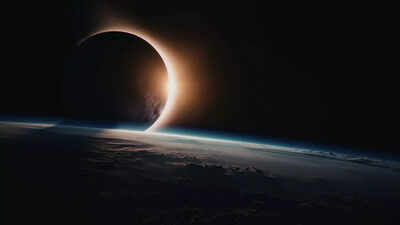
When people on Earth watch a lunar eclipse, they see the Moon slowly move into Earth’s shadow and turn reddish for a short time. It is a familiar sight for skywatchers. But have you ever wondered how a lunar eclipse looks from the Moon itself?Recently, NASA shared a striking visual on its official Solar System account on X that answers this question. The post shows how a lunar eclipse appears from the Moon’s surface, as captured by NASA’s Lunar Reconnaissance Orbiter. Instead of seeing the Moon darken, the spacecraft records Earth blocking the Sun. This rare perspective helps people understand the science of eclipses in a clearer way. The visual has drawn attention because it shows a familiar event from a completely different angle.
What happens during a lunar eclipse
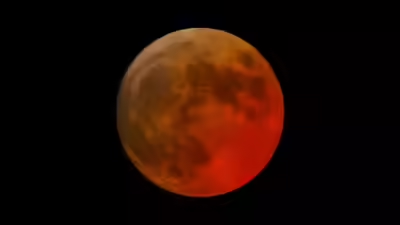
When the Sun, Earth, and Moon are all in a straight line, with Earth in the middle, a lunar eclipse happens. Because of this, the Moon is in Earth’s shadow. When everything is lined up perfectly, the Moon goes into the darkest part of Earth’s shadow, which is called the umbra. The Moon often looks red during this phase. This red colour happens because sunlight passes through Earth’s atmosphere and bends toward the Moon. The atmosphere scatters blue light and allows more red light to reach the lunar surface.From Earth, this looks like the Moon is slowly dimming and then glowing in a deep copper shade.
NASA reveals how a lunar eclipse looks from the Moon
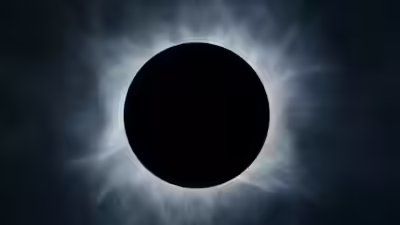
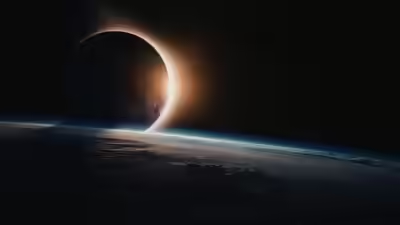
From the Moon, the experience is very different. According to NASA’s Solar System post on X, the Lunar Reconnaissance Orbiter captured what happens on the lunar surface during a lunar eclipse. Instead of the Moon entering darkness, the spacecraft observed Earth moving in front of the Sun. In simple terms, astronauts standing on the Moon would see a solar eclipse caused by Earth.In this view, Earth appears as a dark circle blocking the bright Sun. Around Earth’s edge, a faint reddish ring can be seen. This glow is created by sunlight passing through Earth’s atmosphere. The same atmospheric filtering that makes the Moon look red from Earth creates a glowing ring around Earth when seen from the Moon.
NASA’s Lunar Reconnaissance Orbiter and the eclipse video
The images and video were recorded by NASA’s Lunar Reconnaissance Orbiter, often called LRO. Since 2009, the spacecraft has been going around the Moon. Its main job is to map the surface of the moon and learn more about its environment.LRO is in a special place to record how Earth blocks sunlight during a lunar eclipse. NASA’s most recent video shows how the moon’s surface gets darker as Earth’s shadow moves across it. The footage gives scientists valuable data about how light and shadow behave in space.According to NASA’s post, this perspective helps people understand that eclipses are simply a matter of alignment and shadows.
Why the Moon turns red during a total lunar eclipse
The Moon doesn’t completely disappear during a total lunar eclipse. It doesn’t turn blue or green; instead, it turns red or orange. This happens because the Earth’s atmosphere bends sunlight so that it goes to the Moon. The atmosphere lets longer red wavelengths through and blocks shorter blue wavelengths.This filtered light makes a reddish ring around Earth when seen from the Moon’s surface. The same light that comes from Earth makes the Moon look red. This is why total lunar eclipses are sometimes called blood moons.The colour intensity can vary depending on dust, clouds, and particles in Earth’s atmosphere at the time of the eclipse.
Why this rare Moon perspective matters
Seeing a lunar eclipse from the Moon helps explain a simple but powerful concept. There is nothing strange about eclipses. The alignment of celestial bodies and the movement of shadows cause them. It looks like the Moon is changing when you look at it from Earth. From the Moon, it looks like the Sun is behind the Earth.NASA’s visual demonstration makes it easier to understand how the Moon, Earth, and Sun interact in space. It also shows how scientists can see familiar things from new angles with spacecraft like the Lunar Reconnaissance Orbiter.People who watch the sky can picture what it would be like to see a lunar eclipse from the Moon’s surface. Instead of seeing a dark Moon, they would see Earth standing between the Sun and the lunar horizon, with a faint ring of light around it.