


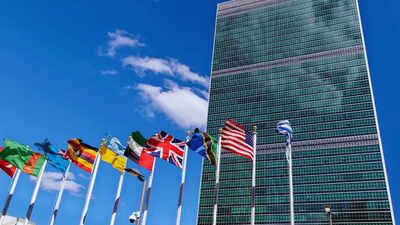
File photo: UN Headquarters in New York City
UNITED NATIONS: Vanuatu will renew its climate justice fight at the United Nations General Assembly with a draft resolution that was watered down after pushback from countries including oil-producing nations, according to documents seen by AFP.The Pacific island nation at the forefront of the quest to get financial support for countries suffering climate loss “revised” its text and set aside a proposal for a global “register” recording climate change damage after facing backlash.In 2024, Vanuatu spearheaded the General Assembly’s request for an advisory opinion from the International Court of Justice on the responsibility of states to fulfill their climate commitments.The world’s top court last year ruled that states were obliged to tackle climate change under international law, and failing to do so would pave the way to reparations for vulnerable countries.The island nation proposed a new draft resolution at the start of this year to implement the ICJ ruling, which is non-binding but can be drawn on by courts around the world.With a vote expected around May, Vanuatu Special Envoy for Climate Justice Lee-Anne Sackett told AFP that adopting the text was important for “protecting the authority of the court’s findings” and “operationalizing” the advisory opinion.“Even if it has been revised to try to build broad support,” the resolution can “strengthen climate action,” said the envoy.An initial draft seen by AFP proposed the creation of an “International Register of Damage” to compile evidence of “damage, loss or injury attributable to climate change.”But this section was removed after facing backlash from the United States, China, the European Union, Japan and multiple oil-producing nations that argued it went beyond the opinion handed down by the ICJ, diplomatic sources told AFP.“Perhaps it was too soon in the current geopolitical context where climate ambition is being deprioritized,” said Sackett.
‘On our way’ to catastrophe
“It will take a lot longer, which is difficult to accept, because we are already on our way to climate catastrophe, and every year does matter for us,” said the envoy from Vanuatu, which like other islands is threatened by rising sea levels accelerated by global warming.“But we are still moving in the right direction,” Sackett insisted.According to documents seen by AFP, one group of majorly oil-rich or fossil fuel reliant countries including Saudi Arabia, China, India, Venezuela, Iran, Kuwait and Qatar slammed initial draft as crossing “multiple red lines.”Rejecting scientific evidence that links certain extreme weather events to climate change, the countries said the “shift” in approach could “destroy the good faith and the cooperation” put in place by the 2015 Paris Agreement to limit warming to 1.5C.The Paris accord signatories managed, with great difficulty, to establish a “loss and damage” compensation fund in 2023, but the mechanism is still in its infancy. Some countries including the United States have rolled on key climate obligations in recent years.“We know that there has been particular concern about compensation or liability in relation to loss and damage,” Bryce Rudyk, legal advisor to the Alliance of Small Island States (AOSIS), told AFP.Countries opposed to the register see it as a “step along the road to reparation,” said Rudyk.Myrto Tilianaki, from Human Rights Watch, regretted the “concessions” but praised “Vanuatu’s courage.”“Despite this diplomatic pressure,” the country “is demonstrating the political leadership that we really need on the issue of climate justice,” Tilianaki told AFP.Some countries are also pushing to remove a commitment, already made by the signatories to the Paris Agreement, to “transition away” from the use of fossil fuels, according to documents reviewed by AFP.“The reference to fossil fuels is critical” for the bloc of small island nations, said Rudyk, as discussions on the draft continue.Whether at the COP climate summits or elsewhere, “every single one of these negotiations on fossil fuels has been difficult,” said Rudyk.“This one is no different,” he said, adding that the island nations leading the charge would continue to “push for it.”