


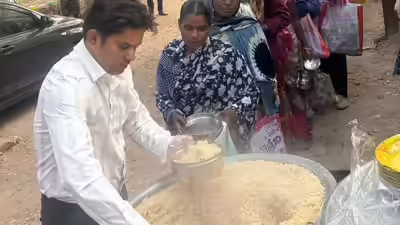
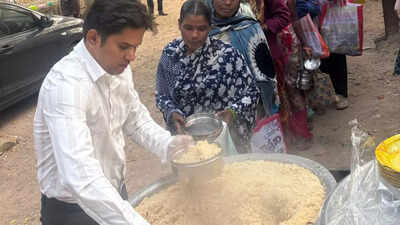
Every morning, a man dressed in office formals can be seen distributing food outside the NIMS hospital in Hyderabad. Even on rainy days, he arrives carrying an umbrella and plastic sheets to cover the food and protect it from the rain. Within minutes, people begin gathering in large numbers, holding utensils of all sizes. With a sense of urgency, he fills each one patiently, making sure everyone receives a portion. By 9:30 a.m., he wraps up the distribution and heads straight to his office.This man is Muhammad Aziz, who works in a bank and currently heads the Telangana and Andhra Pradesh regions of his department. What makes his story remarkable is that this is not a one-day effort or an occasional act of charity. It has been a part of his daily routine for nearly ten years. Aziz started Food Bank in Hyderabad almost a decade ago.Fondly referred to as Foodman, he recalls that the idea first began on Sundays. “When I didn’t have a job, I often thought that once I started earning, I would help the needy,” he says. When he started working, he kept on thinking of ways to help people. He once shared this thought with his mother and later discussed it with his friends Dilip, Sathya, and Iqbal. All of them showed great enthusiasm for the idea. His mother prepared around thirty packets of food, and together they went out to distribute them.

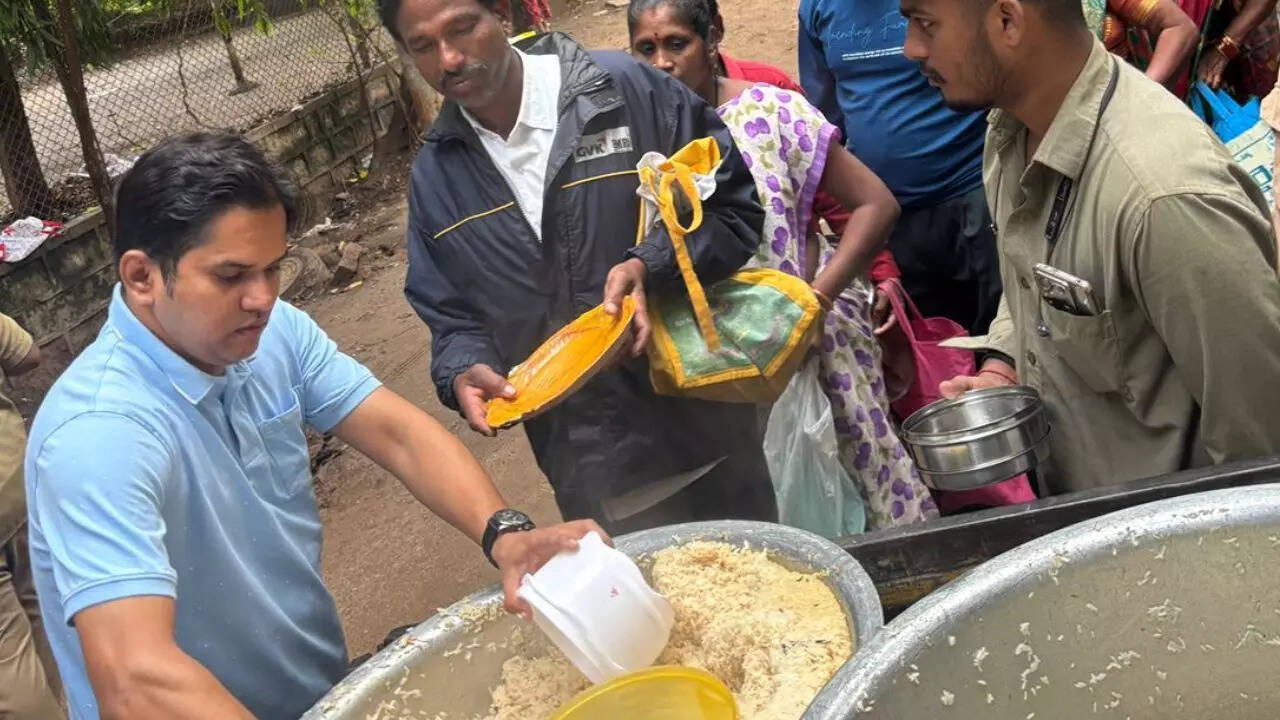
From the following Sunday, it slowly turned into a weekly ritual. His friends also started contributing in whatever way they could. Depending on their capacity, they would bring fifteen, twenty, or sometimes even thirty packets of freshly cooked food every week.The idea behind this effort was simple but meaningful. Aziz wanted to provide people with clean, home-cooked food—the kind of food one would eat at home. He believed that the needy should receive meals that are filling, nutritious, and prepared with care and dignity.I also started posting on social media asking for help from people who wanted to share their home-cooked food with the needy. The first call I received was from a lady who said she wanted to help people but did not feel comfortable going out and distributing the food herself. She said she was willing to prepare food at home. Another call came from a student who did not have much money but still wanted to contribute in some way.I told the lady that I could come and collect the food from her house. And just like that student, we slowly started getting more volunteers—people who were willing to cook, collect, or help distribute the food. What had started with just 30–40 food packets gradually grew to nearly 1,000 packets.As the effort expanded, we realized it was difficult to find large numbers of people in just one location. So we began moving across different parts of Hyderabad to distribute the food where it was needed most.
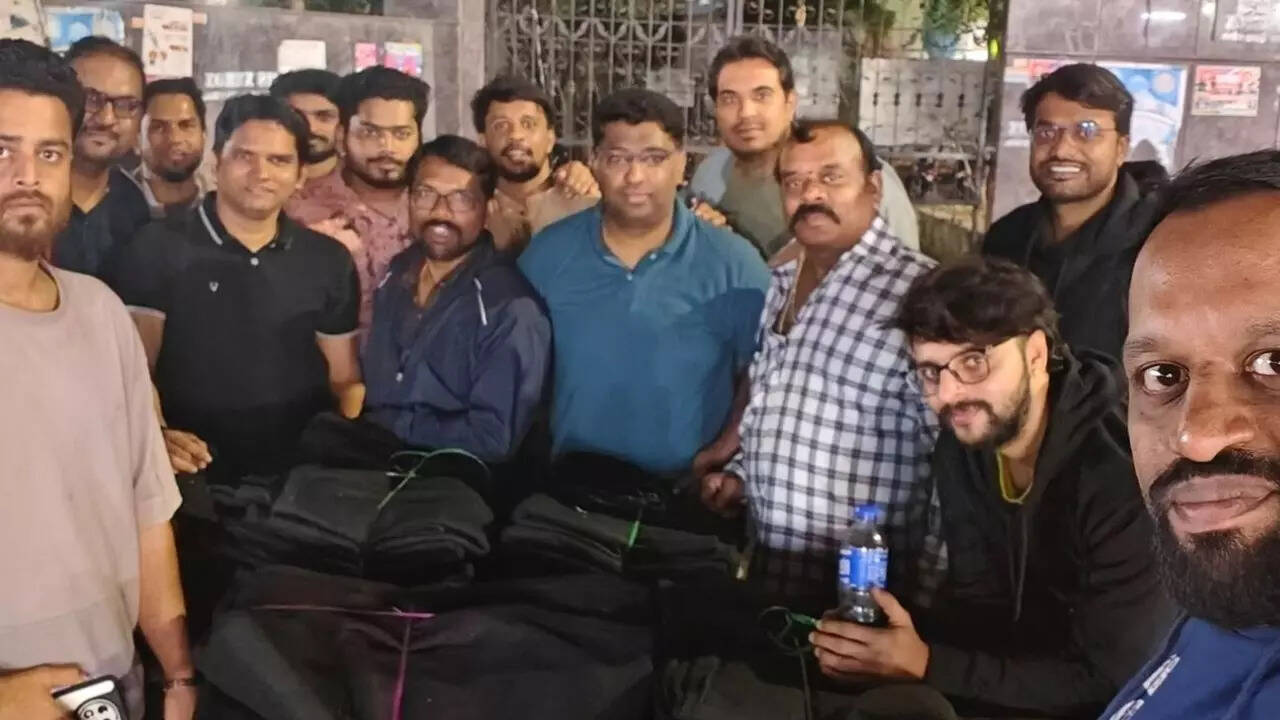
We realized that whenever we distributed food around NIMS Hospital, people received it with great enthusiasm and would even wait specifically for our food. They seemed to really appreciate it because many of them had come from distant villages and towns to care for their relatives who were admitted to the hospital. These families often had nowhere proper to sit, eat, or rest. Many of them were already struggling with debt due to medical expenses and could barely afford basic necessities.“I have seen people in so much poverty that my heart broke. People walk barefoot in the scorching heat and while we toss and turn on our pillows, there are so many who sleep on the pavements with their heads resting on hard stones while waiting for news about their family members who are admitted in hospitals. “Seeing these situations deeply affected me. I felt that this was the place where our service was truly needed. That is when we decided to make this effort a daily service instead of just an occasional activity. For the past ten years, I have been coming here every morning to distribute food.”“Now we have a place where a cook comes every day at around 5 a.m. to prepare food for nearly 300–500 people. Once the food is ready, we carry it to the hospital and distribute it outside on a daily basis. This routine has now become a regular part of our service, ensuring that patients’ families and those in need receive a fresh meal every morning.” We also distribute blankets in winters, fruits to cancer patients every Sunday in MNJ Cancer Hospital and food in Niloufer Hospital regularly.“The food we distribute is fresh, nourishing, and home-cooked, and we can clearly see that people truly appreciate it. Over time, more and more people have come forward to help and support this effort. We do not have a bank account or accept direct donations. Instead, I simply ask people to contribute groceries. Many supporters place orders through platforms like BigBasket or Swiggy and have the supplies delivered directly to our place. We then use those groceries to prepare meals for distribution.”
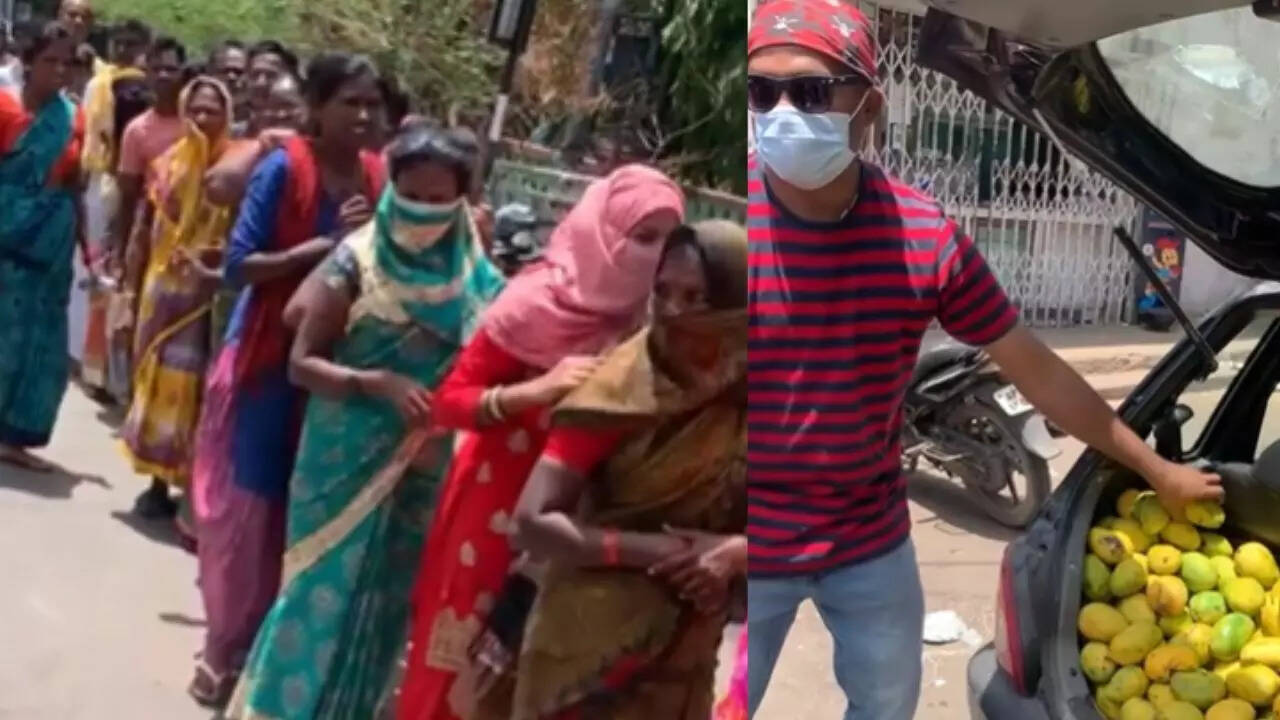
“You would be surprised by the amount of kindness and generosity people show. In fact, so many people want to help that we often have contributions scheduled nearly three months in advance.”
Poll
Have you ever participated in or supported a charity similar to Food Bank?
However, there are other expenses involved, such as the salary for the cook, transportation costs, and fuel expenses. These costs are usually taken care of by Aziz and a few other volunteers who are closely involved in this effort. On special occasions such as Independence Day, Republic Day, and World Food Day, Aziz and his team serve food to as many as 4,000 people. Aziz says that along with him a team always stands by and helps manage the large scale operations of his NGO, “Nikhil, Ritesh, Bharat Saxena Sir, Srinivas, Sanjay, Srikant, Sunita, Iqbal, Dilip and Salam are the backbone of this initiative,” says Aziz. They constantly extend their support and step in to cover expenses whenever there is a shortage of funds.The story of Aziz is not merely about intent, but about the courage to live that intent every single day. From 34 packets of food to feeding hundreds daily, his journey shows how one person’s promise can transform into a movement of compassion. In a world often rushing past suffering, Aziz chose to stop—and because he did, thousands no longer go to sleep hungry.