


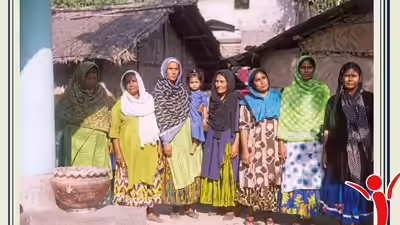
India is home to many small communities whose histories stretch far beyond the country’s borders. One such group lives quietly in Kishanganj, a district in Bihar close to the borders of West Bengal and Nepal. Locals sometimes refer to parts of this area as “Little Iran,” because a small Iranian community has lived here for decades. According to Azad India Foundation, the group is not large; reports suggest there are roughly 800 to 1,000 people, but their story is unusual. Many believe their ancestors originally came from Persia, modern-day Iran, during a period when travel and trade between the two regions were common. Over time, these migrants built lives in India. In Kishanganj, they formed small settlements known as Irani Bastis, where they continue to live while trying to preserve aspects of their cultural identity.
The history behind Kishanganj’s small Irani community
Trade between India and Persia dates back centuries. Merchants travelled across the Arabian Sea and through Central Asia, exchanging spices, textiles, metals, and precious stones. Historical records suggest that traders and travellers frequently moved between the two regions during the Mughal period. The Irani community in Kishanganj is believed to be connected to those movements. Community accounts suggest that a group migrated to the region from the nearby Purnia district around the early 1980s. Over time, they purchased small plots of land and created settlements in areas such as Motibagh Karbala.Most members of the community are Shia Muslims. Even though their roots lie in Persia, they largely consider themselves Indian today. Many families have lived in the region for decades, and their daily lives have gradually blended with the local culture.
How the Iranian community’s trade changed over time
Older members of the community often speak about their ancestors’ nomadic lifestyle. In earlier times, families travelled in groups called khafilas, or caravans. They moved from one town to another and set up temporary tents known as khemas. Trading was their main livelihood. One of their early businesses involved horses. These animals were sold at fairs, festivals, and sometimes to wealthy landlords. As transportation patterns changed and demand declined, the community adjusted its trade.Many Iranians began selling knives, glass frames, and small household goods. In recent years, the gemstone trade has become more common. Semi-precious stones are usually purchased from markets in Jaipur and Kolkata and then sold in local towns and villages. Even today, many Iranian men travel regularly to different places to sell these items. Women typically stay at home and take care of the family.
Irani Basti in Kishangarh: Language, clothing, and food traditions
The language spoken by the community reflects its mixed heritage. Most people use a blend of Persian, Hindi, and Urdu in everyday conversations. Over time, the language has changed because of local influences. Irani women continue to wear traditional lehengas and kurtas, a style that has reportedly existed in the community since the colonial period. The clothing was once seen as a sign that these families were travelling traders. Men generally follow the clothing style common in the surrounding region.Food habits are another distinctive feature of the community. Meat is commonly included in daily meals. Dishes such as halwa puri, degh pulao, halim, and dal gosht are widely prepared. These foods are often cooked with generous amounts of spices, giving them a rich flavour. Some old cooking traditions have survived as well. During large gatherings such as weddings or festivals, families sometimes cook as many as one hundred rotis on a large upside-down tawa using long rolling pins. The method allows large quantities of food to be prepared quickly for guests.
Marriage customs and community leadership
Marriage traditions within the Iranian community remain fairly strict. Families usually prefer marriages to take place within the community. Girls are typically expected to marry Iranian men. Boys have slightly more flexibility. In some cases, they may marry women from other Iranian groups living elsewhere. If a girl marries outside the community, she may face social exclusion.Another difference from many other communities is the absence of a dowry system. Instead, the groom provides a small amount of money known as meher to the bride. This amount is usually Rs. 5,001 or Rs. 10,001. Marriage proposals normally begin with discussions between families before they are presented to the community leader.
Education and daily challenges
Education levels within the Iranian community remain limited. Reports suggest that around half of the boys complete studies up to the matriculation level. Girls’ education is much lower. Only a small number have studied beyond classes six or seven. Many girls stay at home and focus on household work, although some receive basic religious education. There is no strict purdah system, and women are generally allowed to move freely outside their homes.Most families face economic difficulties. Their income depends largely on small trade and travelling businesses, which can be unpredictable. Households often include seven or eight members, which can make financial stability difficult to maintain.
Living between heritage and modern life
Despite all these problems, the Irani community in Kishanganj has over time become part of the larger local culture. They celebrate their festivals together, have joint feasts, and have close associations among themselves. The Irani culture in terms of their language, food habits, and marriage customs is a reflection of their association with history. The Irani community is a small and isolated group; however, their history is a reminder of the complex association between India and Persia.In Kishanganj, the history still exists in a few localities that are referred to by locals simply as “Little Iran.”