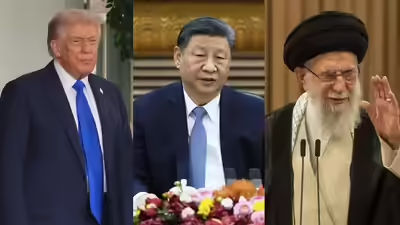
For years, China tried to have it both ways in the Middle East. It wanted cheap Iranian oil without the burden of getting entangled with the Ayatollah regime. It wanted Gulf investment, Gulf markets, and Gulf goodwill, while also keeping ties to Tehran. It wanted America tied down in endless regional crises, but without the sort of chaos that would send energy prices soaring. Above all, Xi Jinping wanted to build the image of China as a rising, benevolent superpower that plays by the rules while the US overreaches.US President Donald Trump’s war on Iran has exposed the fragility of that strategy.
Why it matters: ‘Hard power is king’
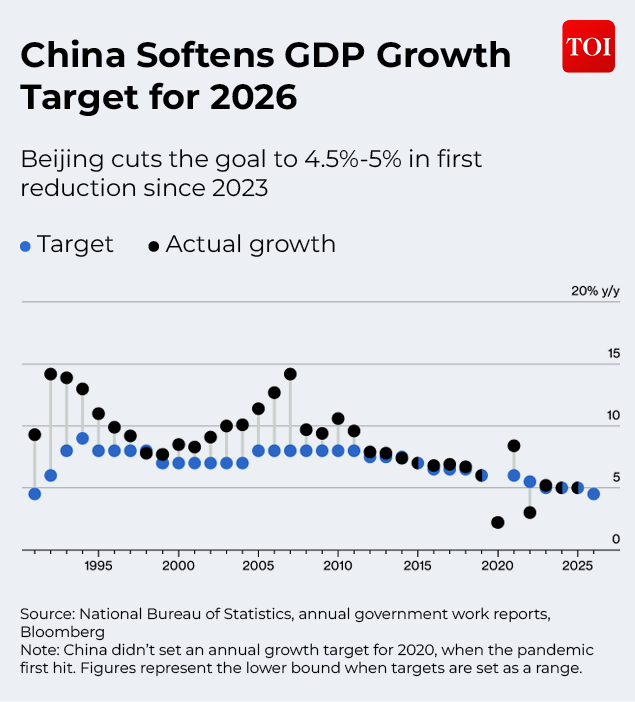
Trump’s war in Iran is not just a Middle East crisis. It is also a strategic shock for Beijing. For Xi, the conflict is bad in the near term, ugly in what it reveals about China’s limits, and only potentially good if the US gets trapped in another long regional war.The core problem for China is simple: Iran was never just another partner. It was an energy supplier, a useful spoiler against US power, and a symbolic piece of Xi’s broader effort to build a world less dominated by Washington. Trump’s use of force has now weakened that asset, exposed Beijing’s inability to protect it, and reinforced Xi’s deepest conviction that in the end, hard power still rules.As David Pierson writes in the New York Times, “The sudden and furious attacks by US and Israeli forces on Iran this past week, including the killing of the country’s supreme leader, are confirming Xi Jinping’s worldview that hard power is king.”In a way, that may sound like vindication for Xi, who has spent more than a decade modernizing the People’s Liberation Army and warning that the US remains China’s most enduring threat.But it is also a humiliation.The same war that validates Xi’s obsession with military strength also reminds Beijing of a harsher truth: China is still not the power that can decisively shape events across distant theaters. The US is. When Washington chooses to act with force, it can capture a president, kill leaders, threaten regimes and reorder strategic calculations overnight. Beijing can condemn, posture and hedge. But it cannot stop it.That asymmetry matters enormously as Xi prepares for a high-stakes meeting with Trump in Beijing later this month.Moreover, the Trump-Xi is summit is coming at a time when China’s economy is on a downward spiral. For the first time since 1991, China has set a GDP growth target between 4.5 and 5%, the lowest in decades.
The summit was supposed to show China’s strength. Instead, the shadow hanging over it is much larger: Trump will arrive not just as a tariff warrior, but as the president who demonstrated that American coercive power still reaches far beyond economics.
The big picture
Iran is useful to China in many ways.Beijing buys large volumes of discounted Iranian oil. It benefits from having Washington tied down in the Middle East due to Iran’s vexed nuclear issue. It also saw value in Iran’s “Axis of Strength.” The axis actors-Hamas, Hezbollah and Houthis- are hostile to the US-led order. They complicate American strategy and consume US attention in the Middle East.Geoffrey Cain writes in the Spectator that “Xi Jinping’s decade-long project to build an alternative to the American-led order died with” Ayatollah Ali Khamenei. That is too sweeping, of course. China’s broader ambitions are far from dead. But the broader point lands: One of Beijing’s cheapest and most convenient strategic assets has been badly damaged.Iran gave China leverage without forcing China to pay much for it. It helped keep the US preoccupied in a volatile region. It sold China oil at favorable prices. It formed part of the geopolitical background noise that made it harder for Washington to concentrate fully on Asia.Now that equation looks much shakier.
Between the lines: The war is a setback for China in three major ways
The first is energy
China remains heavily dependent on imported oil, with a very significant amount coming from the Gulf. Any prolonged disruption in the Strait of Hormuz would hit the Chinese economy at a bad moment, as Beijing is already grappling with low consumption, a property slump, and local debt stress.
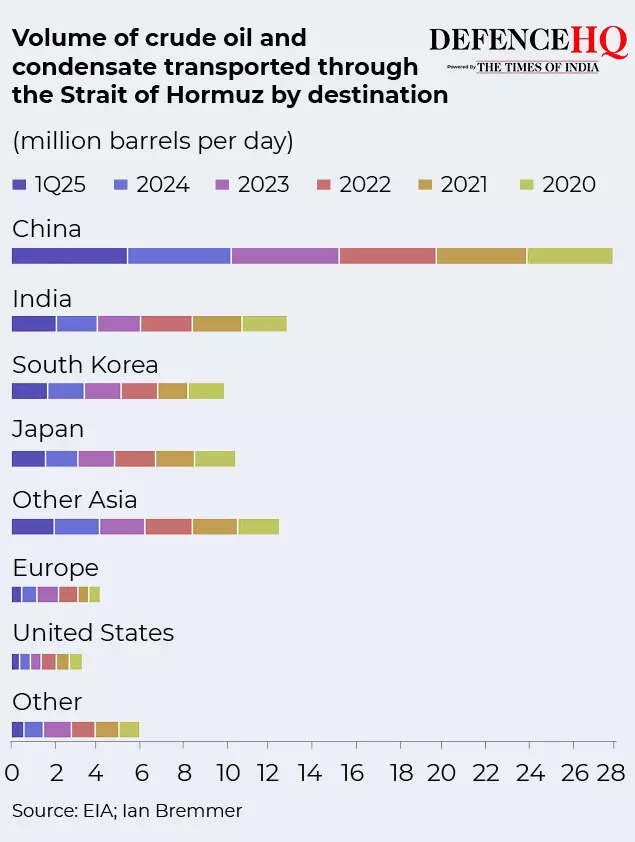
Cheap Iranian crude was not just convenient. It was part of China’s economic cushioning. If that supply is endangered, more expensive energy becomes another drag on growth.
The second is strategic positioning
James Palmer writes in Foreign Policy that Chinese strategists have quietly assumed that a distracted US is good for China. If, instead, Trump’s strikes weaken Iran and its proxy network without pulling the US into another endless occupation or regional quagmire, then China loses one of the very mechanisms that helped drain American bandwidth in the first place. Tehran was useful because it forced Washington to spend time, weapons and political attention outside the Indo-Pacific. If that source of disruption is reduced, the strategic benefit to Beijing shrinks with it.
The third is prestige and credibility
China wants to be seen as a rising superpower and a responsible alternative to the US. But when major partners face existential pressure, Beijing keeps showing the same pattern: Rhetorical condemnation, almost no direct intervention, and careful self-protection.Palmer calls China “an unentangled superpower” in Foreign Policy – one that prefers distance over obligation. That has obvious benefits. China avoids the alliance traps and military overstretch that have burdened the US. But in moments like this, it also reveals a glaring weakness: Beijing looks less like a security provider than a very large bystander.As Philip Shetler-Jones of the Royal United Services Institute told the BBC, the US is showing “what being a superpower really means, which is the ability to force outcomes in theatres across the globe.” China, he said, “is not equipped to protect its friends against this kind of action, even if it wanted to.”
Zoom in: There is also a Taiwan angle hanging over all of this
One of the deeper assumptions behind Xi’s strategy has been that China could build enough economic resilience, diplomatic reach and external partnerships to withstand the punishment that would follow any move on Taiwan. Iran and Russia mattered in that wider picture not because they would fight for China, but because they were part of a looser ecosystem that could help Beijing weather sanctions, secure energy and complicate US-led coalitions.If Iran is weakened, isolated further or destabilized, that ecosystem becomes less reliable.There is another Taiwan lesson, too. From Beijing’s perspective, the strikes reinforce a dark conclusion: if the US under Trump believes a target matters enough, it will use force first and explain later. That does not mean China thinks Washington would strike it in the same way. But it does mean Xi will see even more reason to accelerate deterrence and prepare for surprise.
The good, the bad, and the ugly: For China, the ledger is mixed – but tilted negative
The good, from Beijing’s standpoint, is conditional: if the war drags on, drains US munitions, divides Western allies and delays American focus on Asia, China may recover some strategic advantage. Beijing may also use the crisis to cast itself as the steadier global actor, condemning war while selling itself as a champion of sovereignty and stability.The bad is immediate: Energy exposure, a weakened partner, greater uncertainty before Trump’s visit, and another hit to the image of China as a rising pole able to protect its interests.The ugly is what the war reveals. China has economic weight, diplomatic reach and growing military power – but it still lacks the ability, or perhaps the will, to defend key partners when they are hit hard.Xi wants a world in which China shapes order. What this war shows is that, for now, the US still has the greater capacity to break it.
What’s next
Beijing is likely to respond in familiar ways: Stronger rhetoric against US “hegemonism,” faster military modernization, tighter attention to energy security and more careful diplomacy with Gulf states that China cannot afford to alienate.Xi will also enter his expected talks with Trump in Beijing with less confidence that trade diplomacy can be neatly separated from raw power.China may yet find opportunity in a prolonged US overextension. But for now, Trump’s Iran war looks less like a gift to Xi than a warning – and a setback.