


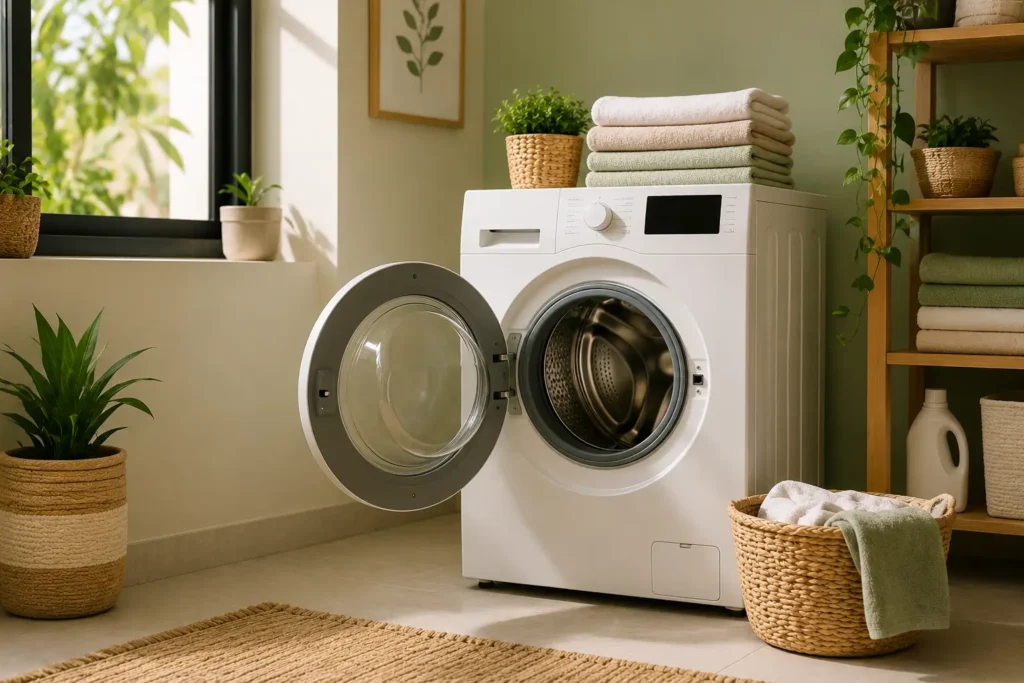
If you’ve ever used a front load washing machine at a friend’s place or in a hotel laundry and noticed how much cleaner and softer your clothes came out, you already understand the appeal. Front load machines tumble clothes through water instead of agitating them against a pulsator — the result is gentler fabric care, noticeably better stain removal, and significant water and energy savings over time.
They cost more upfront than a top loader. But if you do frequent loads, care about fabric longevity, or just want the quietest, most premium laundry experience available, this is the category worth the extra spend. Here’s exactly how to choose the right one.

Why Switch to a Front Load Washing Machine?
- Uses 40–50% less water per cycle compared to top load machines, since the drum doesn’t need to be fully submerged
- Higher spin speeds (often 1000–1400 RPM vs. 700–800 RPM on top loaders) mean clothes come out drier, cutting down drying time significantly
- Gentler on fabric — the tumbling wash action causes far less wear on fibres than a pulsator, which matters if you wash frequently or own delicate/expensive clothing
- Sealed horizontal drum resists odour buildup and is easier to keep hygienic between cycles
- Stackable with a dryer if you’re short on floor space — a top loader can’t be stacked
The trade-off: front loaders take longer per cycle (typically 90–120 minutes vs. 35–50 for top load) and cost roughly ₹10,000–15,000 more for a comparable capacity. If you do four or more loads a week, most buyers recoup that cost difference in water and detergent savings within two to three years.
Step 1: Pick the Right Capacity
| Household Size | Recommended Capacity |
|---|---|
| 1–2 people | 6 – 6.5 kg |
| Small family (3–4 people) | 7 kg |
| Medium family (4–5 people) | 8 kg |
| Large family (6+ people) | 9 kg and above |
Front load drums pack laundry more densely than top loaders because of the tumbling action, so don’t automatically size up just because you’re used to top-load capacity numbers — a 7 kg front loader typically handles what an 8 kg top loader would.
Step 2: The Features That Actually Matter
Inverter motor. Just like top load, this is non-negotiable. It adjusts drum speed to the load size, cutting electricity use and noise significantly, and most premium front-load inverter motors now carry 10-to-20-year warranties — a strong indicator of how confident brands are in their durability.
Spin speed (RPM). This is where front loaders really pull ahead — 1000 RPM+ is standard, and premium models go up to 1400 RPM. Higher RPM extracts more water during the spin cycle, meaning noticeably faster natural drying, which matters a lot during monsoon season.
Steam wash. A genuinely useful feature for loosening tough stains — mud, sweat, humidity-related odours — without needing extra detergent or a longer cycle. It’s also gentler on fabric than an aggressive detergent-heavy wash.
Hard water treatment. If you live in a city with high TDS (total dissolved solids) water — Delhi, Bangalore, and much of North India qualify — look specifically for a built-in hard-water conditioning feature. These systems treat incoming water before the wash begins, which improves detergent effectiveness and protects the machine’s internal components from mineral scale buildup over its lifetime.
In-built heater. Common on mid-to-premium front loaders, letting you wash at higher temperatures (up to 90–95°C) for better germ removal on towels, baby clothing, and bedding — no separate geyser connection needed.
Auto tub/drum clean. Removes lint, detergent residue, and bacterial buildup from inside the sealed drum — important on front loaders specifically because the door seal (gasket) area can trap moisture and grow mould if not cleaned periodically.
Wi-Fi / app connectivity. A genuine convenience on premium models — lets you start, pause, or monitor a cycle remotely and get end-of-cycle notifications. Nice to have, not essential to wash quality.
Anti-tangle / anti-wrinkle drum movement. Some brands use varied drum rotation patterns specifically to prevent clothes from twisting into knots — worth checking for if you frequently wash bedsheets or large fabric items.
Step 3: Match the Machine to Your Water Supply
- Hard water region: Prioritise a model with dedicated hard-water treatment technology over one that simply has a higher price tag — this single feature affects both wash quality and machine lifespan more than almost anything else.
- Low or inconsistent water pressure: Check the minimum inlet pressure requirement in the spec sheet; front loaders generally need more consistent pressure than top loaders to fill and seal the door properly.
- Frequent power cuts: Look for models with a cycle-resume/memory function so an interrupted wash doesn’t restart from zero.
Step 4: Compare the Leading Brands
| Brand | Known Strength |
|---|---|
| LG | Direct Drive motor architecture (fewer moving parts, quieter, more durable), multi-motion drum tech for delicate fabric care |
| Samsung | Bubble-based detergent technology for deeper stain penetration at lower wash temperatures, strong Wi-Fi/app ecosystem |
| IFB | Best-in-class hard water handling via dedicated water-conditioning technology, longest combined warranty coverage in the segment |
| Whirlpool | Reliable mid-range performance, typically the highest spin speed at its price point, solid stainless-steel build |
| Bosch | German engineering reputation, exceptionally quiet operation, strong long-term build quality |
| Godrej | AI-sensing and steam wash features at a more accessible price point, good for hygiene-focused buyers |
Budget Ranges
- ₹25,000–₹28,000: Entry-to-mid front loaders, 6–7 kg, inverter motor, basic wash programs
- ₹28,000–₹32,000: The sweet spot for most households — 7–8 kg, 1000+ RPM, steam or hard-water tech on select models
- ₹32,000–₹40,000: Premium capacity (8–9 kg), Wi-Fi connectivity, AI wash sensing, in-built heater, 1200–1400 RPM
- ₹40,000+: Flagship models with the fastest spin speeds, most wash programs, and longest warranties
Quick Decision Checklist
- Capacity matched to household size (remember: front load packs denser than top load) ✅
- Inverter motor confirmed, with strong motor warranty (10+ years ideal) ✅
- Spin speed of at least 1000 RPM ✅
- Hard-water treatment if your local water is hard ✅
- Steam wash or auto tub-clean for hygiene ✅
- Minimum water pressure requirement matches your home’s supply ✅
- Service network availability in your city/pin code ✅
- Warranty terms compared across your final 2–3 shortlisted models ✅
Where to Check Current Models and Prices
Product listings, prices, and star ratings on Amazon change frequently, so rather than relying on a snapshot, it’s best to check live listings before you buy. Here are direct Amazon search links to compare current front load washing machines by brand:
- Browse all front load washing machines on Amazon
- LG front load washing machines
- Samsung front load washing machines
- IFB front load washing machines
- Bosch front load washing machines
- Whirlpool front load washing machines
- Front load washing machines with hard water wash
When you land on any listing, run it through the checklist above before adding to cart — and always check the Q&A and recent review sections for real-world feedback from buyers in similar water/power conditions to yours.
Frequently Asked Questions
Q1. Is a front load washing machine better than a top load? Front load machines are gentler on fabric, use less water, and spin faster for quicker drying, making them a better long-term investment if you wash frequently or care about fabric longevity. Top load machines are cheaper, faster per cycle, and easier to load without bending down. Neither is universally “better” — it depends on your priorities and budget.
Q2. How much water does a front load washing machine actually save? Front loaders typically use 40–50% less water per cycle than top loaders, since the drum doesn’t need to be fully filled with water — it tumbles clothes through a shallow water pool instead.
Q3. Why do front load washing machines take longer to wash? The tumbling wash action that makes front loaders gentler on fabric also takes longer to achieve the same cleaning result compared to the more aggressive agitation of a top loader. Cycles typically run 90–120 minutes versus 35–50 minutes.
Q4. Do front load washing machines need special detergent? Yes — always use a detergent labelled for front-load or HE (high-efficiency) machines. These produce less foam, which is important since front loaders use significantly less water and excess foam can affect wash performance and drainage.
Q5. How do I prevent mould or bad odour in a front load machine? Leave the door slightly open after each wash to let the drum dry out, wipe the rubber door gasket periodically, and run the auto tub-clean cycle (or a hot empty wash) roughly once a month.
Q6. Which front load washing machine is best for hard water areas like Delhi or Bangalore? Look specifically for models with built-in hard-water conditioning technology, commonly featured on IFB’s front-load range, which is purpose-built for Indian water conditions.
Q7. Is Wi-Fi connectivity on a washing machine actually useful? It’s a genuine convenience — remote start, pause, and cycle-completion alerts — but it doesn’t affect wash quality. Treat it as a nice-to-have rather than a deciding factor unless remote control specifically matters to your routine.
Q8. What spin speed (RPM) should I look for? 1000 RPM is a solid baseline for good drying performance. If you live in a humid or monsoon-heavy region and want to minimise drying time, look for 1200–1400 RPM models.
