


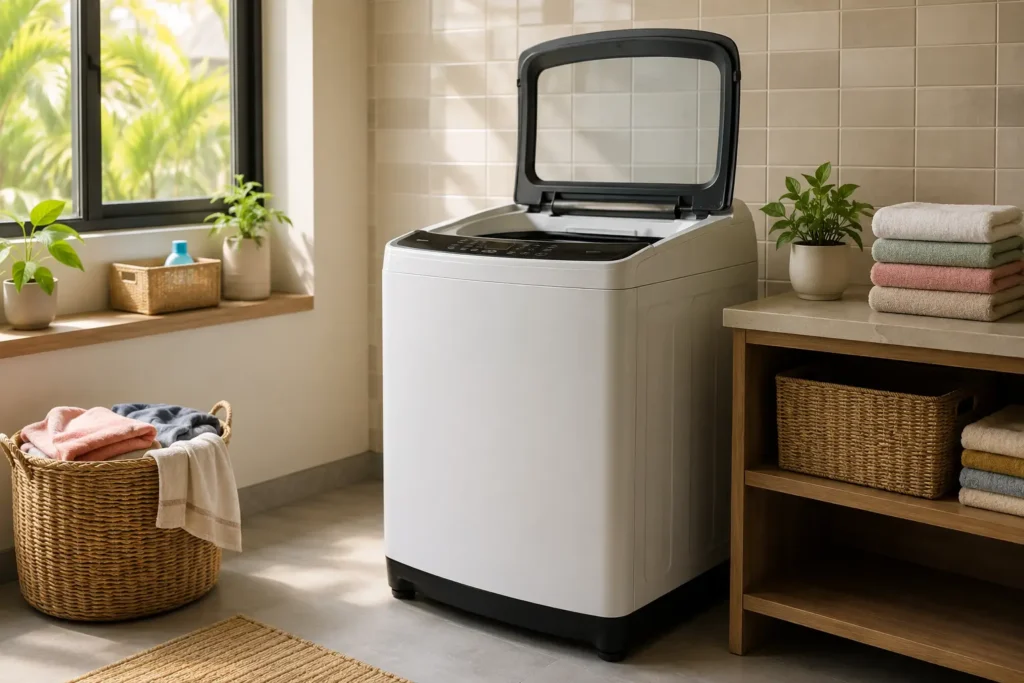
Doing laundry shouldn’t feel like a chore you dread every weekend. A good fully automatic top load washing machine takes care of filling, washing, rinsing, and spinning on its own — you just load the clothes, press a button, and walk away. But with hundreds of models on Amazon claiming “5-star rating,” “smart inverter,” or “AI wash,” how do you actually know which one fits your home?
This guide breaks down exactly what matters, what’s marketing fluff, and how to match a machine to your family size, water supply, and budget — so you can buy once and not regret it.

- Fully Automatic top load washing machine : Affordable with best wash quality and easy to use with In-Built Heater
- Capacity:7.5 kg (Suitable for Small to Medium sized family)
- Energy Rating 5 Star: Best in class efficiency | Energy consumption – 0.0099* KWh/kg/cycle (Please refer BEE label for m…
- Fully-automatic top load washing machine with Ecobubble wash technology: Affordable with great wash quality, Easy to use
- Capacity 8 kg: Suitable for large families | Water Pressure: (0.01-0.78 Mpa(01-8.0kg.f/cm²) | Water Consumption : Refer …
- Energy Star rating : 5 Star | Digital Inverter for energy savings | Energy Consumption: 0.0083 KWh/kg/cycle (For more in…
Why Choose a Top Load Washing Machine in the First Place?
Before comparing models, it helps to know why top load remains the most popular format in Indian homes — it accounts for the large majority of washing machine sales here, and for good reason:
- Lower price for the same capacity compared to an equivalent front load machine
- Faster wash cycles — typically 35–50 minutes versus 90–120 minutes for front loaders
- Easier on the back and knees — no bending down to load or unload, which matters a lot for elderly family members
- Mid-cycle flexibility — you can lift the lid and toss in a forgotten sock or shirt even after the cycle has started
- No stacking or drying-rack conflicts — simpler installation in small utility areas or balconies
If your household values convenience and speed over the marginally better fabric care of a front loader, top load fully automatic is the right category for you.
Step 1: Get the Capacity Right (This Is Where Most Buyers Go Wrong)
Buying a machine that’s too small means running multiple loads every week. Buying one that’s too large wastes water and electricity on small loads. Use this as a rough guide:
| Household Size | Recommended Capacity |
|---|---|
| 1–2 people (bachelors, couples) | 6 – 6.5 kg |
| Small family (3–4 people) | 7 – 7.5 kg |
| Medium family (4–5 people) | 8 kg |
| Large family / joint family (6+ people) | 9 – 10 kg |
Pro tip: If you regularly wash bulky items like blankets, curtains, or bedsheets, round up to the next capacity tier — bulky fabrics need more room to move freely for a proper wash.
Step 2: Understand the Technology Inside the Drum
Inverter Motor — treat this as non-negotiable. An inverter motor adjusts its speed to match the load instead of running at one fixed speed. This alone can cut electricity consumption by roughly 30% and significantly reduces noise and vibration. The price difference between inverter and non-inverter models has shrunk to just a small margin, so there’s little reason to skip it anymore.
Impeller vs. old-style agitator. Nearly every modern fully automatic top loader now uses a low-profile impeller disc at the base of the drum instead of the old central agitator post. Impellers create a strong pulsating water current that cleans effectively while being noticeably gentler on clothes — the agitator post is largely a thing of the past, and you shouldn’t need to actively choose between them, but it’s worth confirming on older/clearance stock.
Counter-rotation wash technology. Some premium models add a feature where the drum and the pulsator spin in opposite directions simultaneously, generating stronger currents for heavily soiled clothes — useful if you deal with a lot of mud, oil stains, or workwear.
Spin speed (RPM). Higher RPM means clothes come out drier, which cuts down ironing and drying time — especially valuable during monsoon season. Look for at least 700 RPM; anything below 650 RPM will leave clothes noticeably damper.
In-built water heater. A handful of mid-to-premium top load models now include a heater (up to 60–90°C), which is genuinely useful for hard water areas, oily kitchen linen, or households prioritizing germ removal — and it removes the need for a separate geyser connection.
Step 3: Match Features to Your Actual Water Situation
This is the step most buyers skip, and it’s the one that determines whether you’re happy with the machine in six months.
- Hard water areas: Look for models with a water softening or scale-prevention function, and ideally a higher-temperature wash option — mineral buildup is one of the top causes of reduced machine lifespan in India.
- Low water pressure / overhead tank supply: Check the minimum water pressure requirement listed in the spec sheet before buying; some machines struggle to fill properly on gravity-fed supply.
- Frequent power fluctuations: Prioritise models with surge protection and a memory backup function so an interrupted cycle resumes instead of restarting.
Step 4: Don’t Skip These “Small” Features
- Child lock — essential if you have young kids or curious pets at home
- Delay start / timer — start a wash a few hours later so it finishes right before you’re home
- Quick wash / express cycle — a lifesaver for single items or lightly worn clothes
- Fuzzy logic sensors — auto-adjusts water level and wash time based on load size and soil level, avoiding water waste
- Self-clean / tub-clean cycle — keeps the drum free of detergent buildup and odour without manual scrubbing
- Rust-free / stainless steel drum — check this specifically if you’re buying a budget model, as some entry-level tubs use painted metal that can corrode over time
- Warranty on the motor — many inverter models now come with 10-year (sometimes longer) motor warranties, which is a strong signal of the brand’s own confidence in durability
Step 5: Know the Trusted Brands and Where They Excel
| Brand | Known Strength |
|---|---|
| LG | Widest service network, TurboDrum counter-rotation tech, strong inverter motor warranties |
| Samsung | Bubble-based wash technology for better stain removal at lower temperatures, Wi-Fi/app control on premium models |
| IFB | Purpose-built hard-water handling and AI wash programs, strong pick for regions with poor water quality |
| Whirlpool | Balanced, no-frills reliability with excellent value at mid-budget price points |
| Haier | Competitive pricing with hygiene-focused features like in-built heaters even at mid-range price tiers |
| Bosch | Quiet operation and long-term build durability, more front-load focused |
None of these brands is objectively “the best” — the right one depends on the local service network in your city, your water type, and your budget. Before finalizing, it’s worth checking current Amazon customer reviews and Q&A sections for your shortlisted model and pin code, since service quality can vary regionally.
Budget Ranges to Set Realistic Expectations
- Under ₹15,000: Basic fully automatic models, usually non-inverter or entry-level inverter, 6–6.5 kg, fewer wash programs
- ₹15,000–₹20,000: Solid inverter motors, 7–7.5 kg, decent RPM (700+), good for small-to-medium families
- ₹20,000–₹25,000: The sweet spot for most Indian households — 7–9 kg, inverter motor, multiple wash programs, often extended motor warranties
- ₹25,000 and above: Premium features like in-built heaters, Wi-Fi connectivity, AI wash sensing, and higher RPM for faster drying
Quick Decision Checklist Before You Click “Buy”
- Capacity matched to household size ✅
- Inverter motor confirmed ✅
- Spin speed of 700 RPM or higher ✅
- Suitable for your water hardness and pressure ✅
- Stainless steel drum (not painted) ✅
- Motor warranty of at least 5–10 years ✅
- Child lock and delay start included ✅
- Brand has reliable service centres in your city/pin code ✅
If a listing checks all eight boxes at a price within your budget range above, you’ve found a genuinely good fit — not just a well-marketed one.
Frequently Asked Questions
Q1. What is the difference between a fully automatic and semi-automatic top load washing machine? A fully automatic machine handles filling, washing, rinsing, and spinning entirely on its own with no manual intervention. A semi-automatic machine has separate wash and spin tubs, requiring you to manually transfer clothes and drain water between steps. Fully automatic costs more but saves significant time and effort.
Q2. Is 7 kg or 8 kg better for a family of four? For a family of four, 7.5–8 kg is usually the better choice, since it comfortably handles a full day’s laundry including bedsheets and towels without needing multiple loads.
Q3. Does an inverter motor really save electricity? Yes. Inverter motors adjust speed based on load size instead of always running at full power, typically reducing electricity consumption by around 30% compared to conventional motors, along with quieter operation.
Q4. Which top load washing machine is best for hard water? Look for models with built-in water-softening technology or scale-prevention systems, and ideally a higher-temperature wash cycle. IFB’s hard-water-focused models are commonly recommended for this specific issue.
Q5. How long does a fully automatic top load washing machine last? With reasonable maintenance (regular tub cleaning, not overloading, and using the recommended detergent type), a good quality inverter model typically lasts 8–12 years. Always check the specific motor warranty period listed for the model you’re buying.
Q6. Is higher RPM always better? Higher RPM (spin speed) means clothes come out drier, reducing drying time — genuinely useful in humid or monsoon-prone regions. However, very delicate fabrics can benefit from lower RPM options, so a machine offering multiple spin speed settings is ideal.
Q7. Can I install a top load washing machine on a balcony with low water pressure? Most machines need a minimum water pressure to fill properly. Always check the “minimum water pressure” specification before buying if your supply is gravity-fed from an overhead tank rather than a pressurized line.
Q8. Are more expensive washing machines always worth it? Not necessarily. Once you cross the ₹20,000–25,000 range with an inverter motor, decent RPM, and a solid warranty, additional spend often goes toward conveniences like Wi-Fi control or AI sensing rather than core wash quality. Prioritize the checklist in this guide over price alone.
