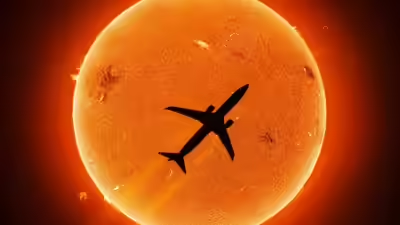
A tiny silhouette against a blazing Sun with a commercial jet is cutting across the solar disc at the exact centre, looks like a random lucky shot, but the reality is far more complex. Astrophotographer Andrew McCarthy has captured what many are calling one of the rarest solar transit images ever recorded. The image shows a commercial aircraft perfectly aligned with the Sun, a moment that lasted only a fraction of a second. Behind it sits nearly a week of preparation, constant tracking, and an extraordinary number of attempts. It reportedly took around six days of planning and shooting to finally get the frame. And even then, nothing was guaranteed until the very last moment.The final result is not just a photograph of a plane and the Sun. It is a carefully timed alignment of aviation data, solar positioning, weather conditions, and patience. McCarthy is known for his high-resolution astrophotography work, especially images of the Sun and deep space objects. This particular capture has now gone viral online, with many calling it a once-in-a-lifetime shot.
An astrophotographer waits days to capture a fast jet crossing the Sun
McCarthy reportedly spent nearly six days preparing for the solar transit. He tracked flight paths, monitored solar position, and waited for the right alignment window. Even a small error in positioning could have ruined the entire attempt. A shift of a few metres, a slight delay, or unexpected cloud cover would have meant missing the moment completely. The timing needed to be exact, down to seconds.He kept shooting continuously during this period, capturing around 1.7 million frames in total. Most of them were ordinary images with nothing special. But somewhere inside that massive collection was the exact moment he was waiting for.
1.7 million photos and one perfect frame
The scale of the effort is what surprises many people. Around 1.7 million photographs were taken over the course of six days. This was not a single attempt but a continuous process of waiting and shooting.McCarthy used different focal lengths to improve detail. One set was captured at about 10 frames per second, while a closer view reportedly ran at 85 frames per second before being processed at a lower playback rate to enhance clarity. This combination allowed him to extract a high-resolution final image that shows both the aircraft silhouette and the Sun’s surface in detail.The final photograph stands out because of its precision. It is not just about timing. It is also about technical control and equipment setup.
Why solar transit photography is so difficult
Capturing a plane crossing the Sun is considered one of the most difficult forms of astrophotography. Experts often say it requires a rare combination of aviation timing, solar alignment, and ground positioning.The aircraft must follow a flight path that lines up with the Sun from a specific viewing location. This alignment window is extremely small, sometimes lasting less than a second. Photographers must be positioned exactly in the right place to catch it.Weather is another major challenge. Even thin clouds can completely block the view or reduce contrast. Because of all these factors, most attempts fail or never even get close to perfect alignment.
Solar prominences made it even more dramatic
What made this particular image even more striking was the presence of solar prominences. These are large arcs of hot plasma extending from the Sun’s surface. They appear like glowing loops or eruptions against the solar background.At the exact moment the aircraft crossed the Sun, two prominences were visible. McCarthy reportedly said this made the shot even more special, turning it from a simple transit into something far more visually powerful.