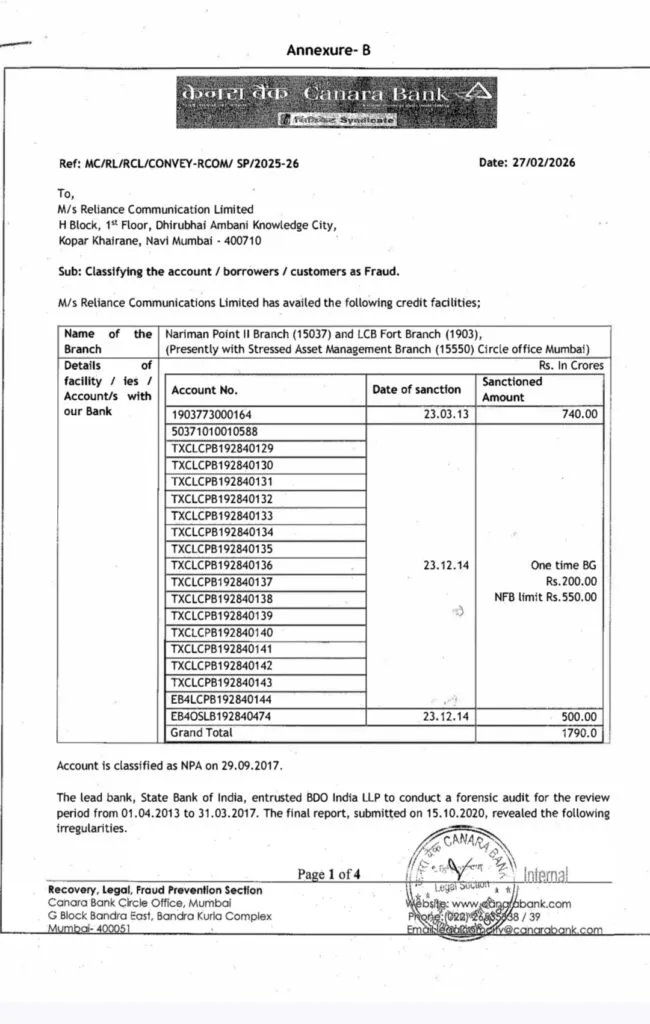
Reliance Communications Limited account has been classified as ‘fraud’ by Canara Bank and Canara Bank has ordered to report RCOM to RBI so as to get it reflected in the Central Fraud Registry.
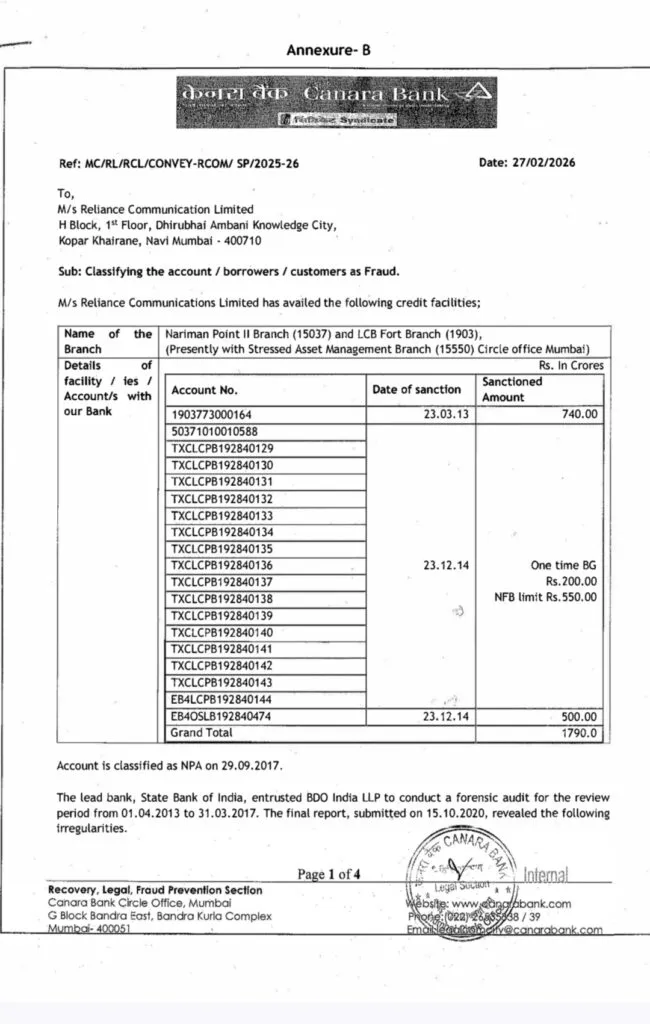
Canara Bank has declared the loan account of Reliance Communications Ltd (RCOM) and its related companies as fraud after an internal review found serious irregularities in the use of bank funds.
According to the bank’s findings, Reliance Communications Ltd (RCOM), Reliance Infratel Ltd (RITL) and Reliance Telecom Ltd (RTL) together received about ₹31,580 crore in loans from various banks. Out of this amount, around ₹13,667.73 crore was used to repay loans and other obligations to banks and financial institutions.
Another ₹1,292.31 crore was paid to connected parties. The bank found that the loan funds were not used as per the conditions mentioned in the sanction letters. Instead, the funds were used to repay loans taken from other banks and were also transferred to related and connected entities.
In some cases, investments made from bank funds were quickly liquidated and the money was used to make payments to various parties. The investigation also revealed possible routing of bank loan funds through group companies. Loans taken by Reliance Infratel Ltd were transferred to Reliance Communications through Reliance Communications Infrastructure Ltd (RCIL).
RCOM then used the money to pay its liabilities or transferred the funds to related parties. Out of ₹1,976 crore obtained by RITL, around ₹1,783.65 crore was used by RCOM to repay other banks and to transfer money to connected entities. The report also noted several intercompany transactions among RCOM, RITL and RTL. RCOM transferred ₹783.77 crore to RTL and ₹1,435.24 crore to RITL from the loan funds it had obtained from banks.
In addition, Reliance Infratel Ltd discounted bills of RCOM worth ₹8,514.70 crore and bills of RTL worth ₹1,041.42 crore. These funds were mainly used to make payments to connected parties.
The review also examined the promoter’s contribution. RCOM allotted shares to Telecom Infrastructure Finance Private Ltd and received ₹1,300 crore. However, out of these funds, ₹1,769.99 crore was invested in mutual funds while ₹527.18 crore was used to repay bank loans. In the financial year 2014–15, bonus shares were also issued by Reliance Infratel Ltd.
Another important finding was related to the movement of funds through Inter-Corporate Deposits (ICDs). During the review period, RCOM, RITL and RTL both borrowed and lent funds to connected parties in the form of ICDs. The total ICD amount during the period was about ₹41,863.32 crore.
Out of this, ₹28,421.61 crore could be traced. Of the traced amount, ₹23,128.45 crore was used to make payments to connected parties while ₹3,214.74 crore was used to repay bank loans.The investigation also looked at transactions involving Netizen Engineering Pvt Ltd.
In 2015-16, Netizen Engineering received capital of ₹5,525 crore from RCOM. Later, in 2017-18, Netizen acquired two assets from MP Network Pvt Ltd, one of which was immediately transferred to RCIL. After the transfer of the asset, RCOM wrote off the capital advance given to Netizen against the receivable balance from RCIL.
The bank noted that the financial background of Netizen Engineering did not match the scale of transactions recorded in RCOM’s books, indicating that the companies may be closely connected.
Further investigation showed that money received by RCOM from Reliance Jio Infocomm Ltd (RJIO) after the sale of spectrum was also transferred to Netizen Engineering. From there, the funds were transferred to other entities with weak financial backgrounds.
Because of this, the bank stated that the possibility of Netizen being used as a channel to siphon off money could not be ruled out. A third-party analysis of the accounts found several unusual transactions. Large receivable and payable balances were assigned to other parties through multiple assignments in the books of RCOM, RTL and RITL.
The bank also observed unusual journal voucher entries and large transfers of funds to entities with weak financial backgrounds or unclear business activities. The bank also compared the assets of the companies with the charges created on those assets. It was found that the value of charges created in favor of lenders was much higher than the assets held by the companies.
As of 31 March 2017, the total charges stood at ₹49,111.47 crore, while the total assets of the companies were only ₹26,163.43 crore. Based on these findings, Canara Bank concluded that there were serious irregularities in the use of loan funds and possible diversion of money through related entities. The bank has therefore classified the account as fraud and reported the matter as per regulatory requirements.