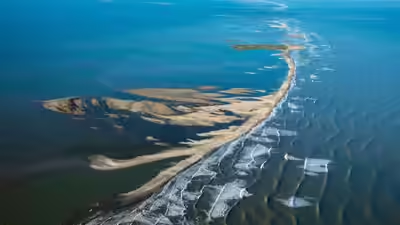
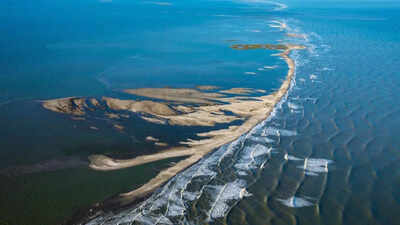
Most of the research conducted around rising oceans might have misjudged the rising coastal hazards by an approximate of 20 to 30 centimetres. Out of 385 expert-reviewed studies published between 2009 and 2025, around 99 percent incorrectly estimated ocean height. Researchers suggest this might have caused a lag of almost a hundred years of sea level rise in total. The findings also suggest that the rising future sea levels might be beyond assumptions. This comes as a matter of worry, for a one metre rise in the sea level might submerge areas inhabited by over 132 million people.
Evidence of underestimated rising sea-level
Climate scientist Anders Levermann of the Potsdam Institute for Climate Research in Germany says sea level rise is slow but dangerous if you ignore it, “That’s basically what we’ve done unknowingly,” he says. “These estimates now tell us that we are much further in the future than we thought we were.”On the other hand, physical geographers Katharina Seeger and Philip Minderhoud of Wageningen University in the Netherlands discovered these irregularities after analysing the global as well as regional studies conducted over the past few years on varied topics including sea level rise, storm surges, tsunamis and general coastal hazards.
Poll
Do you believe that current sea level research accurately reflects potential hazards for coastal regions?
Studies lack accurate data source
Researchers conducting studies around possible coastal hazards draw comparisons between land elevation and sea level. The land elevation data is directly collected from satellites, while the data regarding sea level is evaluated through measurements collected by tidal gauges, ocean buoys, satellites or other monitoring instruments. But Seeger and Minderhoud found that most of the studies they evaluated neglected to include direct sea level measurements, instead relying on wonky, digital shapes called geoids.According to the National Ocean Service, the geoid is an irregular surface which defines zero elevation. Using complex math and gravity readings on land, surveyors extend this imaginary line through the continents. This model is used to measure surface elevations with a high degree of accuracy. Now there are two key issues of using Geoids to measure sea level. First, they can be off by several meters in areas lacking gravitational data. Second, geoids do not account for ocean circulation, currents, winds, tides, water temperatures and other factors influencing sea level. Over 90 percent of the reports used this data, causing discrepancies, and the remaining 9 percent used improper data. Only 1 percent studies are accurate.
The measure by which reports have missed
Seeger and Minderhoud analysed a global sea level dataset, primarily from satellite observations of the ocean surface, to assess the accuracy of prior studies. Their evaluation revealed that these studies, on average, underestimated coastal sea levels by 24 to 27 centimetres (roughly 10 inches), varying slightly based on the geoid model employed.Discrepancies were especially pronounced in data-sparse regions. For example, parts of Southeast Asia and the Indo-Pacific showed sea levels exceeding previous estimates by over one meter. Conversely, a few areas saw overestimations, such as the northern Mediterranean, Antarctica, and certain Atlantic and Pacific islands. The narrowest gaps appeared along eastern North America and in northern and western Europe.
What do these Reports Indicate
This pervasive underestimation signals that ocean encroachment is progressing more severely than previously documented, according to coastal geologist Patrick Barnard from the University of California, Santa Cruz. He stresses the risks of applying broad-scale research directly to local adaptation strategies without further validation, as highlighted in related discussions on vulnerable megacities.To advance the field, Seeger and Minderhoud have released a comprehensive, publicly accessible dataset of coastal sea levels incorporating the latest observations. Seeger expressed optimism that this resource will enable the scientific community to progress collaboratively.