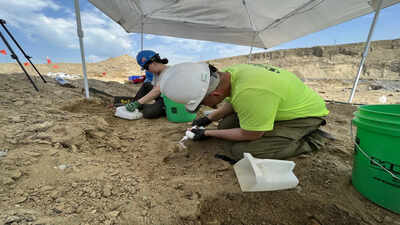
It would seem that the links that one can draw between our Stone Age ancestors and us do not spring forth from the scientific world holding paintbrushes and microscopes, but instead come from the mining industry through the use of bulldozers in the dark of night. This happened in December 2023 inside what was known as the Freedom Mine, located near the town of Beulah in North Dakota, where several miners were engaged in the activity of overburden stripping, the process of removing large amounts of earth from a very old creek bed. It was during this procedure that one miner saw something glimmer in the darkness; something curved and whitish that was nearly seven feet long.Realising that they couldn’t afford any further delay, the workers stopped working on their heavy machinery since one wrong move might result in the death of one of the greatest treasures that would have been reduced to mere dust. Right after the scientists examined the site, it became apparent that the workers had unearthed the fossil of the huge tusk of a mammoth. This mammoth tusk wasn’t just any other piece of history; it marked a great step forward in palaeontology for the country.
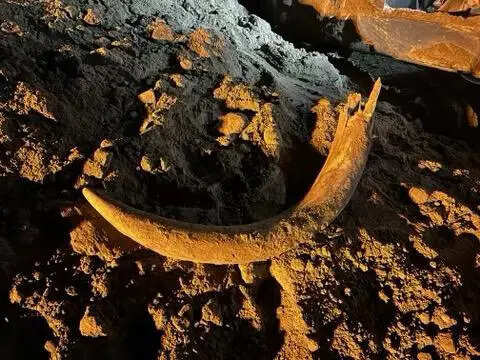
This significant discovery, including over 20 bones, offers invaluable insights into Ice Age life and taphonomy in the region. Image Credits: North Dakota Department of Mineral Resources
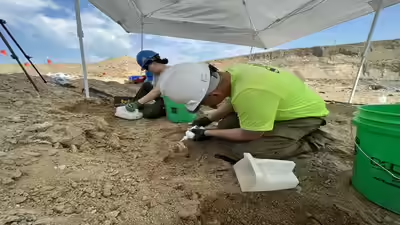
A glimpse into the giants of the American prairiesAs soon as the palaeontologists of the North Dakota Geological Survey rushed to secure the place, it became obvious that the importance of this discovery is enormous. Although isolated mammoth teeth or tusks can be quite common throughout the Midwestern states, it is extremely rare for more than one bone of the same animal to be discovered. In accordance with the Rare Mammoth Specimen Discovered by Coal Miners at Freedom Mine article, more than 20 additional bones were found, including ribs, shoulder blades, and even hip bones of the giant.The abundance of this one particular animal allows the scientists to get a better understanding of the lifestyle and death of these creatures. Using the pattern in which the bones were deposited into the sediment of the ancient river, it is possible to establish the age of the mammoth and understand what kind of environment it had to face during the Ice Age in North Dakota. As explained by the Smithsonian Magazine, the specimen is one of the most complete fossils ever found in the area. It will allow specialists to research the taphonomy of this particular geographical niche.A preserved page of history for future generationsIt turned out to be quite difficult to recover the fossilised creature since time was of the essence. Palaeontologists had to carefully wrap all the water-logged bones of the mammoth in order to move them safely. It is rather fragile because for thousands of years the skeleton has remained frozen within wet soil – in case they would expose it to dry air, the bones would fall apart immediately. The discovery of the tusk right on time before it was transported is considered a miracle of our era.This discovery adds a massive piece to the puzzle of the Pleistocene epoch in America. During this time, North Dakota was home to a variety of megafauna, including mastodons, giant bison, and the iconic woolly mammoth. The National Park Service details in their research on Ice Age Mammals how these creatures were central to the ecosystem before a combination of climate change and human activity led to their extinction. Finding a specimen this complete provides a benchmark that helps scientists compare other scattered finds across the Great Plains.The Freedom Mine mammoth is now undergoing a slow, meticulous cleaning and stabilisation process that could take years. Once the fossils are fully prepared, they will serve as a permanent educational tool for the public. It is a striking reminder that beneath the industrial landscapes we build to power our modern lives, the remnants of an older, wilder world are still waiting to be found. The workers at the mine did not set out to make history that night, but by paying attention to a single flash of white in the dirt, they ensured that an Ice Age giant could finally tell its story.Considering the size of these fossils, it’s very hard not to be awed at the thought that these great beasts used to roam the earth at the same spots where we mine for coal. It does make one think about how many more stories lie buried right beneath us.