NASA has released a document that sketches out one of its most ambitious space plans in decades. The so-called “Moon Base User’s Guide,” published in early April, lays out what it might actually take to build a permanent human presence on the Moon. It does not read like a finished blueprint. It feels more like a list of things that still need to be figured out. The scale is hard to ignore. NASA is aiming for 73 lunar landings, a $20 billion Moon base, and groundwork for future missions to Mars. Still, the document makes it clear that a lot is not ready yet. Some technologies do not exist while others need serious upgrades. Even so, the thinking seems simple.
NASA Moon base guide revealed: Rapid lunar missions and frequent landings
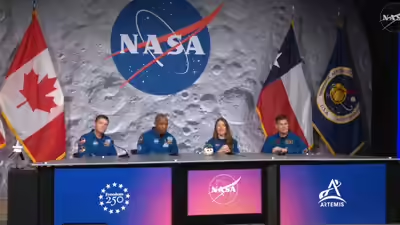
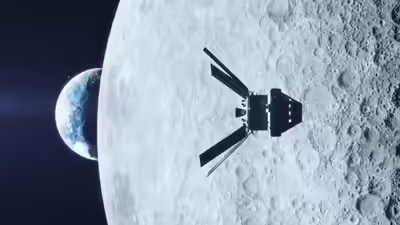
The roadmap is built around speed. NASA wants to move faster than it has in decades. The idea is to increase the number of missions and make landings more routine. It plans to carry out 21 Moon landings within the next three years, mostly using robotic and uncrewed missions. These early steps are meant to prepare the surface before humans return for longer stays.The plan sits within the wider NASA Artemis programme, which has already seen delays and rising costs. The recent success of Artemis II showed that crewed missions are still within reach. At the same time, it also made it clear how much work still needs to be done before anything like a permanent base becomes realistic.
NASA Moon base faces major power and survival challenges
Building a base on the Moon is not just about landing astronauts and leaving a flag. It means keeping people alive there for long stretches. That changes the problem completely. Power becomes one of the biggest concerns. The chosen region near the lunar south pole has tricky lighting conditions. Sunlight is low and uneven. Solar panels might not always deliver what is needed. Because of this, NASA is looking at nuclear options. Small surface reactors could provide steady power when sunlight is not available. These systems are expected to play a role not just on the Moon but also in future Mars missions.The environment itself adds pressure. Lunar dust is extremely fine and sharp. It sticks to surfaces and can damage equipment over time. Temperatures can also drop sharply during long periods without sunlight. That puts extra strain on habitats and machinery that need to keep running no matter what.
NASA moon landings and astronaut safety challenges
Landing on the Moon repeatedly is not as simple as it sounds. The earlier Apollo missions targeted flatter regions. The new missions will focus on the South Pole, where the terrain is uneven, and shadows are deep. Visibility can be poor, which makes landing more difficult. NASA needs more advanced systems to handle this. Precision landing tools, better sensors, and real-time hazard detection will all be required. Some of these technologies are still being developed, and a few may need entirely new designs.Long-term human presence brings another layer of concern. The human body does not respond well to low gravity over time. Muscle loss and reduced bone density are expected. Radiation exposure also increases health risks. The Moon adds its own complications. Dust could affect breathing. Isolation may affect mental health. NASA is still studying how astronauts might handle these conditions during longer missions. Basic needs also remain a focus. Food supply systems, exercise routines, and medical support all need to be planned carefully before any permanent base becomes possible.
A three-step plan for the NASA Moon base
NASA has broken the plan into three phases. The first phase, running until around 2029, focuses on access. More launches. More landings. Building reliability step by step. The second phase, expected between 2029 and 2032, shifts towards infrastructure. This includes setting up early base components and starting semi-regular crewed missions. The third phase aims for something more permanent. Continuous human presence on the Moon, supported by cargo systems and more advanced technology. Each phase depends heavily on the one before it. If early stages face delays, the rest of the timeline could shift as well.
NASA Moon plans face global race and rising costs
The wider picture matters too. China is working on its own lunar plans and aims to land astronauts on the Moon before 2030. Both countries are looking at the same region near the south pole, mainly because it may contain water ice. That overlap increases competition for landing sites and resources. It is not officially called a race, but the situation suggests growing pressure. Costs are another issue. The Artemis programme has already crossed $100 billion, and each launch can cost billions on its own. There have also been discussions about possible budget cuts, which could affect how quickly things move forward.Even with these concerns, NASA is continuing with its plans. The Moon base is seen as a stepping stone toward Mars. Technologies developed here are expected to support deeper space missions later on. For now, the plan remains ambitious. Progress will likely depend on how quickly technology improves, how stable funding remains, and how effectively risks are managed along the way.