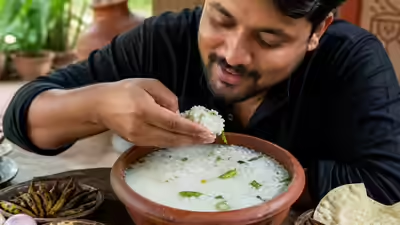
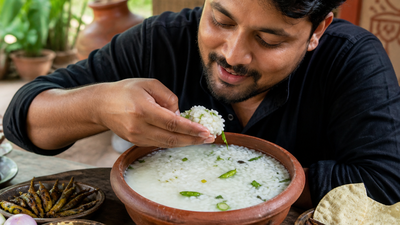
If you spend any time scrolling through reels this time of year, you’ve probably seen it. An Odia person-could be someone from Bhubaneswar, could be someone who moved to Delhi or Mumbai twenty years ago, or even someone living in the United States-posting a video of themselves eating a bowl of plain, soupy rice. They’re relishing it. Really going for it. And the comments are always the same: “What is this?” “Why does it look like that?” “Is that even food?” Someone always pipes up with “It’s Pakhala. You wouldn’t understand.”And that’s kind of the story right there. Pakhala exists in this weird space where millions of people know exactly what it is and can’t imagine summer without it, and then there’s everyone else scrolling past thinking it looks vaguely unsettling. But here’s the thing, that bowl of soupy rice is smarter than probably any food you’re eating right now.When the thermometer hits 40°C in Odisha’s summers, the same ritual happens in millions of households. Families sit down to bowls of fermented rice, buttermilk, and salt. It’s not fancy. It’s not Instagram food. It’s not trying to be anything other than what it is. But there’s something about it that’s kept entire generations going through some of the most brutal heat India has to offer. And it turns out, science backs up what people have known for centuries.This is Pakhala. It’s old. Really old. And it’s basically the result of centuries of people trying to figure out how to eat when it’s too hot to do much of anything else.
Where it came from
The story doesn’t start with kings or fancy kitchens. It starts with rice farmers and fishing villages along Odisha’s coast. Someone noticed something simple: if you took leftover rice, threw some water at it, and let it sit, something happened. The rice transformed. It tasted different. It felt better in your stomach. It made sense to keep doing it.The way you actually make it is almost absurdly simple. Take cooked rice. Mix it with water or buttermilk. Leave it overnight, sometimes a full day. Bacteria and microbes do the heavy lifting. They ferment it. That’s where the tangy taste comes from, that slight sourness. But that fermentation is doing something else too, something deeper to the food itself.And then there’s the spiritual layer. In Odisha, Lord Jagannath, the main deity, the god everyone’s organized their lives around, is believed to eat Pakhala. It’s part of what gets offered to him, his Mahaprasad. This matters. Because when you eat Pakhala in Odia culture, you’re not just having a cool summer meal. You’re eating what your god eats. You’re connecting with something much larger than yourself. You’re saying yes to a really old agreement between the land, the people, and the deity they’ve worshipped for centuries.
The real heat problem
You have to understand what Indian summer actually is to get why Pakhala works. It’s not like mild warmth. It’s May and June, and the thermometer doesn’t just climb, it stays. Forty-something degrees Celsius. The humidity is suffocating. Your body stops trying to do much of anything beyond just existing.During these months, your whole system shifts. Your digestion slows down. You don’t want to eat. Your body is screaming for water but water alone doesn’t cut it. You need something that actually works with your body instead of against it. You need something that’s understood this heat problem for hundreds of years.That’s what makes Pakhala different. Modern nutritionists call it “hydration density”, water plus carbohydrates, minerals, and electrolytes all working together. Way more effective than just water. And the fermentation adds another layer. Those bacteria create lactic acid, which helps your digestion when heat has already made it sluggish.
What the scientists found
For a long time, Pakhala was just… what you did. What your grandmother did. What everyone did when summer came. But recently, AIIMS, the All India Institute of Medical Sciences, India’s top medical research institution, actually studied this stuff. And what they found validated everything people already knew.The fermentation process, they documented, dramatically changes how available the nutrients actually are to your body. You’re not just eating the rice, you’re absorbing way more of it. The bacteria create probiotics that genuinely improve your digestion. They found digestive efficiency improvements compared to regular rice. The AIIMS team also found that the fermented rice has significantly more amino acids, B vitamins, and beneficial microorganisms than non-fermented rice. The glycemic index is lower too, which means you get sustained energy without the blood sugar crashes that can hit hard when it’s sweltering.One of the additional professors at AIIMS’s biochemistry department, Balamurugan Ramadass, explained it pretty directly: “Microbes residing in water rice chew the complex carbohydrates and create end products like short-chain fatty acids (SCFA). These SCFA molecules and other fermented chemicals transform the liquid portion of the water rice into torani. Probiotic bacteria, SCFA, Vitamin B12, and Vitamin K are the four reasons why a person should eat ‘pakhala’ as a whole or drink ‘torani’. SCFAs have multiple functions in our body.” They released this research in 2021.Basically, fermentation isn’t just making the food taste different. It’s making the food work harder for you. The electrolytes in buttermilk-based Pakhala, sodium, potassium, calcium, hit the exact balance your body needs when it’s dealing with heat stress. AIIMS researchers noted this is pretty much identical to modern electrolyte replacement formulas. And the fermentation produces anti-inflammatory compounds that help when prolonged heat exposure starts messing with your system.
Modern relevance
Here’s the thing: we live in an era of expensive superfoods and complicated nutritional science. Pakhala offers something actually radical. It’s effective nourishment from stuff that’s already in every Indian kitchen. No special equipment. No exotic ingredients. It costs a few rupees to make.But the simplicity is deceptive. Every part of it, how long you ferment it, the water-to-rice ratio, buttermilk instead of plain water, that’s all generations of people refining this. Optimizing. Figuring out what actually works.As summers are getting worse across India, as climate change keeps turning up the heat, Pakhala starts looking less like a nostalgic relic and more like an answer. The answers we actually need have probably been sitting in our grandmothers’ kitchens all along. We’re just finally starting to pay attention.One humble bowl tells the whole story: how to use what you have, how to understand what your body needs in different seasons, and how to create something nourishing enough to get people through their harshest months. That’s Indian ingenuity. That’s Pakhala.