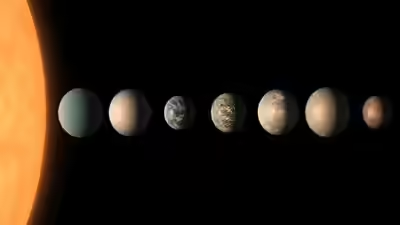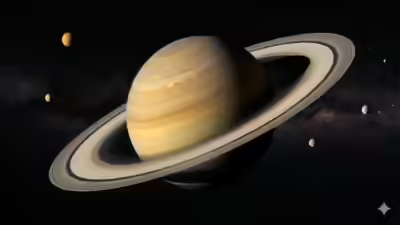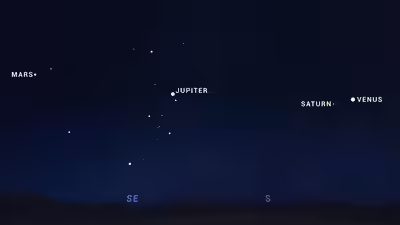
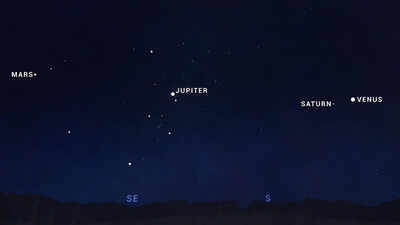
In April 2026, the early morning sky is expected to show a rare grouping of planets that may attract attention from skywatchers around the world. Mercury, Mars, Saturn and Neptune appear relatively close together in the eastern sky before sunrise between 16 and 23 April, with the strongest visibility around 18 to 20 April. The event is often described as a planetary alignment or planet parade, although the planets are not physically lined up in space. Instead, they appear clustered from Earth’s viewpoint along the same general orbital path. Some regions will see a clearer view than others, depending on latitude and horizon conditions.The alignment is a visual effect created by the planets sitting along the ecliptic, the same path the Sun follows across the sky. In mid-April 2026, Mercury, Mars, Saturn, and Neptune gather in a compact region of the dawn sky. Astronomers note that this is not a true alignment in space. The planets remain separated by vast distances. It only looks organised from our viewpoint on Earth.
April 2026 planetary alignment: Date and time
The best viewing window is short. Observers in the Northern Hemisphere are expected to have roughly 30 minutes before sunrise to catch the planets. In the Southern Hemisphere, the window is slightly longer, around 60 to 90 minutes before sunrise.The key dates are 18 to 20 April, although the whole period from 16 to 23 April offers usable conditions.Timing is critical: Once the sky brightens, the fainter planets disappear quickly.
Which planets are actually visible in the April 2026 planetary parade
Not all four planets are equally easy to see. Mercury is expected to be the brightest and most noticeable object in the group. Mars should also be visible to the naked eye under good conditions. Saturn is slightly fainter and sits lower in the sky, which may make it harder to spot.Neptune is the outlier. It is far too dim for unaided vision in dawn light. Telescopes are needed, and even then, it can be challenging due to brightening skies. Experts say most casual observers will realistically see two or three planets at best.
April 2026 planetary alignment visibility
In much of the Northern Hemisphere, the planets sit very close to the eastern horizon. The angle of the ecliptic is shallow in April mornings, which keeps everything low.Light pollution and atmospheric haze play a major role here. Even bright planets can fade quickly near the horizon. Some observers in places like northern Europe or the northern United States may struggle to see anything beyond Mercury or Mars. Saturn may appear only briefly. Neptune is generally not a target.Conditions improve significantly in the Southern Hemisphere. The same planetary group rises higher above the horizon before sunrise, giving a darker background sky. This improves contrast and makes Mercury, Mars and Saturn easier to identify. Australia, South Africa and parts of South America are expected to have the most stable viewing conditions.Even here, Neptune remains faint. But the overall alignment appears more balanced and easier to follow across multiple mornings.
Can you see the April 2026 planetary alignment from India
India sits in a relatively favourable position to view the April 2026 planetary alignment, particularly in its central and southern regions. The planets will appear low in the eastern sky before sunrise, but the overall viewing angle is better than in many higher northern latitudes, giving observers a stronger chance of spotting the grouping. The best time to look is around 30 to 45 minutes before local sunrise, facing the eastern horizon. A clear, open view is important because the planets remain close to the horizon and can quickly become harder to see as the sky brightens.Mercury and Mars are expected to be the most visible planets to the naked eye. Saturn may also be seen if conditions are clear, though it will appear fainter and lower. Neptune cannot be seen without a telescope and is not practical for casual observation.Southern parts of India are likely to offer better visibility overall, with slightly longer and clearer observation windows. In northern regions, the alignment will still occur but may be harder to catch due to the shorter viewing period and lower altitude of the planets.
April 2026 planetary alignment: How the lineup changes day by day
On 13 April, Mars passes close to Neptune. By 16 April, Mercury joins the grouping. Around 17 April, all four planets appear tightly packed.18 April is considered the main reference date. This morning, the grouping is at its most recognisable.After that, the pattern continues to change. On 19 April, Mars approaches Saturn. By 20 April, Mercury, Mars and Saturn form a more linear arrangement in the sky.
What skywatchers might actually experience
Reports from similar alignments suggest that most viewers will notice a compact line of bright points low in the east. Some may only catch brief glimpses between trees or buildings.Still, experts say events like this are useful for understanding how the solar system appears from Earth. The clustering along the ecliptic becomes visually clear even without instruments. The April 2026 planetary alignment is expected to be a short-lived pre-dawn event best seen around mid-April. Mercury, Mars, Saturn and Neptune will appear grouped low in the eastern sky, with visibility strongly dependent on location and local conditions.Southern Hemisphere observers are likely to have the clearest view, while many Northern Hemisphere locations may see only part of the sequence. The alignment is not a physical formation but a line-of-sight effect created by orbital geometry.