
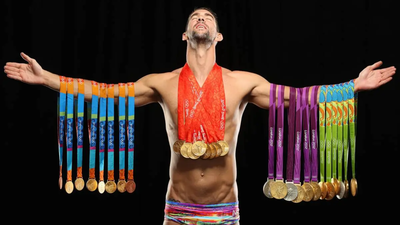
There is a tendency to hear a line like “I think that everything is possible as long as you put your mind to it and you put the work and time into it. I think your mind really controls everything” and file it away with the rest of sport’s familiar assurances. It reads easily enough, almost too easily, until you place it back inside the life of Michael Phelps and realise that nothing about it was ever casual, and very little of it came without cost.Phelps is, on record, the most decorated Olympian there has been, with 28 medals across five Games between 2000 and 2016, 23 of them gold, and eight of those won in a single fortnight in Beijing in 2008. He set 39 world records across a career that stretched far longer than most swimmers manage. Those numbers are often recited first, but they tend to obscure the method, and it is the method that gives the quote its weight.
The making of a routine that left little to chance
Long before Beijing, and well before the medals began to stack, Phelps had already settled into a deliberate routine built on repeating the same work each day. Under his coach, Bob Bowman, he trained through a stretch that ran from roughly 2001 to 2007 without missing a day, not for birthdays, not for Christmas, not for anything that might have broken continuity. “We went five or six years without missing a single day. 365 days. No days off, no birthday, no Christmas. We were in the water every single day. I was willing to do anything, anything it took to have that chance.”
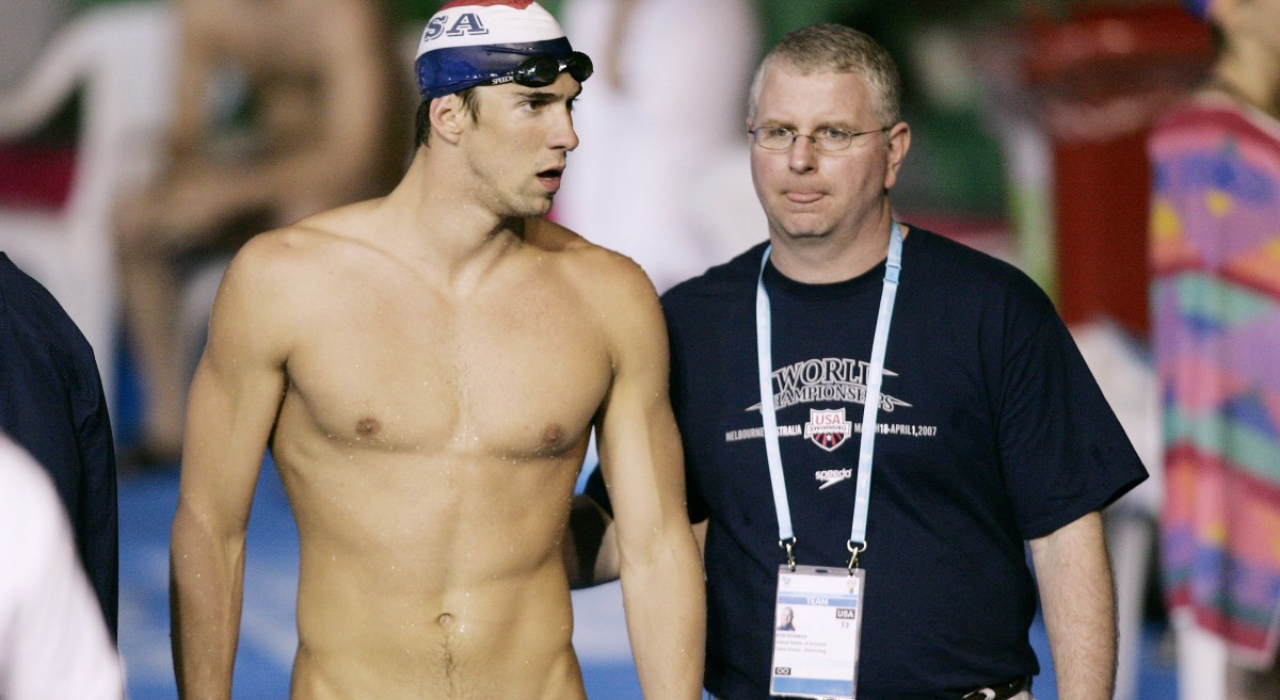
Bob Bowman used “videotape” mental rehearsals and repetition training to prepare Phelps for every scenario/ AP Photo
There is something almost austere in that approach, but it was not simply about volume. Bowman also insisted on a second discipline beyond the physical work, done away from the pool.. Each night, Phelps was told to “watch the videotape,” which was not a literal recording but a rehearsal played out in his head, the perfect race imagined in precise detail, stroke by stroke, turn by turn, until it could be recalled without effort. It was repeated in the morning, then again before competition, until it became less an exercise and more a reflex.That combination, repetition in the water and repetition in the mind, sits behind his insistence that the mind “controls everything,” something built slowly and deliberately over years as a habit, not just a phrase.
Beijing, and the race he could not see
The value of that preparation is easiest to understand in Beijing, where Phelps arrived with a stated aim of surpassing Mark Spitz’s long-standing record of seven gold medals from 1972. He would go on to win eight, seven of them in world-record time, but the detail that has stayed with people is a moment in the 200m butterfly final, often cited as the clearest example of how being fully prepared for every scenario can shape performance under pressure, a principle often borrowed in military training, coaching, and everyday decision-making.In that race, things did not go to plan from the start. He entered the water cleanly enough, but almost immediately his goggles began to leak. By the final length they were filled, leaving him effectively blind, unable to see the line, the wall, or the field around him. For most swimmers, that would have been enough to undo the race. Phelps did not slow, and he did not hesitate, because he had already prepared for it. Bowman had put him through sessions without goggles, even making him swim in a Michigan pool in the dark, believing he needed to be ready for any surprise. Some of the “videotapes” in Phelps’s mind had featured problems like this, including the possibility of goggle failure, and he had mentally rehearsed exactly how he would respond. He counted his strokes, as trained, knowing exactly how many it would take to reach the wall, and finished in 1:52.03, a world record.It is easy, in hindsight, to treat that as a moment of instinct, but it was closer to recall. He had seen it before, not in reality but in rehearsal, and so the body followed what the mind already knew.
The narrowest of margins
A few days later, in the 100m butterfly, the margin was so fine it required a review down to the ten-thousandth of a second. Phelps won in 50.58 seconds, touching ahead of Milorad Čavić by 0.01. He thought he had lost as he hit the wall, believing a shortened final stroke had cost him, before seeing the “1” beside his name. “When I did chop the last stroke, I thought that had cost me the race,” he said afterwards. “But it was actually the opposite. If I had glided, I would have been way too long.”Spitz, watching from afar, described the performance in terms that have been repeated often since: “It goes to show you that not only is this guy the greatest swimmer of all time and the greatest Olympian of all time, he’s maybe the greatest athlete of all time, and he’s the greatest racer who ever walked the planet.”Spitz had one word for the performance that matched his own record before it was surpassed days later: “One word: epic.”Those races are remembered for how close they are, but there is usually something more consistent behind them. The decision at the wall in that 100m butterfly was not improvised in the way it might appear. Phelps did not glide because he knew, from repetition, where the wall would be and how much distance remained. Even in a race decided by a fraction, it came back to the same thing, knowing what to do before the moment arrived.
The arithmetic beneath the legend
What distinguished Phelps was not merely his capacity to win, but the peculiar arithmetic by which he constructed those victories. There is a detail, easily overlooked, that reveals more than the medals themselves: while many of his competitors may have taken Sundays off, he did not. It was a simple decision, almost dull in its logic. Fifty-two additional training days each year. Over four years, that becomes 208 extra days in the water, nearly another Olympic cycle hidden inside the official one. There is nothing romantic about that figure. It is not the stuff of headlines. But it is, rather quietly, the difference. His weekly training volume often ranged between 80,000 and 100,000 metres, spread across multiple sessions a day. Mornings began before dawn, bodies slipping into cold water while most of the world remained sensibly asleep. Afternoons brought strength conditioning, hours devoted to core stability, flexibility, and the sort of marginal gains that do not announce themselves but accumulate with a stubborn persistence. Evenings, as mentioned, belonged to the mind, to those silent rehearsals conducted in the privacy of one’s own head. It is here that one begins to understand the quote not as encouragement, but as instruction. “Put your mind to it,” he says, but what he means, in practice, is to subject the mind to discipline as rigorous as the body.
A mind that did not always cooperate
And yet, it would be a grave mistake to imagine that Phelps’ mind was some perfectly ordered instrument, always obedient, always aligned with purpose. Quite the contrary. As a boy, he was diagnosed with Attention Deficit Hyperactivity Disorder (ADHD), struggling to sit still in classrooms, to focus in the manner expected of him. Swimming, in those early years, was less a calling and more a channel, a place where that restless energy might be directed rather than suppressed. Later, after the triumphs had begun to mount, a different difficulty emerged. Following the 2004 Summer Olympics, and more acutely after 2012 Summer Olympics, he spoke of descending into periods of deep depression. There is something almost paradoxical in that: the world’s most decorated athlete returning home from unparalleled success only to find himself adrift, uncertain of purpose once the structure of training and competition fell away. In 2014, after a second arrest for driving under the influence, he entered rehabilitation, a moment he would later describe as a turning point. It is worth pausing here, if only to note the contrast. The same man who could calculate his strokes to the wall with unerring precision could not, at times, navigate the quieter distances of his own life. And yet, perhaps that is precisely the point. The mind, as he says, controls everything, but it is not always easily controlled.By the time the 2016 Rio Summer Olympics arrived, Phelps was 31 years old, an age at which swimmers are generally expected to have retired to commentary boxes or quiet anonymity. He returned nonetheless, leaner in ambition perhaps, but no less exacting in preparation, and won five more gold medals.
What, then, are we to do with it?
It would be easy, too easy, to extract from all this a set of tidy lessons, to package them into something one might paste upon an office wall. That, perhaps, would miss the texture of the thing. Phelps did not rely on confidence in the abstract. He replaced it with repetition, to the point where decisions could be made without hesitation because they had already been made many times before. The visualisation was not about imagining success in broad terms, but about rehearsing the exact sequence, including the possibility that something would go wrong. When it did, as it did in Beijing, it did not introduce something new. The training without breaks, including the choice to work on days others rested, was not framed as sacrifice so much as arithmetic. Over time, small differences accumulate into something that looks significant only when viewed from the end. And the parts of his life that were less controlled, the periods after competition, the struggles with mental health, do not contradict the quote so much as complete it. If the mind “controls everything,” then it requires attention beyond performance, especially when the structure that supports it is no longer there.None of this needs an Olympic pool to matter. The details change, but the pattern is the same. When you prepare for the ordinary day with the same care as the visible moment, things feel less uncertain when they actually arrive. Thinking through problems before they show up doesn’t make them easier, but it does change how you react when they do.A trader, for example, does not only picture the market going right, but also the point at which it turns and positions must be cut. A student does not only revise for what is expected, but for the question that appears in a form they have not seen before. A small business owner keeps a second supplier in mind long before the first one becomes unreliable. These are not acts of pessimism; they are ways of making sure you don’t freeze when the moment arrives.