Cat owners might relate how their fur babies keep showing puzzling habits every now and then. A common scenario is when the cat starts eating, stops midway, and leaves. After taking a brief pause, the cat returns and continues eating. Any guesses about the reason behind this?According to recent findings, cats never stop eating because they are full. Their consumption reactions might be linked to the odour rather than satiety. According to a study published in Physiology & Behavior, feeding behaviour in cats was significantly affected by odours and not hunger.Masao Miyazaki, an animal behaviour researcher and co-author of the study, explained that, unlike dogs and other animals, cats don’t stop eating simply because they are no longer hungry. Instead, their desire to continue eating diminishes as they become habituated to the smell of the food.The influence of smell on cat appetitesSmell plays a vital part in cats’ decisions about eating. Unlike humans, who base their food choices on both flavour and odour, cats are more dependent on olfactory information.Exposure to the food odours repeatedly causes the cat to be less interested. This phenomenon has been described as olfactory habituation. The smell becomes less arousing, and the animal’s motivation diminishes. It is similar to an effect known as sensory-specific satiety in humans.Research indicates that while the individuals might feel satiated by one type of food, they might still develop hunger for another smell or taste. In cats, the effect is even more pronounced.Two-part bowl experiment increased the cats’ consumptionThe research involved 12 cats that were subjected to a strictly monitored diet regimen. Despite being kept fasting for 16 hours, most animals ate only about a third of the portion provided.Upon presenting the food repetitively, the amount consumed became smaller. However, when introduced to a novel food, or at least its odour, cats consumed more food.In another experiment, a two-part bowl was employed, allowing the cats to consume food only from the top part, whereas another type of food was positioned in the bottom part to emit an odor.Even though no changes in the actual food were observed, the cats increased their consumption. From this, it can be concluded that smell can reset the cats’ appetite on its own.
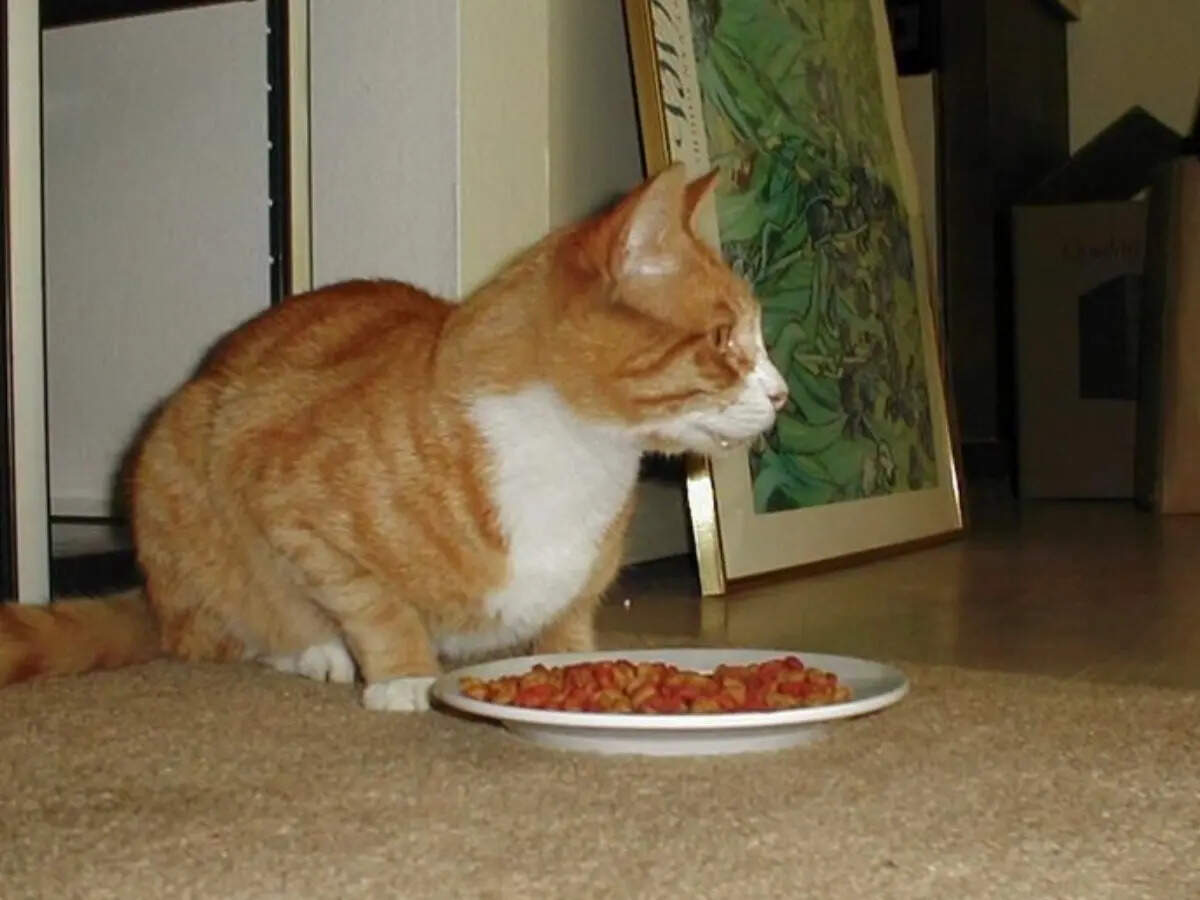
The real reason cats suddenly lose interest in their food bowl. Image credit – Wikimedia
The reasons why cats eat in smaller portionsThe results of the study are also connected to the evolution of cats. According to a study published on ScienceDirect, the domesticated cats have evolved from the African wildcat, which is a solitary predator hunting smaller animals several times a day.Therefore, it is natural for the cats to consume smaller portions of food at a higher frequency compared to humans or dogs. The latter tend to consume larger portions at once because they evolved as group hunters competing for food.Why a cat owner should care about this researchThese results can help pet owners better understand the behaviour of their pets. In some cases, when the cat refuses to consume food, the reason is not its health or satiety level but a lack of appetite.Here are some practical insights that can help:
- Switching flavours or kinds of food may aid in maintaining an appetite.
- Introducing mild variations in scent may promote eating.
- Being repeatedly exposed to the same scent may reduce the motivation to eat.
These results may even have implications for health management. In overweight cats, controlled exposure to food scents may reduce overeating. For sick or senior cats, scent variations may improve nutrition intake.Scientific reason behind the common phenomenonThe question of why cats leave their food behind has been puzzling veterinarians and pet owners for decades. This experiment provides a scientific explanation that is backed by behavioural observations.Cats are not reacting only to hunger. They are reacting to stimulus variations, particularly smell. It implies that the next time a cat leaves its dish, it might not have finished eating but needs a new smell instead.