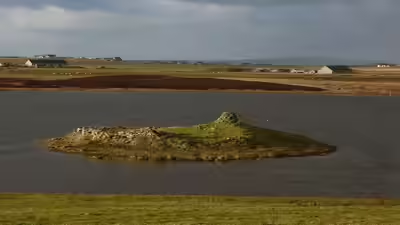
As one looks out into the hazy water surface of a Scottish loch, the small, perfect circles of an island surrounded by trees just appear to be a naturally occurring phenomenon in the rough Highland landscape. However, what people believed these little islets to be has been drastically altered in recent times as archaeologists discovered the true nature of such a formation. Most of the islands in the lochs of Scotland are, in fact, not naturally occurring. They are called crannogs, a term used to describe man-made structures made of stone formations.Even when we used to think that these islands served as Iron Age defensive posts, science has recently discovered that ancient people of Scotland created their very own private islands long before Stonehenge became the first stone project. This shows a high level of social organisation and technical skills that are yet to be fully understood by the world.A stone age engineering wonderIt’s difficult to appreciate the magnitude of these buildings without seeing them underwater. Contrary to what you may imagine, creating a crannog was a multi-step process that required driving sharpened logs underwater or making an artificial raft of large tree trunks on which the stone mass could be laid. Once a wooden base had been constructed, tons of stone, soil, and moss could be laid out until they finally formed islands.One of the most important studies conducted and published in the Antiquity journal has totally changed the chronology of these constructions. Thanks to radiocarbon analysis of wooden materials recovered from various sites, it was established that these structures had been built around 3600 B.C. It means that the age of these islands is considered to be Neolithic times. It should be mentioned that the large amount of materials used to build those structures shows that they might have been used as a monument.It certainly took some serious effort. As recent reporting on the BBC states, after examining the areas underwater, the divers have discovered that the construction workers actually chose enormous stones and dragged them down underwater, most likely using rafts for this purpose. It wasn’t an easy task to do over the course of a single weekend.
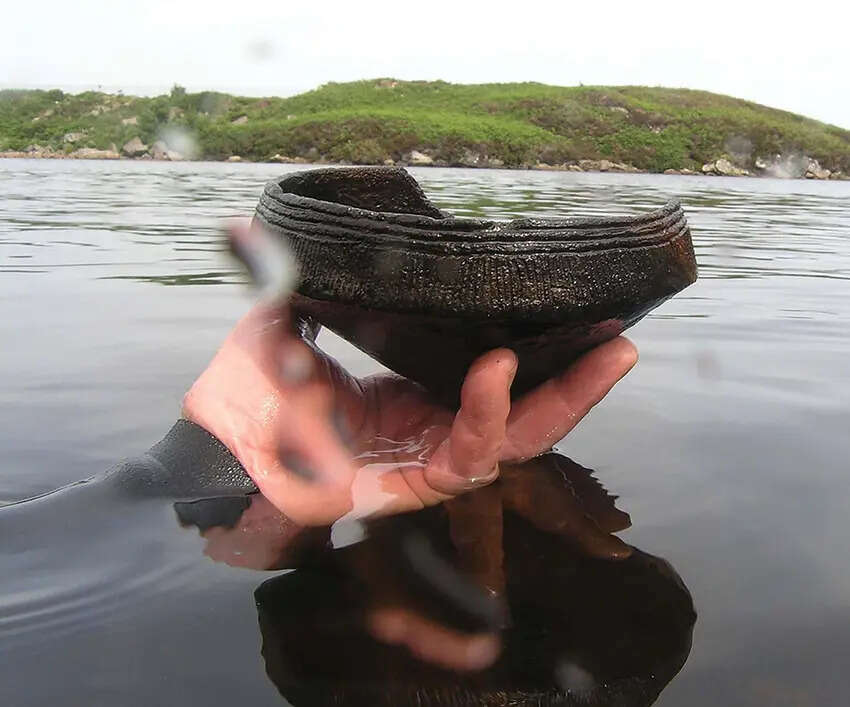
These Neolithic stone and timber structures, built with remarkable engineering skill, served as exclusive, defensive dwellings. Image Credits: Neolithic crannogs: rethinking settlement, monumentality and deposition in the Outer Hebrides and beyond study Fig 2
Time underwater and digital time machinesWhat makes the mystery of the crannogs such a long-lasting one is the fact that the material used in their construction doesn’t typically withstand five thousand years. However, the coldness and lack of oxygen under the Scottish loch waters make them an excellent preserver. Even after five millennia, the marks left by tools on the wood are perfectly preserved.In order to be able to see these spectral buildings without harming them, modern scientific methods have been applied. The article titled At the Water’s Edge: Photogrammetry in Extreme Shallow-Water Environments discusses the new scientific method through which archaeologists are using thousands of high-resolution photographs of the loch bottom to create three-dimensional models. With this scientific method, they are able to virtually “remove” the water, thus seeing the detailed construction of the wooden jointure and the careful stacking of stones to avoid slipping into the depths.These digital reconstructions have revealed that the islands were often connected to the shore by hidden, zig-zagging stone causeways submerged just below the surface. This suggests that the crannogs were designed for exclusivity and defence. You had to know the exact path to reach the island, or you would find yourself swimming in the freezing loch.These Islands of Stone serve today to remind us of the amazing vision and drive of our ancestors. Not only did they live in these places, but they constructed these places themselves from scratch. Next time you come across an island alone in the waters of a Scottish lake, realise you have seen something that is a work of architecture that is five thousand years old.