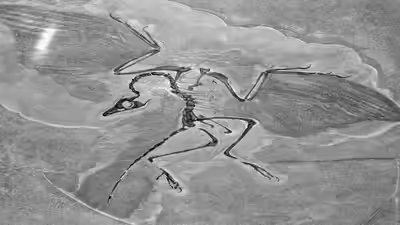
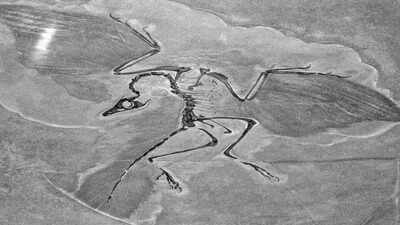
Imagine yourself in an open-air quarry in Bavaria, breaking open a slab of finely grained limestone, and seeing a beautifully preserved feather inside. This very thing happened at Solnhofen in Germany way back in 1861. The entire world had just been shocked by the findings of Charles Darwin about the evolution of living beings, and a “missing link” to show how the species evolve slowly from one another had been longed for by the scientific community.Not long after the feather was discovered, an almost entirely intact skeleton of the animal was excavated from the very same stone. It appeared as if an anomaly existed within the very fabric of life – this animal had the wings and plumage of a bird alongside the toothy jaws, clawed digits, and tail bone of a dinosaur. Known as Archaeopteryx, or “ancient wing,” this organism was the ultimate biological hybrid, an inhabitant of prehistory’s strange limbo world that proved birds didn’t just evolve out of thin air – they came from dinosaurs.A fossil dispute that is still ragingArchaeopteryx remains a triumph for evolutionary theory, yet its discovery marked the beginning of a scientific investigation into ancient history that persists to this day. One of the most interesting questions surrounding the discovery of Archaeopteryx was whether or not the lone feather found earlier on was part of the skeletal system that was excavated afterwards. As described by a paper titled Detection of lost calamus challenges identity of isolated Archaeopteryx feather, modern science has made this debate a new battleground of discovery.However, despite all of the controversy, the fossil is considered the quintessential transitional form in history. It came during an ideal time to help illustrate visually how flight may have started. Although the creature was probably unable to glide like the eagle we see today, it can be seen that, based on its skeleton, it could at least glide or fly briefly. It proves to everyone that evolution is a chaotic process and not necessarily about making something new out of something completely different.
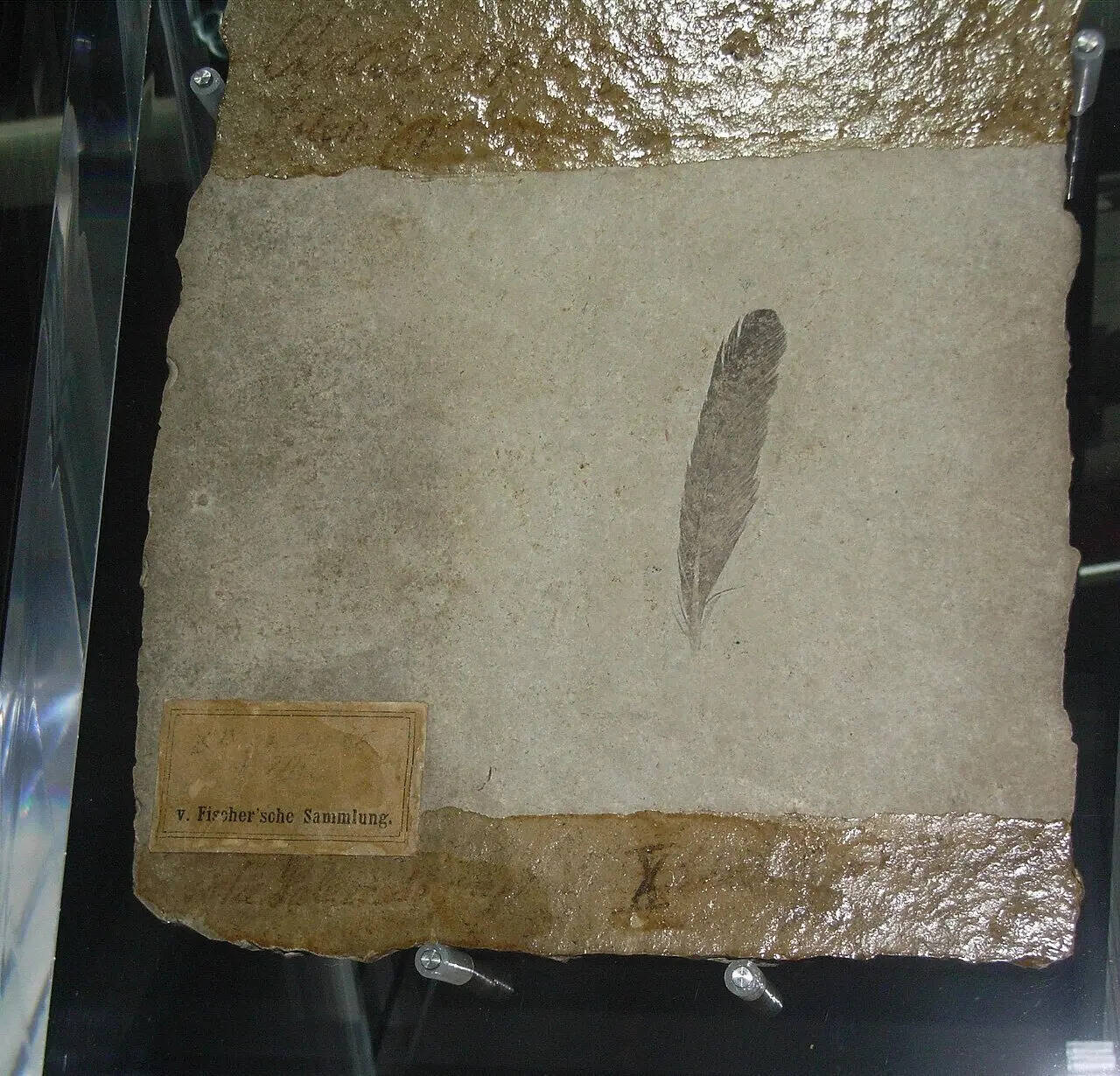
This “ancient wing” became a pivotal piece of evidence for evolution, proving birds descended from dinosaurs. Modern science continues to analyse its pigments, revealing details about its appearance and flight capabilities. Image Credits: Wikimedia Commons
Colour map of a 150-million-year-old birdThe advancement in science has helped us move past seeing a fossil made up of dust and stone; instead, scientists are now able to look at fossils with a whole different set of eyes. In this case, researchers can look not only at the structure of the bones but also the chemical makeup of the feathers as well. According to the research published in the Journal of Analytical Atomic Spectrometry, high-energy X-rays are used to find original pigments within the fossil.These advanced scans have allowed us to reconstruct what this “dino-bird” might have actually looked like as it flitted through the tropical islands of prehistoric Germany. We now know that some of its feathers were likely black, and the distribution of these pigments might have even helped strengthen the feathers for flight. This level of detail moves the story of Archaeopteryx out of the realm of dry facts and into a humanised lifestyle perspective; we can almost see it shaking its wings and hunting for insects in the humid air.The tale of the feather found in Solnhofen is a testament to the fact that it is often the tiniest of things that can have the greatest impact on our conception of the world. A mere feather, no bigger than one’s thumb, made man reconsider the entire history of life. He learned that the pigeons in his garden are descendants of savage reptilian creatures that once ruled the earth.In retrospect, when thinking about the year 1861, it is amazing to see how much weight was carried by such a simple limestone piece. This is still an object of wonder and an endless quest for knowledge regarding our beginnings. But then the question arises; if a feather was enough to revolutionise the biological world, how many other mysteries are left in the quarries of the world?