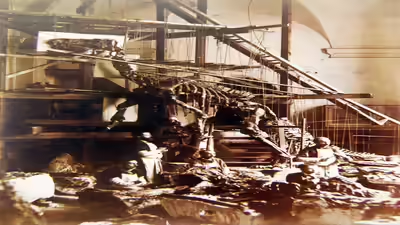
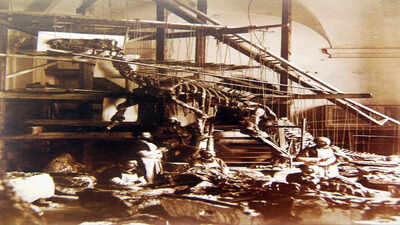
Deep below the Belgian village of Bernissart, a team of coal miners working at depths greater than a thousand feet uncovered something they never expected to see in a coal seam. The year was 1878, and these miners came across objects that resembled bones but sparkled with a metallic sheen. Initially, they believed themselves to be in possession of fossilised wood or possibly gold, considering the fact that the bones were covered in pyrite, commonly referred to as fool’s gold. However, little did they know that they had just entered into a graveyard of tremendous historical significance.It turned out that this particular group of miners had discovered an enormous mass of clay that held dozens of extinct giant creatures from many millions of years ago. After the arrival of the specialists from the Royal Museum of Natural History in Brussels, everything became clear about the scope of the discovery made by the miners. These were not just random bones but rather an enormous collection of Iguanodon skeletons belonging to the Early Cretaceous epoch. Previously, researchers could only speculate about dinosaurs since they had nothing but a few teeth or broken bones.From the depths of the coal mine to the world of scienceThe process of extracting the bones was not a routine matter but rather a challenging task that was more akin to military operations than any standard excavation project. During three whole years, the team working at the mine extracted fossil specimens under harsh conditions. As stated in the article The Bernissart Iguanodons at a glance by the Institute of Natural Sciences, the significance of the find lies in the discovery of articulated skeletons, meaning that for the first time in the history of palaeontology, the exact arrangement of the bones could be seen.The huge numbers of skeletons discovered at once made the researchers believe that the animals used to move in groups, or perished suddenly in some mass disaster, such as a flash flood. According to an article from the Institute of Natural Sciences, The Bernissart Iguanodons, the site changed scientists’ views on dinosaurs’ posture. For many years, the creatures have been considered slow-moving, lizard-like animals crawling on their four legs. But due to complete skeletons found at the site, scientists tried putting dinosaurs into various postures, and as a result, created a well-known bipedal “kangaroo” position dominating dinosaur exhibits for more than a hundred years afterwards.
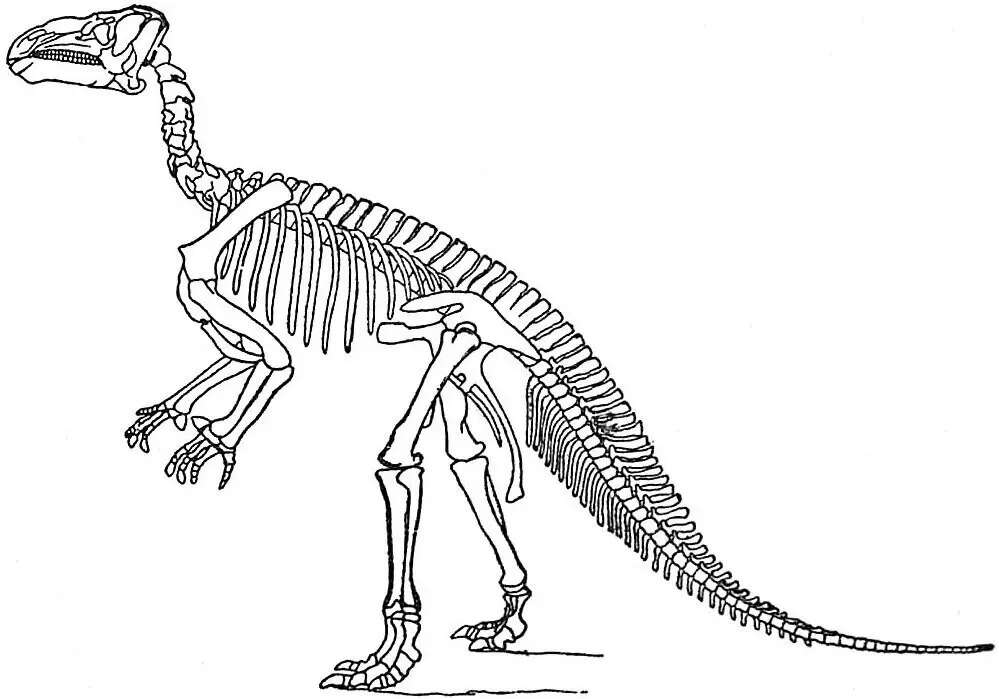
Scientists learned about dinosaur posture and anatomy. This find reshaped museum displays and our understanding of prehistoric life. The Bernissart Iguanodons remain a key exhibit. Image Credits: restoration of skeleton by O. C. Marsh,via Wikimedia Commons
A golden discovery that reshaped the prehistoric worldHowever, the importance of the discovery went much further. It introduced new approaches to the representation of ancient creatures in museums around the world. First of all, due to the weight of the dinosaurs’ skeletons, the process of putting them together into an exhibit needed special metal frameworks that gave a unique look to museum displays that is characteristic even nowadays. Also, the pyrite, which attracted the attention of the miners, became a source of trouble since it decomposed upon exposure to air and cracked the fossils.One of the most famous features of the Iguanodon is its sharp thumb spike. Before the Belgian discovery, early pioneers had mistakenly placed that spike on the animal’s nose, like a rhino horn. It was only when the miners in 1878 uncovered the complete hands of the Bernissart skeletons that scientists realised the spike belonged on the thumb. This simple correction is a perfect example of how the “fool’s gold” in the mine helped clarify the blurry vision of early palaeontology.Today, the Bernissart Iguanodons remain the centrepieces of the Museum of Natural Sciences in Brussels. They stand as a reminder that some of the greatest breakthroughs in our understanding of life on Earth come from the most unexpected places. If those miners had not been curious enough to investigate the glittering debris in their coal seam, we might still be imagining dinosaurs as scattered fragments rather than the complete, awe-inspiring animals they truly were.It is amazing to consider the fact that a simple day in a coal mine resulted in the rewriting of millions of years of history. One wonders what else lies buried in the ground and what else could be discovered by striking the correct point with the pickaxe.